

China’s New Moon Robot Aims to Assist Future Lunar Missions
China has unveiled a new AI-powered lunar robot designed to assist future Moon missions by carrying equipment, deploying instruments, and helping build infrastructure on the lunar surface. The robotic “construction worker” is expected to be part of the country’s planned Chang’e-8 mission.
Developed by researchers at Hong Kong University of Science and Technology, the robot weighs around 220 pounds (100 kilograms) and moves on four wheels built for navigating rough lunar terrain. Unlike traditional Moon rovers, the machine also features two robotic arms capable of handling tools and manipulating equipment. The design allows the robot to use tools originally created for astronauts, avoiding the need to redesign existing systems for fully robotic operation.
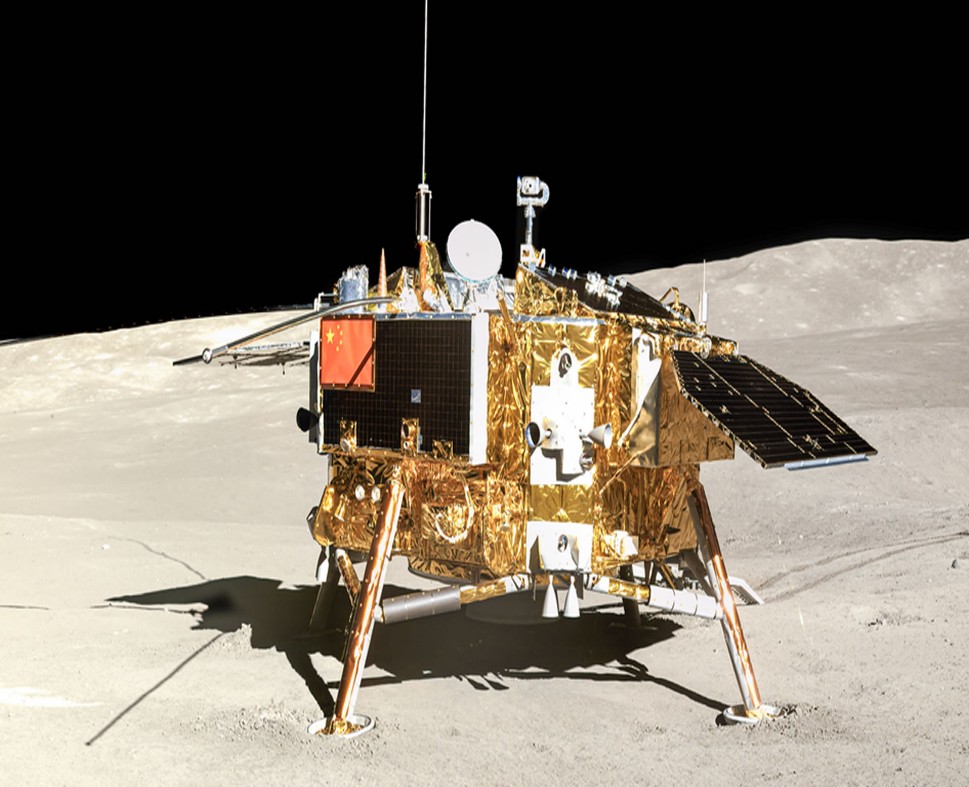
Figure 1. Moon Robot.
A Robotic Construction Worker for The Moon
“We have heard that Chang’e-7 may include the first humanoid robot landing near the Moon’s South Pole,” said Gao Yang. “But our robot will explore a different region of the South Pole. It is a vast area, and we are eager to study more of it.” Figure 1 shows moon robot.
The robot combines rover-style mobility with human-like dexterity. Its wheels provide reliable, energy-efficient movement across the lunar surface, while the robotic arms enable it to lift tools, carry scientific instruments, position sensors, and collect rock and soil samples. Researchers say the machine will also function as a robotic “porter,” helping install equipment and potentially assisting with the construction of future lunar infrastructure.
AI-Powered Operations on the Lunar Surface
The robot is equipped with artificial intelligence systems that allow it to operate semi-autonomously once deployed on the Moon. This capability could make it useful for tasks that would otherwise require constant human supervision from Earth.
The project reflects a broader shift in lunar exploration goals—from simple observation and sample collection toward long-term engineering and infrastructure development on the Moon. Future missions such as Chang’e-8 are expected to test technologies for permanent lunar bases, sensor networks, and long-duration habitation systems.
Why China is targeting the Moon’s South Pole
China’s lunar missions are focused on the Moon’s South Pole because scientists believe permanently shadowed craters in the region may contain water ice [1]. The area also receives extended periods of sunlight, making it attractive for future exploration and energy generation.
If accessible, lunar ice could provide drinking water, breathable oxygen, and even hydrogen and oxygen for rocket fuel production—resources considered essential for sustainable Moon bases.
In the future, teams of robots like the Chang’e-8 machine could potentially help mine these resources, build infrastructure, and carry out maintenance work on permanent lunar installations. Researchers view the Chang’e-8 robot as an important early demonstration of how autonomous robotic workers could support long-term human activity on the Moon.
References:
- https://interestingengineering.com/ai-robotics/china-unveils-robot-construction-worker
Cite this article:
Keerthana S (2026), China’s New Moon Robot Aims to Assist Future Lunar Missions, AnaTechMaz, pp.369
Recent Post
-

Agile Robots Joins Forces with Google DeepMind in New Robotics Partnership
Agile Robots has entered into a new partnership with Google....
-
Amazon Buys Humanoid Robotics Startup Fauna Robotics
Amazon has acquired New York–based humanoid robotics startup Fauna Robotics, as confirmed....
-
DJI Brings Immersive Aerial Dogfighting Experience to Insta360
The imaging system is built around 1-inch–equivalent sensors with 2.4-micrometer....
-
Robot Legs Wow in Demo: Skating, Stair-Climbing, and One-Wheel Balancing
Launched in 2022 with a $400 million investment from Hyundai....
-

Tiny Robots, 50 Times Thinner Than a Hair, Can Track and Move Bacteria
Photon-powered nanorobots can precisely steer, capture, and.....
-
“Robot Explores 1.5 Miles Below, Captures 86,000 Images of French Shipwreck”
A cutting-edge underwater robot has captured thousands of....
-

“Notion Faces Data Exposure Risk from Unprotected API Access”
Privacy-focused browser maker Brave Software has rolled out its “Shred” feature to Android...
-

Humanoid Robot Passenger Sparks Flight Delay Over Oversized Banned Battery in the U.S.
An unusual airline incident unfolded in California when a....
-
China’s New Moon Robot Aims to Assist Future Lunar Missions
China has unveiled a new AI-powered lunar robot designed to assist future Moon missions by carrying....
-

Touch-Sensitive Robot Can Navigate Like Humans Without Vision
Researchers at the National University of Singapore have....
-
Brain-Like Navigation Gives Robots Smarter Mobility
For decades, robotics researchers have envisioned autonomous machines capable of navigating...
NVIDIA Builds the Foundation for an AI-Driven Robotic Future
As artificial intelligence moves beyond software and into the physical world, NVIDIA is positioning itself at....
New Low-Power Antenna Boosts Deep-Water Robot Communication
Communicating underwater has long been one of the biggest challenges facing autonomous underwater....
Hybrid Intelligence Revolutionizes Precision Manufacturing Robotics
Researchers led by Changtian Z., Jiaxuan H., and Xinyang L. have developed an...
Robots Break Free from Maps with Smarter LiDAR Technology
Autonomous robots are taking a major step toward operating independently in complex, real-world ....