

Touch-Sensitive Robot Can Navigate Like Humans Without Vision
Researchers at the National University of Singapore have developed a soft robotic system that gives machines a human-like sense of body awareness, allowing them to sense touch, movement, and external forces without relying on cameras or external tracking devices.
The breakthrough centers on proprioception, often described as the body’s “sixth sense,” which enables humans to understand the position and movement of their bodies without needing to look. Inspired by this biological ability, the research team created what they call an “expected perception” framework for soft robots.
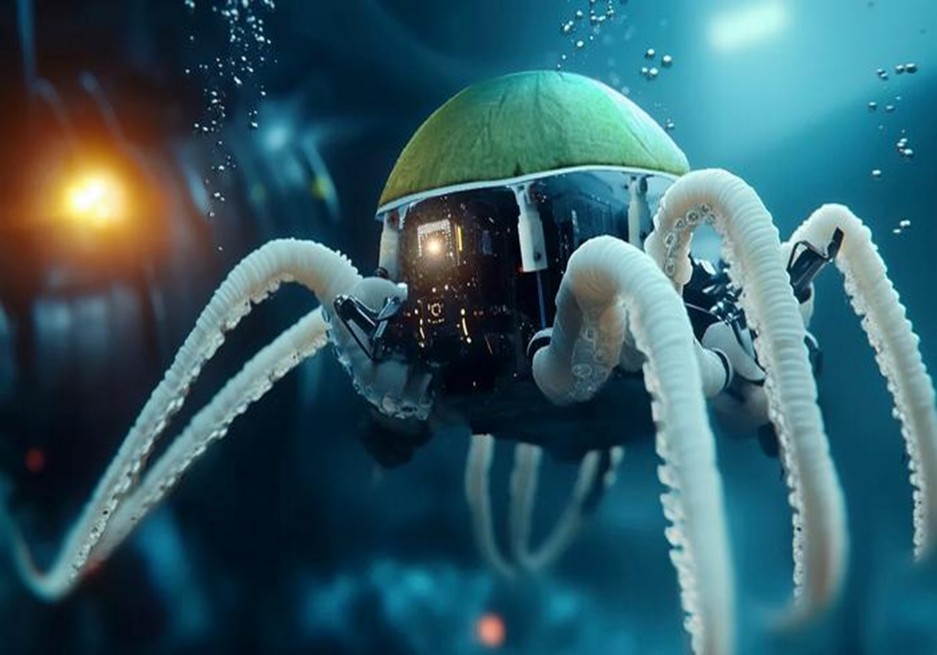
Figure 1. Touch-Sensitive Robot.
Robots that Understand Their Own Movement
The new system enables the robot to predict how its body should move and compare those predictions with real-time sensory feedback. When the two do not match, the robot recognizes that it has come into contact with an external object or force. This approach helps solve a longstanding challenge in soft robotics: distinguishing between a robot’s own movement and interactions with its surroundings.
To demonstrate the technology, researchers equipped a flexible robot with liquid-metal-based sensors capable of detecting bending, stretching, and deformation. Using only its internal sensing system, the robot was able to navigate and respond to physical contact in real time. “Soft robots, too, need proprioception,” said Cecilia Laschi. Figure 1 shows touch-sensitive robot.
Camera-Free Navigation Through Touch
Traditional soft robots often struggle because their sensors respond both to self-generated motion and external contact, making environmental interpretation difficult. The new framework mimics how the human brain predicts sensory input. The robot calculates its expected body position based on movement commands and continuously compares those predictions with signals from its flexible sensors.
In one experiment, researchers tested the robot in a maze-navigation task where it moved autonomously without cameras. Instead, it relied entirely on touch and internal sensing to detect walls and adjust its direction.
In another test, a human operator guided the robot through movements similar to massage therapy or medical procedures performed on a manikin. The robot later reproduced those motions with high precision. “It could detect external contact within 0.4 seconds and determine the direction of applied forces with an error margin below 10 degrees, even in dynamic environments,” Laschi explained.
Potential Uses in Healthcare and Underwater Robotics
Researchers believe the technology could improve human-robot collaboration in healthcare, rehabilitation, and assistive robotics. Soft robots with advanced tactile awareness may eventually help support elderly care, assist medical professionals, or aid surgeons during minimally invasive procedures.
The system could also benefit underwater robotics, where cameras are often limited by darkness or poor visibility. Robots inspired by octopus arms, for example, could rely on touch-based sensing to navigate challenging underwater environments. The team plans to further enhance the technology using machine learning systems modeled on how the human brain develops internal representations through experience.
References:
- https://interestingengineering.com/ai-robotics/soft-robot-sixth-sense-camera-free-navigation
Cite this article:
Keerthana S (2026), Touch-Sensitive Robot Can Navigate Like Humans Without Vision, AnaTechMaz, pp.370
Recent Post
-

Agile Robots Joins Forces with Google DeepMind in New Robotics Partnership
Agile Robots has entered into a new partnership with Google....
-
Amazon Buys Humanoid Robotics Startup Fauna Robotics
Amazon has acquired New York–based humanoid robotics startup Fauna Robotics, as confirmed....
-
DJI Brings Immersive Aerial Dogfighting Experience to Insta360
The imaging system is built around 1-inch–equivalent sensors with 2.4-micrometer....
-
Robot Legs Wow in Demo: Skating, Stair-Climbing, and One-Wheel Balancing
Launched in 2022 with a $400 million investment from Hyundai....
-
Tiny Robots, 50 Times Thinner Than a Hair, Can Track and Move Bacteria
Photon-powered nanorobots can precisely steer, capture, and.....
-
“Robot Explores 1.5 Miles Below, Captures 86,000 Images of French Shipwreck”
A cutting-edge underwater robot has captured thousands of....
-

“Notion Faces Data Exposure Risk from Unprotected API Access”
Privacy-focused browser maker Brave Software has rolled out its “Shred” feature to Android...
-
Humanoid Robot Passenger Sparks Flight Delay Over Oversized Banned Battery in the U.S.
An unusual airline incident unfolded in California when a....
-
China’s New Moon Robot Aims to Assist Future Lunar Missions
China has unveiled a new AI-powered lunar robot designed to assist future Moon missions by carrying....
-
Touch-Sensitive Robot Can Navigate Like Humans Without Vision
Researchers at the National University of Singapore have....
-
Brain-Like Navigation Gives Robots Smarter Mobility
For decades, robotics researchers have envisioned autonomous machines capable of navigating...
NVIDIA Builds the Foundation for an AI-Driven Robotic Future
As artificial intelligence moves beyond software and into the physical world, NVIDIA is positioning itself at....
New Low-Power Antenna Boosts Deep-Water Robot Communication
Communicating underwater has long been one of the biggest challenges facing autonomous underwater....
Hybrid Intelligence Revolutionizes Precision Manufacturing Robotics
Researchers led by Changtian Z., Jiaxuan H., and Xinyang L. have developed an...
Robots Break Free from Maps with Smarter LiDAR Technology
Autonomous robots are taking a major step toward operating independently in complex, real-world ....