

Tiny Robots, 50 Times Thinner Than a Hair, Can Track and Move Bacteria
Photon-powered nanorobots can precisely steer, capture, and transport bacteria, opening new ways to manipulate microscopic environments and advancing tools for microbiology.
Roughly 50 times smaller than the diameter of a human hair, these tiny robots are expanding what scientists can do at extremely small scales. They bring researchers closer to directly interacting with the microscopic world—something long considered a major scientific goal.
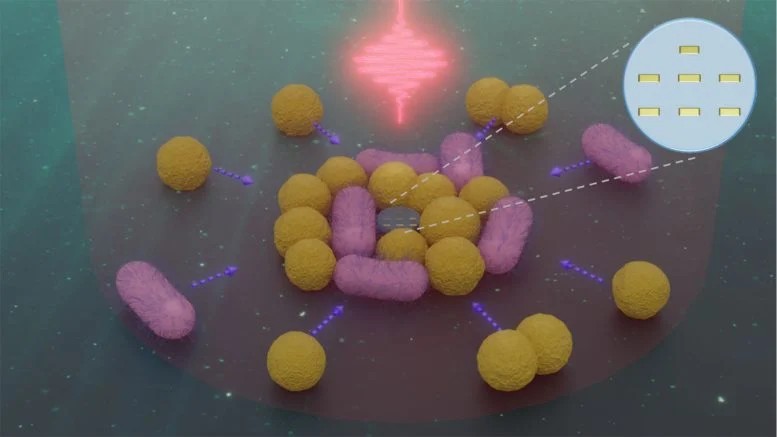
Figure 1. Tiny Robots.
This capability is especially valuable for working with biological materials in liquids, such as individual cells or bacteria. Until now, controlling such tiny objects with precision has been difficult. These nanorobots demonstrate that tasks like collecting, moving, and repositioning bacteria can be carried out with accuracy. Figure 1 represents Tiny Robots.
One of the biggest challenges has been how to power and guide machines at such a small scale. A team at Julius-Maximilians-Universität Würzburg (JMU), led by Professor Bert Hecht, addressed this by harnessing the recoil force generated by individual photons to drive micrometer-sized devices known as microdrones.
Photon Recoil Drives Motion
Each microdrone contains up to four plasmonic nanoantennas that absorb light with specific characteristics and re-emit it in a controlled direction. Every emitted photon produces a minute recoil force—similar in principle to the backward kick of a fired bullet [1]. Because these devices have extremely low mass, even such tiny forces can propel them at high speeds with rapid acceleration.
In their latest work, the researchers reduced the robots to less than one micrometer in size. At the same time, they simplified how the robots are steered while still relying on photon-based propulsion.
The key lies in nanoscale antenna wires inside the robots, which naturally align with the polarization of incoming light. By adjusting that polarization, scientists can control the robots’ orientation, while motion continues to be driven by photon recoil—much like steering a vehicle while keeping it in motion.
Light-Guided Bacteria Capture
The nanorobots are highly agile, capable of executing sharp 90-degree turns. This allows them to scan large areas efficiently and systematically. They can selectively capture, transport, and release significant numbers of bacteria with precision.
This functionality effectively turns them into microscopic “cleaners,” able to gather bacteria and deposit them at chosen locations in controlled laboratory settings.
Toward Practical Applications
Even when carrying clusters of bacteria, the robots remain maneuverable, though their speed decreases slightly. This resilience highlights their potential for applications in microbiology, biomedical research, and other fields requiring precise manipulation at very small scales.
Beyond observation, this work shows how light can be used to actively shape and control the microscopic world—bringing the concept of tiny robotic cleaners from theory closer to reality.
References:
- https://scitechdaily.com/these-tiny-robots-50x-smaller-than-a-hair-can-hunt-and-move-bacteria/
Cite this article:
Keerthana S (2026), Tiny Robots, 50 Times Thinner Than a Hair, Can Track and Move Bacteria, AnaTechMaz, pp.365
Recent Post
-

Agile Robots Joins Forces with Google DeepMind in New Robotics Partnership
Agile Robots has entered into a new partnership with Google....
-
Amazon Buys Humanoid Robotics Startup Fauna Robotics
Amazon has acquired New York–based humanoid robotics startup Fauna Robotics, as confirmed....
-
DJI Brings Immersive Aerial Dogfighting Experience to Insta360
The imaging system is built around 1-inch–equivalent sensors with 2.4-micrometer....
-
Robot Legs Wow in Demo: Skating, Stair-Climbing, and One-Wheel Balancing
Launched in 2022 with a $400 million investment from Hyundai....
-
Tiny Robots, 50 Times Thinner Than a Hair, Can Track and Move Bacteria
Photon-powered nanorobots can precisely steer, capture, and.....
-
“Robot Explores 1.5 Miles Below, Captures 86,000 Images of French Shipwreck”
A cutting-edge underwater robot has captured thousands of....
-

“Notion Faces Data Exposure Risk from Unprotected API Access”
Privacy-focused browser maker Brave Software has rolled out its “Shred” feature to Android...
-
Humanoid Robot Passenger Sparks Flight Delay Over Oversized Banned Battery in the U.S.
An unusual airline incident unfolded in California when a....
-
China’s New Moon Robot Aims to Assist Future Lunar Missions
China has unveiled a new AI-powered lunar robot designed to assist future Moon missions by carrying....
-
Touch-Sensitive Robot Can Navigate Like Humans Without Vision
Researchers at the National University of Singapore have....
-
Brain-Like Navigation Gives Robots Smarter Mobility
For decades, robotics researchers have envisioned autonomous machines capable of navigating...

NVIDIA Builds the Foundation for an AI-Driven Robotic Future
As artificial intelligence moves beyond software and into the physical world, NVIDIA is positioning itself at....
New Low-Power Antenna Boosts Deep-Water Robot Communication
Communicating underwater has long been one of the biggest challenges facing autonomous underwater....
Hybrid Intelligence Revolutionizes Precision Manufacturing Robotics
Researchers led by Changtian Z., Jiaxuan H., and Xinyang L. have developed an...
Robots Break Free from Maps with Smarter LiDAR Technology
Autonomous robots are taking a major step toward operating independently in complex, real-world ....