

Morphing Robot Duo Walks, Drives and Takes to the Skies
Like something straight out of an early Transformers movie, researchers at Caltech have showcased how a humanoid robot and a drone can team up to achieve multiple modes of movement. The demonstration hints at exciting new possibilities in robotic locomotion.
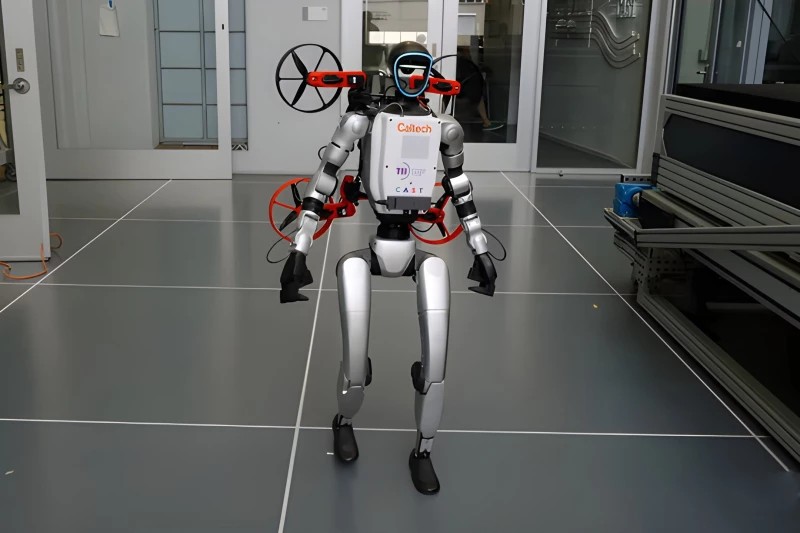
Figure 1. Morphing Robot Duo Walks, Rolls and Flies.
"Right now, robots can fly, robots can drive, and robots can walk," says Aaron Ames, professor of mechanical and civil engineering, control and dynamical systems, and aerospace at Caltech. "Those are all great in certain scenarios. But how do we combine these different locomotion modes into a single system, so we can leverage the benefits of each while minimizing their drawbacks?" Figure 1 shows Morphing Robot Duo Walks, Rolls and Flies.
To explore this, Ames and his team started with an off-the-shelf G1 humanoid from China's Unitree Robotics. They mounted Caltech’s M4 bot—a drone-like robot that can fly or transform its rotor guards into wheels to roll along the ground—onto the humanoid’s back, creating the hybrid system named X1.
In a demonstration, the humanoid walked outdoors, bent forward, and allowed the M4 to take off from its back. The M4 then rolled along the ground until it reached a turtle pond, where it lifted off again to fly over the obstacle. You can watch the entire sequence in the accompanying video.
While the demonstration may look simply, it took the Caltech team roughly three years to work out all the logistics of combining the two robotic systems. First, they modified the Unitree humanoid to navigate autonomously, rather than just mimic human movements. They also had to ensure it could maintain balance with the M4 mounted on its back.
"The robot learns to walk according to the laws of physics," explains Ames. "So X1 can walk across different terrains, climb stairs, and—crucially—carry something like the M4 on its back."
The project was a collaborative effort between Caltech’s Center for Autonomous Systems and Technology, which developed the M4 robot; the Ames Lab, which focuses on locomotion and algorithms for the safe operation of robots; and TII, a team specializing in robotic sensing and autonomy.
"We’re focused on safety-critical control—making sure our systems are reliable and secure," says Ames. "We have multiple projects that go beyond this one, exploring different aspects of autonomy. By combining these efforts, we can tackle larger challenges and advance robotic autonomy in a meaningful and coordinated way."
Source: NEW ATLAS
Cite this article:
Priyadharshini S (2025), Morphing Robot Duo Walks, Drives and Takes to the Skies, AnaTechMaz, pp.287
Recent Post
-

Vine Robot Expands by Everting its Own Skin from the Tip
Researchers have developed miniature, steerable vine-like robots capable of navigating complex pathways....
-
Morphing Robot Duo Walks, Drives and Takes to the Skies
Like something straight out of an early Transformers movie, researchers at Caltech....
-
Robot Hands are Growing Increasingly Human-Like
Hyundai-owned Boston Dynamics recently unveiled a new set of grippers” for its streamlined Atlas ....
-
Spider-Inspired Construction Robot Could Build a House in Just One Day
Instead of performing individual tasks like tying rebar or assembling....
-
X-BAT Combat Drone Combines VTOL Agility, Stealth and High-Speed Performance
Autonomous aircraft makers seem to be engaging in a bit of one-upmanship ....
-
TikTok Robot Sensation Rizzbot Flips off Users
Rizzbot, a kid-sized humanoid robot built by Unitree Robotics with over a million TikTok followers and more...
-
Mbodi to Demonstrate AI-Powered Robot Training at TechCrunch Disrupt 2025
Robots can perform a wide range of tasks, from packing boxes....
-
Dive Deeper: The First Underwater Exoskeleton that Enhances Your Swimming Instincts
Divers may soon get a helpful boost to their flutter kicks thanks to....
-
Futuristic Visions Captured in Stunning Robot Imagery
Humans have long been fascinated with their own image. In the 1920s play R.U.R. (Rossum’s Universal Robots)....
-

Marching Robot Inspired by Nature Brings 'Interstellar' to Life
If you want to build a real-life HAL 9000, all you really need is an LED, some carpentry skills, and a laptop....
-
Microscopic Robots Navigate Your Bloodstream to Combat Strokes
Microrobots could become a promising method for clearing dangerous blood vessel blockages that lead to strokes....
-
Watch: Hyper-Realistic Robot Revealed as Machine in Shocking Dissection
When Xpeng unveiled its next-gen Iron humanoid earlier this month, it stole....
-
DARPA Pledges $6.5M for Top Small Heavy-Lift Drone Innovations
Through its Tactical Technology Office (TTO), DARPA aims to push drone technology forward with its Lift....
-

Agile Robots Takes Over Thyssenkrupp Automation Engineering
A physical AI company is deepening its capabilities in industrial automation....
-

Advantech Combines Computing Power with D3 Embedded Sensing for Mobile Robots
As mobile robots increasingly populate factories and warehouses, there....