

New $16 Million Investment Boosts US Defense-Grade Chip Production
The U.S. Department of Defense has awarded $16 million to BAE Systems to restore domestic production of radiation-hardened microelectronics, reinforcing the nation's supply of specialized semiconductors used in missile systems, spacecraft, satellites, and other strategic defense platforms.
Funded through the Defense Production Act (DPA) Title III program, the investment is intended to strengthen the U.S. defense industrial base by expanding manufacturing capacity for radiation-hardened microelectronics (RHMs), which are designed to operate reliably in high-radiation environments where conventional chips can fail.
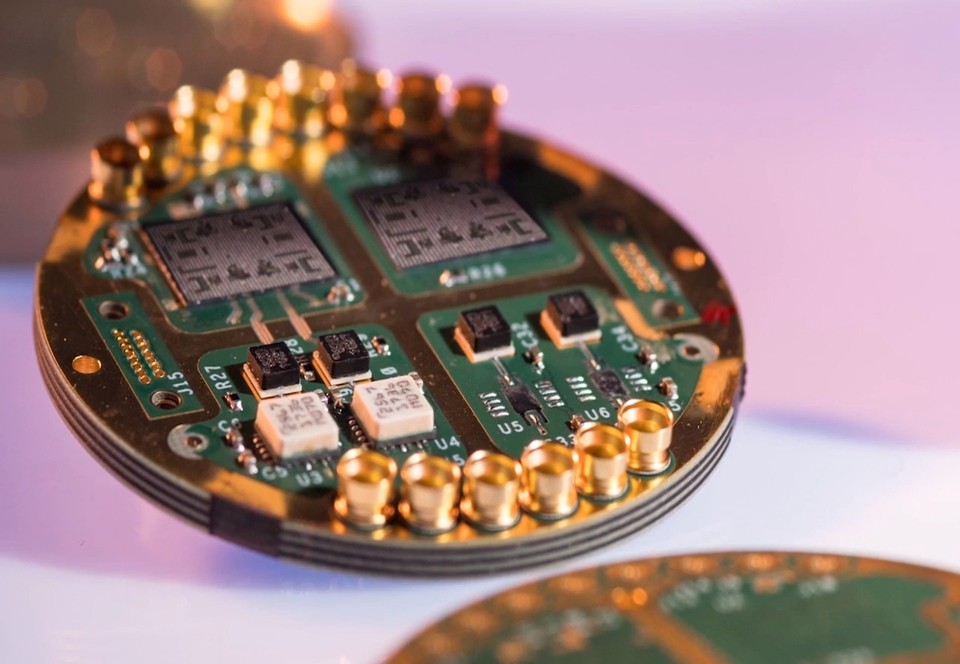
Figure 1. Defense-Grade Chip.
Reviving Trusted Radiation-Hardened Manufacturing
A central part of the initiative is the restoration of BAE Systems' RH45 Storefront, a trusted manufacturing platform based on 45-nanometer Radiation Hardened by Design (RHBD) silicon-on-insulator technology. Once operational, the facility will enable government agencies and defense contractors to design and manufacture custom radiation-hardened chips using qualified and secure domestic production processes.
The project supports broader efforts to rebuild critical semiconductor manufacturing capabilities within the United States while reducing dependence on overseas supply chains for strategic technologies. Figure 1 shows defense-grade chip.
Protecting Critical Defense Systems
Radiation-hardened microelectronics play a vital role in military and space applications where electronic systems must withstand intense radiation. Unlike conventional semiconductors, these specialized chips are engineered to resist radiation-induced failures that can corrupt data or permanently damage electronic components.
Their reliability makes them indispensable for military satellites, missile guidance systems, deep-space missions, and other defense platforms operating in harsh environments beyond Earth's protective atmosphere.
According to Michael Cadenazzi, Assistant Secretary of Defense for Industrial Base Policy, radiation-hardened microelectronics remain essential to the Department of Defense's missile, space, and strategic capabilities, and the investment will help ensure a dependable supply of qualified components for future defense programs.
Building a Resilient Semiconductor Supply Chain
The restored RH45 Storefront will serve as a centralized manufacturing resource, providing standard fabrication processes, design support, and production services for application-specific integrated circuits (ASICs) and other radiation-hardened semiconductor devices.
The Department of Defense expects the investment to expand domestic production capacity while improving long-term resilience across the nation's defense semiconductor supply chain.
Preserving Proven Technology for Future Programs
Maintaining the trusted 45-nanometer silicon-on-insulator manufacturing process also enables defense programs to continue using proven chip designs without the need for expensive redesigns or lengthy recertification efforts [1]. This approach helps reduce costs, shortens development timelines, and accelerates deployment of next-generation defense and space systems.
According to Jeffrey Frankston, Acting Deputy Assistant Secretary of Defense for Industrial Base Resilience, preserving the existing manufacturing platform provides significant cost savings by allowing current defense programs to continue relying on qualified and trusted semiconductor technology.
The award is one of five DPA Title III investments announced during fiscal year 2026, representing a combined $102.6 million in federal funding to strengthen key segments of the U.S. defense industrial base.
As demand continues to grow for resilient electronics across military and space applications, the latest investment underscores the strategic importance of securing domestic production of advanced radiation-hardened semiconductors to support future national security missions.
References
- https://interestingengineering.com/innovation/us-bae-radiation-hardened-chip-production
Cite this article:
Keerthana S (2026), New $16 Million Investment Boosts US Defense-Grade Chip Production, AnaTechMaz, pp.440.
Recent Post
-
Grain-Sized Crystal Challenges Conventional Physics with Magnetic Field Breakthrough
Scientists at Institute of Science and Technology Austria have....
-

Ultra-Fast Flexible Transistors Reach 100 GHz Milestone
Researchers have achieved a major breakthrough in flexible electronics by developing carbon....
-
Ancient Chemical Method Inspires Breakthrough in Advanced Glass Engineering
Scientists have revived a centuries-old glassmaking principle to...
-
Cracking the Code of High-Temperature Superconductors
For decades, the mystery of high-temperature superconductivity has challenged some of the..
-

Unlocking the Atomic Secrets of Record-Breaking Superconductors
The quest for lossless electricity transmission has taken a major step forward. An international...
-
New Artificial Leaf Uses Sunlight to Turn CO₂ into Clean Methanol
Researchers at Yale University have developed a solar-powered artificial leaf capable of converting carbon ...
-

Solidion Unveils Extreme-Climate Battery Platform for Future Space Missions
Battery manufacturer Solidion Technology has introduced a...
-
Revolutionary Mass Spectrometry System Detects Billions of Molecules at Once
Mass spectrometry has long been one of the most important tools...
-
Recycling for Technology: New Partnership Extracts Semiconductor Resources from Aluminum Scrap
A new partnership between ...
-

Smart Thermal Tags Offer a Breakthrough in Plastic Waste Sorting
Plastic waste remains one of the world's most pressing...
-

Physicists Detect Unusual Quantum Rotation Phenomenon That Challenges Intuition
Researchers have found that atomic-scale rotations inside a crystal....
-

Scientists Discover Low-Cost Route to Clean Hydrogen Production
Researchers at the University of Birmingham have developed a new technique for producing hydrogen...
-

Scientists Harvest Electricity from Moisture in the Air Using Common Materials
A study published in Nano Energy reports the development of a....
-

Scientists Solve Long-Standing Mystery of High-Temperature Superconductors
New experimental measurements of nickelate superconductors...
-

Breakthrough Discovery Unveils Previously Hidden State of Matter
Scientists have achieved a major breakthrough by capturing a long-theorized hidden state of....