

Scientists Harvest Electricity from Moisture in the Air Using Common Materials
A study published in Nano Energy reports the development of a highly stable, biodegradable moisture-electric generator (MEG) created by researchers from Queen Mary University of London, the University of Warwick, Imperial College London, and Universitas Mercatorum.
The device is made using food-grade, biodegradable materials such as gelatin, sodium chloride (table salt), and activated carbon. It generates electricity by harnessing ambient humidity—turning atmospheric moisture, which is usually a challenge for electronic systems, into a usable energy source. This represents a new approach in electronic design that treats environmental moisture not as a limitation but as a functional input for power generation.
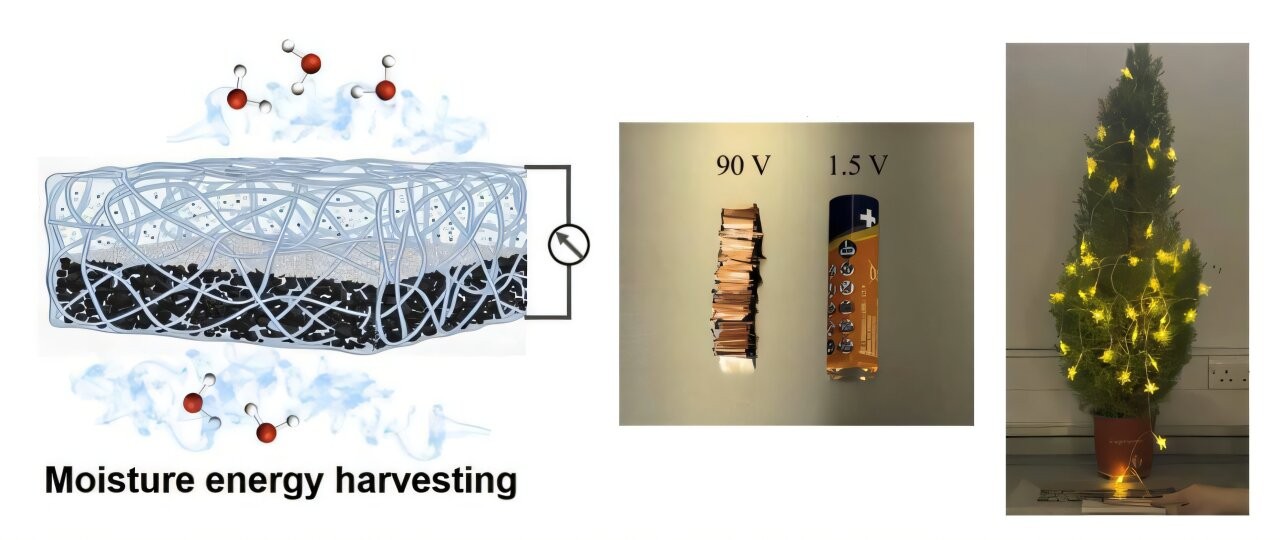
Figure 1. Structure and Performance of a Food-Grade Moisture-Electric Generator
A Sustainable Alternative to Traditional Power Sources
With the rapid growth of global electronic waste, the new moisture-electric generator (MEG) offers a low-impact alternative to conventional batteries and energy systems. Built through a simple water-based process, the device uses widely available, non-toxic materials, supporting more sustainable and circular approaches to electronics design. Figure 1 shows Structure and Performance of a Food-Grade Moisture-Electric Generator.
The technology generates electricity by absorbing water molecules from air or human skin. As the gelatin–salt mixture dries, it self-assembles into a stable three-layer structure. When exposed to humidity, this structure enables ion movement within the material, producing a steady electrical output of around 1 volt per unit for more than 30 days. By linking multiple units in series, the researchers achieved outputs of up to 90 volts and 5.08 mA, enough to power small devices such as a 40-LED light strip.
According to Ming Dong of Queen Mary University of London, the approach demonstrates that strong electrical performance can be achieved using simple and sustainable ingredients like gelatin and salt, with ambient humidity serving as the sole energy source.
Dual-Function Device for Power Generation and Sensing
Beyond energy harvesting, the material also shows promise as a highly sensitive, skin-compatible sensor. Since its electrical output changes in response to subtle shifts in moisture, it can detect physiological signals associated with variations in humidity.
The researchers demonstrated that the device can monitor real-time breathing patterns and identify speech-related changes through fluctuations in exhaled moisture. It also shows potential for touchless proximity detection, making it suitable for integration into wearable health monitors and human–machine interfaces that operate without the need for a battery.
Designed for Biodegradability
A major advantage of the technology is its environmentally friendly end-of-life behavior. Unlike conventional electronics that depend on plastics and heavy metals, the moisture-electric generator (MEG) is designed to break down safely.
After use, the device can biodegrade in soil within a few weeks or dissolve in water, allowing its components to be recovered and reused without the need for harmful chemicals [1]. This makes it a strong candidate for circular electronics, where materials are designed to return safely to the environment or be recycled.
According to Dimitrios Papageorgiou of Queen Mary University of London, the study demonstrates that high-performance energy devices can be built from low-cost, environmentally friendly materials. He noted that the ability of a gelatin-based system to generate meaningful electrical output highlights its potential for scalable, sustainable applications.
References
- https://techxplore.com/news/2026-05-scientists-generate-electricity-ambient-moisture.html
Cite this article:
Janani R (2026), Scientists Harvest Electricity from Moisture in the Air Using Common Materials, AnaTechMaz, pp.403
Recent Post
-

Grain-Sized Crystal Challenges Conventional Physics with Magnetic Field Breakthrough
Scientists at Institute of Science and Technology Austria have....
-

Ultra-Fast Flexible Transistors Reach 100 GHz Milestone
Researchers have achieved a major breakthrough in flexible electronics by developing carbon....
-

Ancient Chemical Method Inspires Breakthrough in Advanced Glass Engineering
Scientists have revived a centuries-old glassmaking principle to...
-
Cracking the Code of High-Temperature Superconductors
For decades, the mystery of high-temperature superconductivity has challenged some of the..
-

Unlocking the Atomic Secrets of Record-Breaking Superconductors
The quest for lossless electricity transmission has taken a major step forward. An international...
-
New Artificial Leaf Uses Sunlight to Turn CO₂ into Clean Methanol
Researchers at Yale University have developed a solar-powered artificial leaf capable of converting carbon ...
-
Solidion Unveils Extreme-Climate Battery Platform for Future Space Missions
Battery manufacturer Solidion Technology has introduced a...
-
Revolutionary Mass Spectrometry System Detects Billions of Molecules at Once
Mass spectrometry has long been one of the most important tools...
-
Recycling for Technology: New Partnership Extracts Semiconductor Resources from Aluminum Scrap
A new partnership between ...
-
Smart Thermal Tags Offer a Breakthrough in Plastic Waste Sorting
Plastic waste remains one of the world's most pressing...
-

Physicists Detect Unusual Quantum Rotation Phenomenon That Challenges Intuition
Researchers have found that atomic-scale rotations inside a crystal....
-

Scientists Discover Low-Cost Route to Clean Hydrogen Production
Researchers at the University of Birmingham have developed a new technique for producing hydrogen...
-
Scientists Harvest Electricity from Moisture in the Air Using Common Materials
A study published in Nano Energy reports the development of a....
-

Scientists Solve Long-Standing Mystery of High-Temperature Superconductors
New experimental measurements of nickelate superconductors...
-

Breakthrough Discovery Unveils Previously Hidden State of Matter
Scientists have achieved a major breakthrough by capturing a long-theorized hidden state of....