

Grain-Sized Crystal Challenges Conventional Physics with Magnetic Field Breakthrough
Scientists at Institute of Science and Technology Austria have uncovered new clues behind one of the strangest superconducting materials ever discovered—a uranium-based crystal that unexpectedly regains superconductivity under extremely powerful magnetic fields.
The material, known as Uranium Ditelluride, has puzzled physicists since its discovery in 2019. Unlike conventional superconductors, which lose their ability to conduct electricity without resistance when exposed to strong magnetic fields, UTe2 behaves in a far more unusual way.
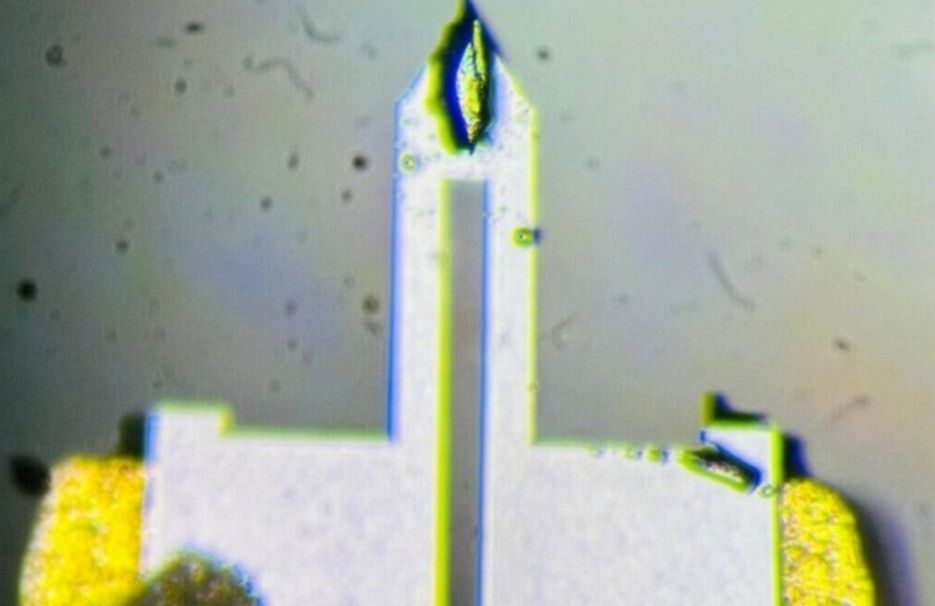
Figure 1. Magnetic Field.
A Superconductor That “Comes Back to Life”
Under normal conditions, superconductors allow electrical current to flow with zero resistance at extremely low temperatures. However, powerful magnetic fields usually destroy this state. Figure 1 shows magnetic field.
UTe2 initially follows that rule, losing superconductivity at magnetic fields around 10 Tesla—already far stronger than the fields used in most MRI machines. But surprisingly, the material regains its superconducting state at even higher magnetic fields between 40 and 70 Tesla, a phenomenon known as reentrant superconductivity. Researchers say this unusual behavior challenges long-standing assumptions in quantum physics.
Magnetic Fluctuations May Hold the Answer
To investigate the mystery, scientists exposed tiny samples of UTe2 to rapid magnetic field pulses reaching up to 60 Tesla [1]. The team focused on understanding how magnetic fluctuations inside the material might enable superconductivity to reappear under such extreme conditions.
“We have long suspected that magnetism plays an important role in unconventional superconductivity,” said Kimberly Modic. “But UTe2 itself is not actually magnetic, which makes its behavior especially surprising.”
Lead researcher Valeska Zambra developed a specialized technique that mechanically “wiggles” the crystal while it sits inside intense magnetic fields. The tiny crystal—smaller than a grain of salt—was mounted on a cantilever-like structure that allowed researchers to study how its magnetic properties changed in real time.
Discovering the “glue” behind superconductivity
The experiments revealed a region of strong transverse magnetic susceptibility inside UTe2. Researchers believe these magnetic fluctuations act as the “glue” that binds electrons together, enabling superconductivity to survive and reappear under extreme magnetic fields.
The team says the findings may point to an entirely new form of superconductivity and could help scientists better understand other exotic quantum materials.
Tiny Crystals, Massive Implications
Working with samples roughly the thickness of a human hair presented major technical challenges, but the researchers successfully developed methods to precisely fabricate and integrate the microscopic crystals into their experiments. According to Modic, high-field laboratories worldwide have already expressed interest in adopting the group’s new measurement technique.
“Other unconventional superconductors exist, but UTe2 makes the term ‘unconventional’ seem almost inadequate,” she said. The discovery could eventually contribute to future advances in quantum computing, ultra-efficient electronics, and next-generation superconducting technologies.
References
- https://interestingengineering.com/science/quantum-material-switches-superconductivity-back
Cite this article:
Keerthana S (2026), Grain-Sized Crystal Challenges Conventional Physics with Magnetic Field Breakthrough, AnaTechMaz, pp.391
Recent Post
-
Grain-Sized Crystal Challenges Conventional Physics with Magnetic Field Breakthrough
Scientists at Institute of Science and Technology Austria have....
-

Ultra-Fast Flexible Transistors Reach 100 GHz Milestone
Researchers have achieved a major breakthrough in flexible electronics by developing carbon....
-

Ancient Chemical Method Inspires Breakthrough in Advanced Glass Engineering
Scientists have revived a centuries-old glassmaking principle to...
-
Cracking the Code of High-Temperature Superconductors
For decades, the mystery of high-temperature superconductivity has challenged some of the..
-

Unlocking the Atomic Secrets of Record-Breaking Superconductors
The quest for lossless electricity transmission has taken a major step forward. An international...
-
New Artificial Leaf Uses Sunlight to Turn CO₂ into Clean Methanol
Researchers at Yale University have developed a solar-powered artificial leaf capable of converting carbon ...
-
Solidion Unveils Extreme-Climate Battery Platform for Future Space Missions
Battery manufacturer Solidion Technology has introduced a...
-
Revolutionary Mass Spectrometry System Detects Billions of Molecules at Once
Mass spectrometry has long been one of the most important tools...
-
Recycling for Technology: New Partnership Extracts Semiconductor Resources from Aluminum Scrap
A new partnership between ...
-

Smart Thermal Tags Offer a Breakthrough in Plastic Waste Sorting
Plastic waste remains one of the world's most pressing...
-

Physicists Detect Unusual Quantum Rotation Phenomenon That Challenges Intuition
Researchers have found that atomic-scale rotations inside a crystal....
-

Scientists Discover Low-Cost Route to Clean Hydrogen Production
Researchers at the University of Birmingham have developed a new technique for producing hydrogen...
-
Scientists Harvest Electricity from Moisture in the Air Using Common Materials
A study published in Nano Energy reports the development of a....
-

Scientists Solve Long-Standing Mystery of High-Temperature Superconductors
New experimental measurements of nickelate superconductors...
-

Breakthrough Discovery Unveils Previously Hidden State of Matter
Scientists have achieved a major breakthrough by capturing a long-theorized hidden state of....