

New Artificial Leaf Uses Sunlight to Turn CO₂ into Clean Methanol
Researchers at Yale University have developed a solar-powered artificial leaf capable of converting carbon dioxide and water directly into methanol, offering a promising new approach to sustainable fuel production and carbon recycling. The innovative system mimics natural photosynthesis, using sunlight as its sole energy source to drive the chemical reaction without requiring external electricity.
The breakthrough was achieved through a collaboration between Yale and researchers from University of North Carolina at Chapel Hill, North Carolina State University, and University of Pennsylvania. The project also contributes to the mission of the Center for Hybrid Approaches in Solar Energy to Liquid Fuels (CHASE), which focuses on developing technologies that transform solar energy into usable liquid fuels.
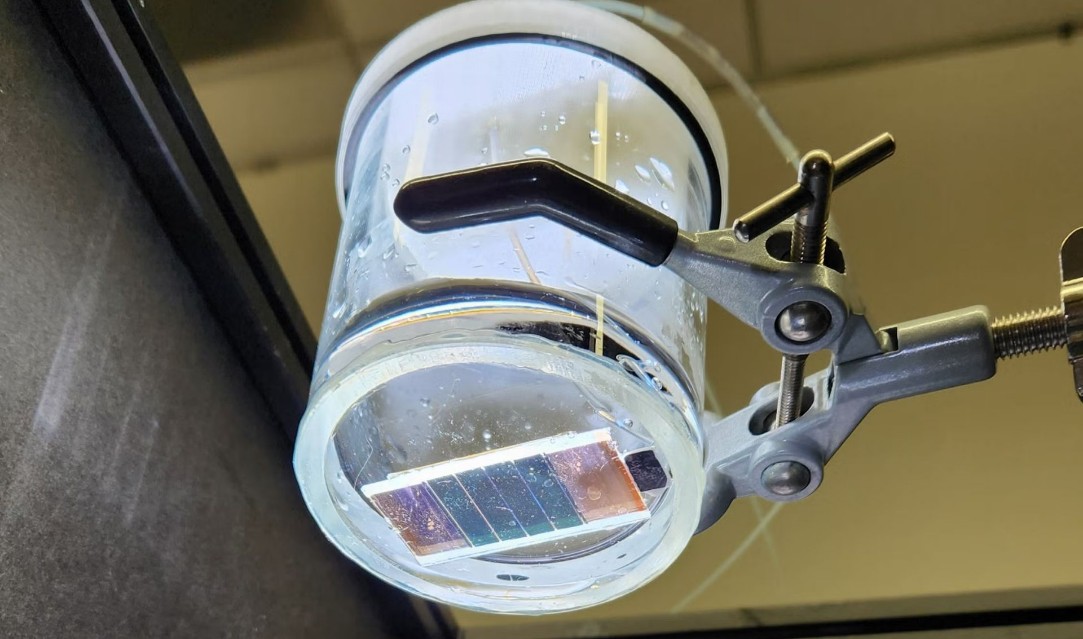
Figure 1. Sunlight to Turn CO₂.
According to Yale chemistry professor Hailiang Wang, the device takes inspiration from nature’s ability to convert sunlight into stored chemical energy. Unlike conventional solar technologies that generate electricity, the artificial leaf produces methanol directly, creating a fuel that can be stored, transported, and integrated into existing industrial infrastructure. Methanol already plays a vital role as a chemical feedstock and is increasingly being explored as a lower-emission fuel for shipping and energy applications. Figure 1 shows sunlight to turn CO₂.
At the heart of the system is a highly advanced catalyst developed in Wang’s laboratory. The catalyst uses cobalt phthalocyanine molecules attached to carbon nanotubes, enabling a complex six-electron reaction that converts carbon dioxide and water into methanol. The carbon nanotubes act as highly efficient pathways for electron transport, continuously supplying energy to the catalytic sites and enhancing reaction performance.
The research team also engineered a novel photoelectrode composed of microscopic silicon pillars coated with fullerene-based carbon materials. This architecture improves charge separation, accelerates electron transfer, and increases the active surface area available for chemical reactions. By integrating these two technologies, the researchers created one of the most efficient silicon-based photoelectrocatalytic systems yet reported for solar-driven methanol production.
Doctoral researcher Bo Shang, who spent five years helping develop the device, described the achievement as a significant milestone [1]. What once seemed an unlikely goal has now become a functioning standalone system capable of producing liquid fuel from sunlight, water, and carbon dioxide.
Although further improvements in efficiency, durability, and scalability are still needed before commercial deployment, the research demonstrates the growing potential of engineered photosynthesis. The technology could eventually support large-scale carbon capture and recycling initiatives while generating renewable liquid fuels with a lower environmental footprint.
By successfully combining advanced catalysts, nanomaterials, and solar energy harvesting, the Yale-led team has taken an important step toward transforming artificial photosynthesis from a laboratory concept into a practical clean-energy solution.
References
- https://interestingengineering.com/energy/artificial-leaf-photosynthesis-methanol-fuel
Cite this article:
Keerthana S (2026), New Artificial Leaf Uses Sunlight to Turn CO₂ into Clean Methanol, AnaTechMaz, pp.396
Recent Post
-

Grain-Sized Crystal Challenges Conventional Physics with Magnetic Field Breakthrough
Scientists at Institute of Science and Technology Austria have....
-

Ultra-Fast Flexible Transistors Reach 100 GHz Milestone
Researchers have achieved a major breakthrough in flexible electronics by developing carbon....
-

Ancient Chemical Method Inspires Breakthrough in Advanced Glass Engineering
Scientists have revived a centuries-old glassmaking principle to...
-
Cracking the Code of High-Temperature Superconductors
For decades, the mystery of high-temperature superconductivity has challenged some of the..
-

Unlocking the Atomic Secrets of Record-Breaking Superconductors
The quest for lossless electricity transmission has taken a major step forward. An international...
-
New Artificial Leaf Uses Sunlight to Turn CO₂ into Clean Methanol
Researchers at Yale University have developed a solar-powered artificial leaf capable of converting carbon ...
-

Solidion Unveils Extreme-Climate Battery Platform for Future Space Missions
Battery manufacturer Solidion Technology has introduced a...
-

Revolutionary Mass Spectrometry System Detects Billions of Molecules at Once
Mass spectrometry has long been one of the most important tools...
-
Recycling for Technology: New Partnership Extracts Semiconductor Resources from Aluminum Scrap
A new partnership between ...
-

Smart Thermal Tags Offer a Breakthrough in Plastic Waste Sorting
Plastic waste remains one of the world's most pressing...
-

Physicists Detect Unusual Quantum Rotation Phenomenon That Challenges Intuition
Researchers have found that atomic-scale rotations inside a crystal....
-

Scientists Discover Low-Cost Route to Clean Hydrogen Production
Researchers at the University of Birmingham have developed a new technique for producing hydrogen...
-
Scientists Harvest Electricity from Moisture in the Air Using Common Materials
A study published in Nano Energy reports the development of a....
-

Scientists Solve Long-Standing Mystery of High-Temperature Superconductors
New experimental measurements of nickelate superconductors...
-

Breakthrough Discovery Unveils Previously Hidden State of Matter
Scientists have achieved a major breakthrough by capturing a long-theorized hidden state of....