

The Next-Gen Storage Breakthrough: Terahertz Light Paves the Way for Ultra-Fast, Non-Volatile Memory
The Next Frontier of Data Storage
Modern life runs on digital technology, where every bit of information is encoded as simple 0s and 1s. Any physical system that can reliably flip between two stable states can, in principle, serve as a data storage medium.
Ferroic materials exemplify this idea. Ferromagnets, for instance, can align their magnetization in opposite directions, while ferroelectrics maintain opposite electric polarizations. Because these states can be easily switched using magnetic or electric fields, such materials are fundamental to today’s storage and electronic devices.
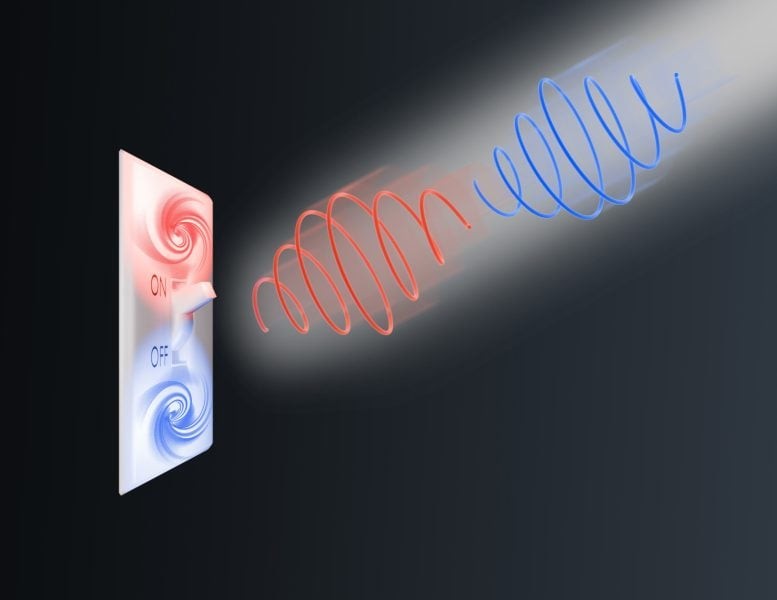
Figure 1. Terahertz Light.
However, conventional ferroic materials aren’t without flaws. They can degrade over time or be disrupted by external forces—like a strong magnet near a hard drive—spurring researchers to seek more stable and resilient alternatives. Figure 1 shows Terahertz Light.
A New Kind of Ferroic Stability
Enter ferroaxial materials, the newest members of the ferroic family. Rather than relying on magnetic or electric states, these materials host vortices of electric dipoles that twist in two opposing directions. These “clockwise” and “anticlockwise” orientations are exceptionally stable and immune to external fields—but this same stability makes them notoriously difficult to control.
A research team led by Andrea Cavalleri has now overcome that challenge. Using circularly polarized terahertz light pulses, they managed to switch between ferroaxial domains in a crystal called rubidium iron dimolybdate (RbFe(MoO₄)₂).
“We exploit a synthetic effective field created when a terahertz pulse drives ions in the crystal lattice along circular paths,” explains lead author Zhiyang Zeng [1]. “This field interacts with the ferroaxial state much like a magnetic or electric field would switch ferromagnetic or ferroelectric states.”
Toward Ultrafast, Non-Volatile Memory
By tuning the helicity—the twist—of these terahertz light pulses, the researchers can stabilize either a clockwise or anticlockwise arrangement of the dipoles, effectively encoding digital information.
“Because ferroaxial states are immune to stray magnetic and electric fields, they represent a remarkably stable, non-volatile form of data storage,” adds co-author Michael Först.
“This discovery paves the way for an entirely new platform for ultrafast, robust information storage,” concludes Cavalleri. “It also highlights how circular phonon fields—first demonstrated in our lab in 2017—are becoming powerful tools for controlling exotic material phases.”
References:
- https://scitechdaily.com/the-ultimate-hard-drive-terahertz-light-unlocks-a-new-class-of-non-volatile-memory/
Cite this article:
Keerthana S (2025), The Next-Gen Storage Breakthrough: Terahertz Light Paves the Way for Ultra-Fast, Non-Volatile Memory, AnaTechMaz, pp.282
Recent Post
-
Tech That Tackles Fatbergs Could Save Cities Billions in Sewer Maintenance
Fatbergs are massive, concrete-like clumps of cooking oil, greases....
-

Review Links High-Potency Cannabis to Schizophrenia, Psychosis and Other Risks
High-concentration cannabis products were defined as those....
-

Breaking Chemical Rules: Scientists Accidentally Discover a Novel Gold Compound
It was unexpected because gold is usually chemically inert....
-

AI-Designed Super-Adhesive Underwater Hydrogels
Material design is shifting toward data-driven methods, where discovery increasingly relies on....
-
Record-Breaking Atom Images Uncover New Vibrational Modes
US researchers have directly visualized moiré phasons—ultra-low-energy atomic vibrations—for the first....
-

Quantum Mystery Solved: Graphene Electrons Defy Fundamental Physics Law
For decades, quantum physicists have debated whether electrons can.....
-
America’s Strongest Laser Achieves First 2-Petawatt Pulse
The ZEUS laser facility at the University of Michigan has completed its first official experiment at 2.....
-

Low-Cost Liquid Battery Could Rival $10,000 Lithium Systems
Engineers have developed a new water-based “flow battery” aimed at making rooftop solar storage....
-
Perovskite-Silicon Tandem Solar Cells Hit 33.1% Efficiency
An international team of photovoltaics researchers has made a significant step toward large-scale industrial....
-

Harvard Develops Chemical-Free Way to Recycle Hair
Each year, textile and meat-processing industries produce billions of tons of feathers, wool, and hair, all....
-
Scientists Uncover a “Giant” Twist on a 140-Year-Old Physics Effect
For the first time, researchers in Japan have observed a giant anomalous Hall effect (AHE) in a nonmagnetic....
-
The Next-Gen Storage Breakthrough: Terahertz Light Paves the Way for Ultra-Fast, Non-Volatile Memory
Modern life runs on.....
-

Researchers Engineer Graphene Defects to Unlock Novel Capabilities
“Defects in materials are usually seen as problems that.....
-
Scientists Discover Novel Method to Manipulate Exotic Light Waves In 2D Materials
DPPs provide a promising solution. By confining and guiding....
-
Chemists Create Next-Gen Rocket Fuel Compound that Packs 150% More Energy
Manganese diboride belongs to a class of chemical compounds....