

Juno’s Near Miss: Jupiter’s Harsh Radiation Forces Spacecraft into Safe Mode
Juno Enters Safe Mode During Close Encounter with Jupiter
On April 4, NASA’s Juno spacecraft entered safe mode twice during a close flyby of Jupiter. Safe mode is a protective state that activates when the spacecraft encounters unexpected conditions. In this mode, nonessential systems are shut down to allow Juno to focus on vital operations like preserving power and maintaining communication with Earth. As a result, the spacecraft’s science instruments were automatically turned off for the remainder of the flyby.
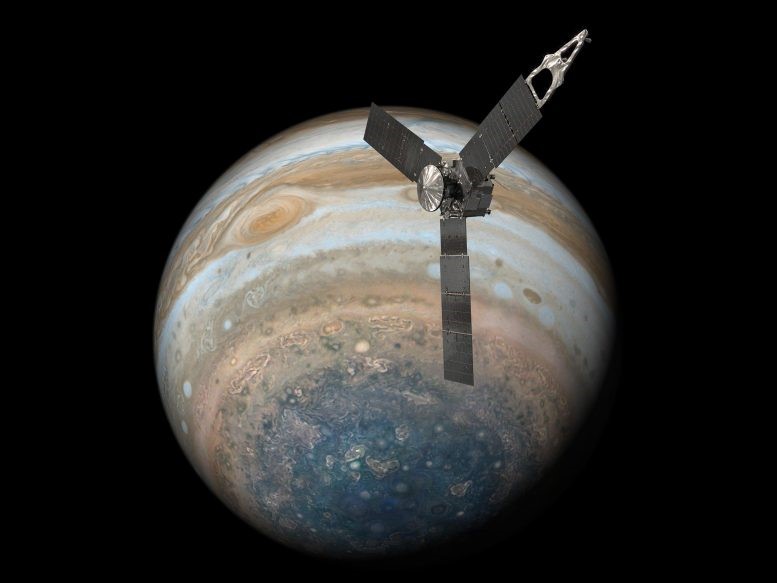
Figure 1. Juno’s Close Encounter: Intense Jupiter Radiation Triggers Safe Mode.
Since then, mission controllers have restored high-speed communication with Juno. The spacecraft is currently undergoing diagnostics on its flight software, and the team is working to recover the engineering and science data gathered before and after the safe-mode events. Figure 1 shows Juno’s Close Encounter: Intense Jupiter Radiation Triggers Safe Mode.
Safe Mode Timeline and Jupiter’s Hostile Environment
The first safe mode event occurred at 5:17 a.m. EDT, roughly an hour before Juno’s 71st close approach to Jupiter — an event known as perijove. The second was triggered about 45 minutes after the flyby. In both instances, Juno responded exactly as designed: it rebooted its onboard computer, powered down nonessential systems, and oriented its antenna toward Earth to maintain communication.
Jupiter’s environment is the most extreme in the solar system, particularly within its intense radiation belts near the planet. Preliminary analysis suggests that both safe mode events during Perijove 71 were triggered as Juno passed through these high-radiation zones. To protect its critical systems, Juno is equipped with a titanium radiation vault designed to shield sensitive electronics from the damaging effects of energetic particles.
Juno Enters Safe Mode During Close Jupiter Flyby
NASA’s Juno spacecraft entered safe mode twice on April 4 during its 71st close approach to Jupiter, known as perijove. Safe mode is a protective state triggered when the spacecraft detects unexpected conditions. When activated, nonessential systems are powered down, allowing the spacecraft to focus on critical functions like maintaining power and communicating with Earth. As a result, Juno’s science instruments were automatically shut off for the remainder of the flyby.
Timeline of Events and Jupiter’s Harsh Radiation
The first safe mode was initiated at 5:17 a.m. EDT, about an hour before perijove. The second followed roughly 45 minutes after the close approach. In both instances, Juno functioned exactly as designed—rebooting its onboard computer, shutting down nonessential systems, and aiming its antenna toward Earth to preserve communication.
Jupiter presents the most extreme radiation environment in the solar system, particularly in the belts closest to the planet. Preliminary data suggests both safe mode events were triggered as Juno passed through these intense radiation zones. To shield its sensitive electronics, the spacecraft is equipped with a titanium radiation vault that helps protect against the harmful effects of high-energy particles.
A History of Safe Mode Incidents
With the recent events during Perijove 71, Juno has now entered spacecraft-induced safe mode four times since its arrival at Jupiter in July 2016. Previous instances occurred during its second orbit in 2016 and its 39th orbit in 2022. In all four cases, the spacecraft behaved as expected and successfully recovered full functionality.
Juno’s next close pass by Jupiter is scheduled for May 7 and will include a flyby of the Jovian moon Io, coming within approximately 55,300 miles (89,000 kilometers) of the volcanic world.
About the Juno Mission
Juno is a NASA mission designed to deepen our understanding of Jupiter’s origin, internal structure, atmosphere, and magnetosphere. Launched in 2011, it arrived at Jupiter in 2016 as part of NASA’s New Frontiers Program, overseen by the Marshall Space Flight Center for the agency’s Science Mission Directorate.
The mission is led by Principal Investigator Scott Bolton of the Southwest Research Institute in San Antonio and is managed by NASA’s Jet Propulsion Laboratory (JPL), a division of Caltech in Pasadena, California. Lockheed Martin Space, based in Denver, built and operates the spacecraft. The mission also features international collaboration, including the Italian Space Agency’s contribution of the Jovian InfraRed Auroral Mapper (JIRAM), alongside instruments developed by research institutions across the United States.
Source: SciTECHDaily
Cite this article:
Priyadharshini S (2025), Juno’s Near Miss: Jupiter’s Harsh Radiation Forces Spacecraft into Safe Mode, AnaTechMaz, pp.338
Recent Post
-
Asteroid 2024 YR4 Triggers Global Alert – Now on Course to Possibly Strike the Moon Instead
Astronomers utilized the 2.5-meter Nordic Optical Telescope (NOT) in La Palma, Canary Islands...
-

Two Dying Stars Discovered Only 150 Light Years Away Set to Explode 10 Times Brighter Than the Moon
That's a huge discovery! Type Ia supernovae are critical for measuring cosmic...
-

Magnetic Origins: New Study Unravels Black Hole Mystery
The research team originally set out to model a star’s life cycle—from its formation to its...
-

No Signs, Big Revelations: How Null Results Shape Our Search for Life
According to researchers, surveying between 40 and 80 Earth-like exoplanets and finding no...
-
Celestial Spectacle: Hubble Captures Breathtaking Image of a Dying Star
Planetary nebulae like this one emerge during the closing chapters of a giant star’s life...
-

Starless Galaxies? Scientists Investigate the Universe’s Darkest Halos
Galaxies are believed to form at the centers of dark matter halos—vast regions of...
-

Alien Fermentation on Titan? Tiny Microbes Could Exist in Saturn’s Icy Moon Ocean
Titan, Saturn’s largest moon, is a bizarre and alien world. Its surface is lined with rivers ...
-
Juno’s Near Miss: Jupiter’s Harsh Radiation Forces Spacecraft into Safe Mode
On April 4, NASA’s Juno spacecraft entered safe mode twice during a close flyby of Jupiter...
-

New AI Algorithm Analyzes Neutron Star Collisions 3,600 Times Faster Than Conventional Techniques
Real-time computation is essential because it allows astronomers to respond immediately...
-
New Seismic Study Suggests Possibility of Life Beneath Mars' Surface
SEIS detects seismic waves caused by natural events such as Marsquakes and meteorite impacts...
-

A Star Was Ejected at A Million MPH – Unveiling A Hidden Black Hole
Stellar-mass black holes, such as the famous Cygnus X-1, form when massive stars collapse at...
-

Astrophysicists Reveal Millions of Interstellar Objects May Be Hidden Within Our Solar System
We know from our own solar system that giant planets stir up a bit of chaos in space...
-

Tiny Solar Jet Causes 200,000x Surge in Rare Helium-3, Astonishing Scientists
The NASA/ESA Solar Orbiter has recently detected the highest concentration of the rare helium...
-
Scientists May Have Finally Unlocked A 60-Year-Old Cosmic Mystery
After sixty years of searching, we may have finally uncovered the source of the universe’s most...
-
Supernova Explosions May Have Erased Life on Earth Twice
Researchers describe this as “a great illustration of how massive stars can serve as both...