

Celestial Spectacle: Hubble Captures Breathtaking Image of a Dying Star
The Final Performance of a Dying Giant
Planetary nebulae like this one emerge during the closing chapters of a giant star’s life. Once a red giant exhausts its nuclear fuel, it becomes unstable and expels its outer layers into space. The star’s core, now hot and dense, briefly reignites fusion, releasing intense ultraviolet radiation. This radiation energizes the surrounding gas, causing it to glow with vivid colors—red and orange from nitrogen, green from hydrogen, and blue from oxygen.
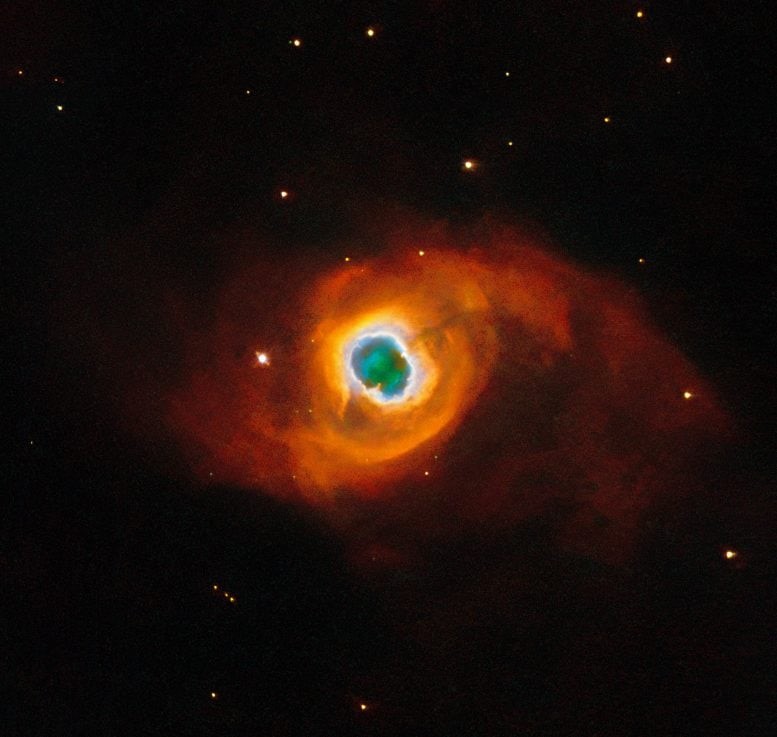
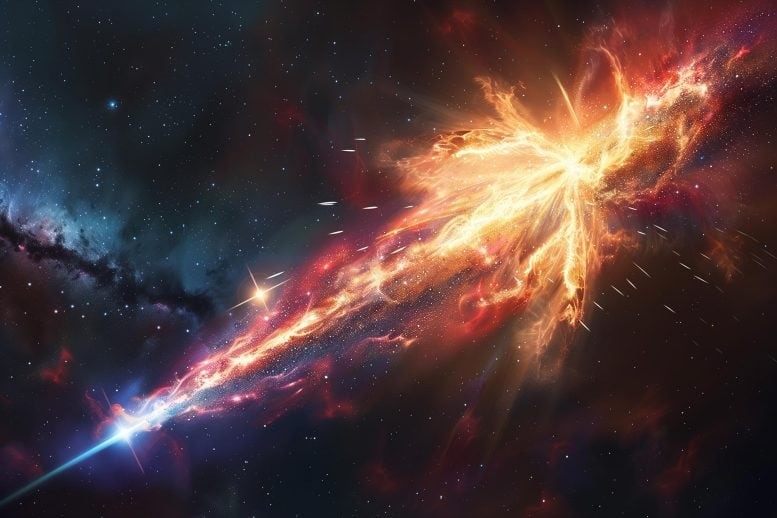
Figure 1. Stellar Farewell: Hubble Reveals the Beauty of a Dying Star.
Kohoutek 4-55 stands out with its layered beauty: a luminous central ring, a dimmer surrounding shell, and an expansive outer halo of ionized nitrogen. This dazzling display is short-lived in cosmic terms. Figure 1 shows Stellar Farewell: Hubble Reveals the Beauty of a Dying Star.
Within tens of thousands of years, fusion will cease completely, and all that will remain is a white dwarf—a compact, dense remnant no longer capable of illuminating the nebula around it.
A Symphony of Ionized Light
This image also serves as a swan song—the final masterpiece captured by one of Hubble’s most iconic instruments: the Wide Field and Planetary Camera 2 (WFPC2). Installed in 1993 as a replacement for the original Wide Field and Planetary Camera, WFPC2 played a pivotal role in capturing many of Hubble’s most enduring and scientifically significant images. Its legacy continued until 2009, when it was succeeded by the Wide Field Camera 3 during Hubble’s final servicing mission.
The data for this image were collected just ten days before the instrument was retired—a fitting farewell after 16 years of stellar service. With the aid of the latest image processing techniques, these final observations have been revived and transformed into this stunning new portrait of Kohoutek 4-55—one last luminous legacy from a camera that helped redefine our view of the cosmos.
The Grand Finale – What Is a Planetary Nebula?
Introduce the concept of planetary nebulae—what they are, how they form, and their role in the stellar life cycle. Clarify that despite the name, they have nothing to do with planets.
Key points:
- Occur in the final stages of a medium-to-large star’s life.
- Result from a red giant shedding its outer layers.
- The exposed hot core energizes surrounding gases, making them glow.
Kohoutek 4-55 – A Layered Legacy in Space
Dive into the specific nebula featured in the image: Kohoutek 4-55. Discuss its unique structure and what makes it visually and scientifically interesting.
Key points:
- Features a bright inner ring, faint surrounding shell, and a nitrogen-rich halo.
- Colors in the image correspond to different elements: red/orange (nitrogen), green (hydrogen), blue (oxygen).
- Offers insight into the final breaths of a star like our Sun.
The Science of Color – Light, Elements, and Ionization
Explain how the vivid colors are created using filters and why different elements glow in specific hues. Touch on spectroscopy and the importance of light in space observation.
Key points:
- Ultraviolet radiation excites gas particles, causing them to emit colored light.
- Each element emits light at distinct wavelengths.
- These colors reveal chemical composition and dynamics within the nebula.
A Farewell in Focus – The Last Light of WFPC2
Celebrate the instrument that captured the image—Hubble’s Wide Field and Planetary Camera 2 (WFPC2)—and its historical significance in space exploration.
Key points:
- Installed in 1993, retired in 2009.
- Captured some of Hubble’s most iconic images.
- Kohoutek 4-55 was one of its last observations—taken just 10 days before decommission.
White Dwarf Futures – What Comes After the Light?
Look ahead to what happens after the nebula fades—how the remaining white dwarf cools and what it means for our understanding of stellar evolution.
- Nebula fades within tens of thousands of years.
- Left behind is a white dwarf: hot, dense, Earth-sized.
- Offers clues to the eventual fate of our own Sun.
Source: SciTECHDaily
Cite this article:
Priyadharshini S (2025), Celestial Spectacle: Hubble Captures Breathtaking Image of a Dying Star, AnaTechMaz, pp.335
Recent Post
-
Asteroid 2024 YR4 Triggers Global Alert – Now on Course to Possibly Strike the Moon Instead
Astronomers utilized the 2.5-meter Nordic Optical Telescope (NOT) in La Palma, Canary Islands...
-

Two Dying Stars Discovered Only 150 Light Years Away Set to Explode 10 Times Brighter Than the Moon
That's a huge discovery! Type Ia supernovae are critical for measuring cosmic...
-

Magnetic Origins: New Study Unravels Black Hole Mystery
The research team originally set out to model a star’s life cycle—from its formation to its...
-

No Signs, Big Revelations: How Null Results Shape Our Search for Life
According to researchers, surveying between 40 and 80 Earth-like exoplanets and finding no...
-
Celestial Spectacle: Hubble Captures Breathtaking Image of a Dying Star
Planetary nebulae like this one emerge during the closing chapters of a giant star’s life...
-

Starless Galaxies? Scientists Investigate the Universe’s Darkest Halos
Galaxies are believed to form at the centers of dark matter halos—vast regions of...
-

Alien Fermentation on Titan? Tiny Microbes Could Exist in Saturn’s Icy Moon Ocean
Titan, Saturn’s largest moon, is a bizarre and alien world. Its surface is lined with rivers ...
-
Juno’s Near Miss: Jupiter’s Harsh Radiation Forces Spacecraft into Safe Mode
On April 4, NASA’s Juno spacecraft entered safe mode twice during a close flyby of Jupiter...
-

New AI Algorithm Analyzes Neutron Star Collisions 3,600 Times Faster Than Conventional Techniques
Real-time computation is essential because it allows astronomers to respond immediately...
-

New Seismic Study Suggests Possibility of Life Beneath Mars' Surface
SEIS detects seismic waves caused by natural events such as Marsquakes and meteorite impacts...
-

A Star Was Ejected at A Million MPH – Unveiling A Hidden Black Hole
Stellar-mass black holes, such as the famous Cygnus X-1, form when massive stars collapse at...
-

Astrophysicists Reveal Millions of Interstellar Objects May Be Hidden Within Our Solar System
We know from our own solar system that giant planets stir up a bit of chaos in space...
-

Tiny Solar Jet Causes 200,000x Surge in Rare Helium-3, Astonishing Scientists
The NASA/ESA Solar Orbiter has recently detected the highest concentration of the rare helium...
-
Scientists May Have Finally Unlocked A 60-Year-Old Cosmic Mystery
After sixty years of searching, we may have finally uncovered the source of the universe’s most...
-
Supernova Explosions May Have Erased Life on Earth Twice
Researchers describe this as “a great illustration of how massive stars can serve as both...