

Andromeda XXXV: A Newly Discovered Galaxy That Defies Expectations
Astronomers have discovered Andromeda XXXV, the faintest and smallest known satellite galaxy of Andromeda, our closest major galactic neighbor. Located about 3 million light-years away, this dwarf galaxy is challenging existing theories on galaxy evolution across different cosmic environments and eras.
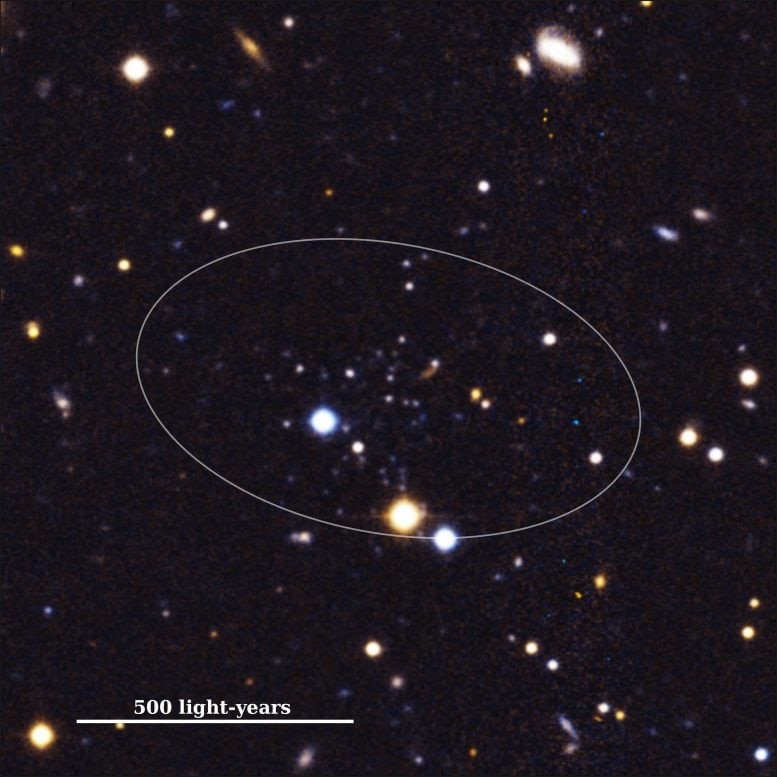
Figure 1. Andromeda XXXV: A Mysterious New Galaxy Challenging Science.
Rewriting the Story of Galactic Evolution
The discovery of Andromeda XXXV raises more questions than answers—a hallmark of cosmic exploration, says Marcos Arias, lead author of the study published on March 11. Figure 1 shows Andromeda XXXV: A Mysterious New Galaxy Challenging Science.
"The universe still holds countless mysteries," Arias said, "but this discovery refines what we do know and sheds light on what remains unknown."
Arias, who conducted this research as an undergraduate in the Department of Astronomy and now works as a post-baccalaureate researcher in astronomy and physics, emphasized the vast gaps in our understanding.
“There’s still so much to uncover—even in our cosmic neighborhood—about galaxy formation, evolution, and structure. Only by filling in these gaps can we piece together the history of the universe and understand how we arrived at this moment in time,” he explained.
Our Milky Way, like Andromeda, also hosts dozens of satellite galaxies. These companions, though significantly smaller, orbit within the gravitational influence of their massive central galaxy, shaping—and being shaped by—their cosmic environment.
A Breakthrough in Galactic Discovery
“These are fully functional galaxies, but they’re about a millionth the size of the Milky Way,” said Eric Bell, senior author of the study and professor of astronomy at the University of Michigan. “It’s like having a perfectly functional human being that’s the size of a grain of rice.”
Due to their tiny size, these satellite galaxies are incredibly faint and difficult to detect. Only in the past couple of decades have astronomers developed technology sensitive enough to identify most of the Milky Way’s known satellites. Even now, spotting extremely dim satellites orbiting galaxies farther away than Andromeda remains impossible, Bell explained.
Until now, the Milky Way’s satellite galaxies have been our primary window into these cosmic companions. While Andromeda’s satellites have been cataloged before—hence the name Andromeda XXXV rather than Andromeda I—previous discoveries have been too large and bright to truly challenge our understanding.
“This is why Marcos’ discovery is so significant,” Bell said. “Until now, this type of galaxy had only been detected around the Milky Way. For the first time, we’ve identified one around Andromeda, expanding our ability to study these faint galaxies beyond our own system.”
Using Hubble to Spot the Unseen
To uncover Andromeda XXXV, Marcos Arias meticulously analyzed massive observational datasets, searching for potential companion galaxies. After identifying a shortlist of promising candidates, he and Eric Bell secured time on the Hubble Space Telescope for a closer look.
“The opportunities for high-impact research as an undergraduate in the astronomy department at U-M are extensive,” Arias said. The study was supported by the National Science Foundation and NASA through the Space Telescope Science Institute.
Hubble’s observations confirmed that Andromeda XXXV was not only a satellite galaxy but also small enough to challenge existing models of galactic evolution—particularly regarding how long such galaxies can sustain star formation.
“It was really surprising,” Bell said. “It’s the faintest object in the area, making it an intriguing system. But it also defies expectations in many ways.”
The research team included scientists from the University of Chicago, Utah Valley University, the Vatican Observatory, the University of La Serena in Chile, the University of Alabama, Montana State University, and the Leibniz Institute for Astrophysics Potsdam in Germany.
A Celestial Whodunit
While the discovery of Andromeda XXXV was unexpected, Bell emphasized that complexity is a natural part of astronomical research. “When you only have one system to analyze, it’s hard to separate universal patterns from unique anomalies,” he explained.
Now, Andromeda XXXV offers strong evidence to help distinguish these features. One of the most striking differences between satellite galaxies in the Milky Way and Andromeda lies in their star formation history.
The Mystery of Star Formation in Andromeda
“Most of the Milky Way’s satellite galaxies have extremely ancient star populations, ceasing star formation around 10 billion years ago,” Arias said. “But what we’re seeing in Andromeda is that similar satellites continued forming stars until much more recently—about 6 billion years ago.”
A Cosmic Murder Mystery
This new information helped researchers solve what Bell described as a "murder mystery" unfolding in Andromeda.
For a galaxy—big or small—to form stars, it needs a reservoir of gas. Once that gas is depleted, star formation ceases. The key question is: does this happen naturally as a galaxy runs out of gas over time, or is its supply stripped away by the gravitational influence of a larger host?
In the Milky Way’s satellites, star formation ended roughly 10 billion years ago, suggesting they lost their gas naturally. But in Andromeda, where satellite galaxies sustained star formation much longer, the evidence points to the latter scenario—these galaxies were stripped of their gas by their host.
“It’s a little dark, but it’s like asking: did they fall, or were they pushed?” Bell said. “These galaxies appear to have been pushed. And with that, we’ve learned something fundamentally new about galaxy formation.”
Deep Fried Cosmology
Andromeda XXXV’s extended star formation is even more intriguing in the context of its tiny size and the history of the universe.
In its earliest days, the universe was extremely hot and dense. But by the time it was a billion years old, it had expanded and cooled to the temperature of a mild spring day—perfect conditions for gas to condense into stars, forming galaxies.
However, as stars burned and black holes devoured matter, the universe heated up again. For small galaxies—those with a mass less than about 100,000 suns—this should have been catastrophic, effectively "cooking off" the gas they needed for star formation.
“We thought they were all going to be fried because the entire universe turned into a vat of boiling oil,” Bell said.
The Universe Always Has More Surprises
“I don’t have an answer,” Bell admitted. “It’s still true that the universe heated up—we’re just realizing the consequences are more complex than we thought.”
In the coming years, missions from organizations like NASA will seek out more satellite galaxies, helping astronomers refine their understanding of galaxy evolution.
While Arias and Bell are eager to learn from these advancements—and from the tools already at their disposal—they’re also comfortable with the mysteries that remain. For Arias, that sense of the unknown is what drew him to the field in the first place.
Source: SciTECHDaily
Cite this article:
Priyadharshini S (2025), Andromeda XXXV: A Newly Discovered Galaxy That Defies Expectations", AnaTechMaz, pp. 264
Recent Post
-
Web Telescope Provides First Direct Evidence of Carbon Dioxide on an Exoplanet
NASA’s Webb Space Telescope has captured the first direct images of carbon dioxide in an exoplanet beyond...
-

NASA’s SpaceX Crew-9 Splashes Down Off Coast of Florida
NASA astronauts Nick Hague, Suni Williams, Butch Wilmore, and Roscosmos cosmonaut...
-
AI Uncovers a Cosmic Secret, Revealing Hidden Bubbles in the Milky Way
A team of Japanese researchers has leveraged artificial...
-
Google's Inaugural Satellite Designed for Wildfire Detection Is Now in Orbit
The first satellite in a groundbreaking constellation designed to...
-
Scientists Have Captured the Sharpest Image Yet of The Universe’s First Light
The Atacama Cosmology Telescope (ACT) has captured the most...
-
NASA's Cloud Software Helps Businesses Secure Their Spot in Space
Planning space missions is a complex process that requires precise...
-
Scientists Discover an Unusual Gas on Exoplanets, Potentially the Biggest Clue in The Search for Alien Life
Scientists from the University of California, Riverside, propose...
-
Ultra-Thin Lightsails with Micro-Perforations for High-Speed Space Travel
Researchers from TU Delft and Brown University have developed...
-
Andromeda XXXV: A Newly Discovered Galaxy That Defies Expectations
Astronomers have discovered Andromeda XXXV, the faintest...
-
Blood Moon Rising: Witness The Breathtaking Total Lunar Eclipse
On the night of March 13 into the early hours of March 14,...
-
After A Century of Searching, Astronomers Confirm Four Planets Orbiting Barnard’s Star
Astronomers have uncovered strong evidence that Barnard’s...
-
Ancient Asteroid Reveals 4.6-Billion-Year-Old Magnetic Secrets of The Solar System
Around 4.6 billion years ago, the solar system emerged from a dense cloud of interstellar ...
-
Could Black Holes Serve as Gateways to Another Universe? Scientists Explore the Possibility
New research from the University of Sheffield has the potential...
-
When Disks Collide: The Turbulent Origins of Rogue Planets
To explore this concept, scientists from multiple institutions—including the University of Zurich...
-
NASA’s SpaceX Crew-10 Prepared for Launch
NASA and SpaceX are on track to launch the Crew-10 mission...