

A spacecraft exploring cosmic evolution captures an 'Einstein ring'
The object appears as a massively distorted image of a distant galaxy due to gravitational lensing. This phenomenon occurs when a massive foreground galaxy bends and magnifies the light from a more distant galaxy, sometimes forming an Einstein ring. Such observations provide valuable insights into dark matter distribution and cosmic evolution.
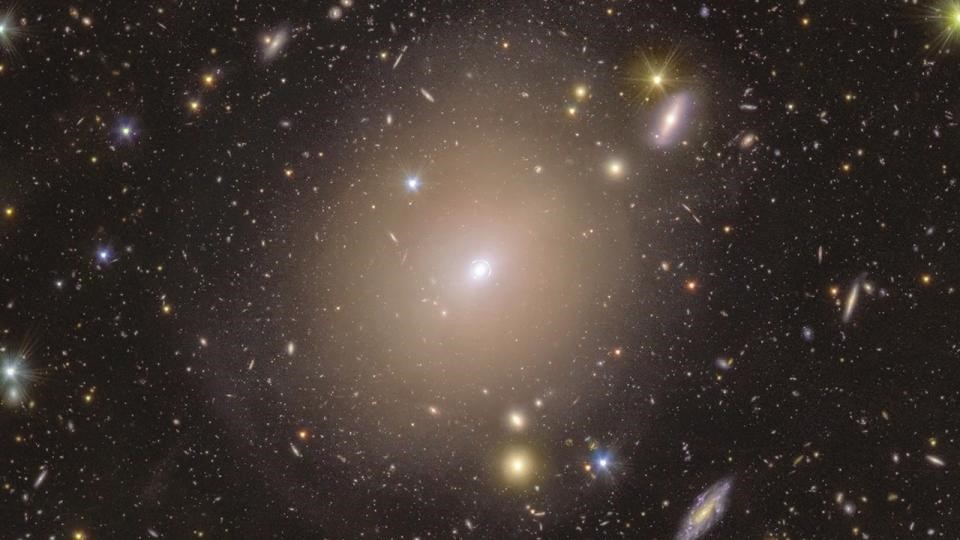
Figure 1.Image Of The Galaxy NGC 6505: The Einstein Ring Created By This Gravitational Lens Can Be Seen In The Center Of The Image.
The Euclid space telescope has unexpectedly discovered its first Einstein ring, and it’s remarkably beautiful. Besides its visual appeal, this perfectly circular ring has enabled scientists to measure the dark matter at the center of a galaxy nearly 600 million light-years away Figure 1 Image Of The Galaxy NGC 6505: The Einstein Ring Created By This Gravitational Lens Can Be Seen In The Center Of The Image.
The European Space Agency’s Euclid telescope, while preparing to study the universe’s evolution, unexpectedly discovered an Einstein ring. This ring surrounds the galaxy NGC 6505, located 590 million light-years away, and is actually the heavily distorted image of a more distant galaxy, 4.4 billion light-years from Earth. The light from the distant galaxy is bent by NGC 6505’s gravity, creating the ring effect known as strong gravitational lensing[1].
The phenomenon appears as a ring around the center of the elliptical galaxy NGC 6505, located about 590 million light-years from Earth
Euclid, a mission by the European Space Agency with contributions from NASA, has made an unexpected discovery: an Einstein ring in our cosmic neighborhood.
An Einstein ring occurs when light from a distant galaxy bends around a foreground object, forming a ring. This effect, predicted by Albert Einstein's general theory of relativity, happens because massive objects like galaxies or galaxy clusters act as cosmic lenses, magnifying even more distant objects—a phenomenon known as gravitational lensing.
Euclid Archive Scientist Bruno Altieri first noticed a hint of this ring in images from the spacecraft’s early testing phase in September 2023. “Even from that first observation, I could see it, but after Euclid made more observations of the area, we could see a perfect Einstein ring,” Altieri said. “For me, with a lifelong interest in gravitational lensing, that was amazing.”
The ring surrounds the center of NGC 6505, a well-studied elliptical galaxy about 590 million light-years away in the constellation Draco. Although this distance sounds vast, NGC 6505 is relatively close on a cosmic scale. Thanks to Euclid's high-resolution instruments, this is the first time the ring of light around the galaxy has been observed.
Light from a distant galaxy about 4.42 billion light-years away creates the Einstein ring observed by Euclid. As this light traveled toward Earth, its path was distorted by gravity. This distant galaxy is previously unobserved and remains unnamed.
Conor O’Riordan from the Max Planck Institute for Astrophysics, lead author of the first paper analyzing the ring, explained that an Einstein ring is a form of strong gravitational lensing, where the gravity of a foreground object bends light from a background source, creating multiple images or arcs that can form a ring[2]. “Strong lenses are rare and scientifically valuable. This one is especially unique because it’s so close to Earth and beautifully aligned,” he noted.
Einstein rings are valuable tools for exploring cosmic mysteries, including the study of dark matter, which contributes to the light-bending effect. They also provide insights into the universe's expansion, as the space between us and the galaxies involved is stretching. Additionally, they reveal details about the background galaxy itself.
Valeria Pettorino, ESA Euclid project scientist, expressed excitement about the discovery: “It’s fascinating that this ring was found around a well-known galaxy first identified in 1884. This shows Euclid’s incredible power to uncover new phenomena even in familiar regions. It’s a promising sign for the mission’s future and showcases Euclid’s remarkable capabilities.”
Euclid aims to uncover the secrets of gravity, dark energy, and dark matter by studying how the universe has expanded and evolved over time. Dark energy, the mysterious force driving the universe's accelerated expansion, is a key focus. To achieve this, Euclid will map over a third of the sky, observing billions of galaxies up to 10 billion light-years away and identifying around 100,000 strong gravitational lenses.
While discovering this Einstein ring is significant, Euclid's primary mission involves detecting a subtler form of gravitational lensing called “weak lensing,” where background galaxies appear slightly stretched or displaced. To study this effect and better understand dark energy, scientists will analyze billions of galaxies.
Euclid launched from Cape Canaveral on July 1, 2023, and began its detailed sky survey on February 14, 2024. It is gradually building the most extensive 3D map of the universe ever created. Discovering the Einstein ring early in its mission suggests that Euclid is poised to reveal many more cosmic mysteries.
Reference:
- https://www.jpl.nasa.gov/news/euclid-discovers-einstein-ring-in-our-cosmic-backyard/
- https://www.space.com/euclid-einstein-ring-dark-matter
Cite this article:
Keerthana S (2025),A spacecraft exploring cosmic evolution captures an 'Einstein ring, AnaTechMaz, pp. 205
Recent Post
-
James Webb Confirms Hubble's Calculation of the Universe's Expansion
In recent years, significant advancements in our...
-
NASA's Synthetic Universe: Bringing Roman's Vision to Life
Astronomers have unveiled over a million simulated images showcasing how NASA’s Nancy ...
-

The Era of The International Space Station Is Coming to A Close – Here's What NASA Has in Store Next
NASA has set its final goals and objectives for low Earth orbit (LEO), focusing on...
-
Could This Asteroid Be a Fragment of The Moon
“We suspected that this asteroid could have originated from...
-
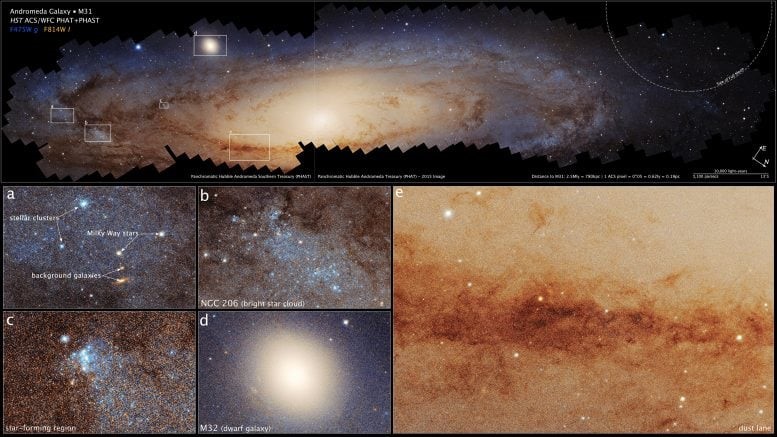
Hubble's Remarkable New Portrait of Andromeda: A 200 million-Star Tapestry
Since the launch of NASA’s Hubble Space Telescope...
-
From Fusion Propulsion to Lunar Glass Houses: NASA's Bold Vision For 2025
“Our next steps and giant leaps rely on innovation,...
-
Cosmic 'Ghost Towns': Three Small Galaxies Reveal Secrets of The Ancient Universe
Ultra-faint dwarf galaxies are some of the most elusive...
-
NASA Reveals a Secret Universe of Supermassive Black Holes
Despite their reputation for being completely dark—so...
-

Scientists are puzzled as Earth's core may be shifting its shape
Unusual seismic wave changes deep within the planet ...
-
A spacecraft exploring cosmic evolution captures an 'Einstein ring'
The object appears as a massively distorted image of a distant...
-
Australia's Cutting-Edge Technology Detects Mysterious Signals from Deep Space
Australia's innovative telescope technology, CRACO, is enabling...
-
Hydrogel Absorbs Cosmic Rays to Shield Space Travelers
Space is a hazardous environment. During spaceflight,...
-
Firefly's Blue Ghost Captures a Stunning Selfie of Earth During Its Journey to the Moon
Firefly Aerospace's Blue Ghost lunar lander is en route to the Moon and recently captured...
-
A Mysterious Signal Illuminates a Dead Galaxy, Leaving Astronomers Puzzled
Researchers propose that it might originate from an ...
-
Around 4,000 Supernovae Could Potentially Alter Our Entire Understanding of Dark Energy
The Palomar 48-inch telescope at the Palomar Observatory in California, with the Milky ...