

From Fusion Propulsion to Lunar Glass Houses: NASA's Bold Vision For 2025
Exploring the Future of Space Missions
“Our next steps and giant leaps rely on innovation, and the concepts born from NIAC can radically change how we explore deep space, work in low Earth orbit, and protect our home planet,” said Clayton Turner, associate administrator for NASA’s Space Technology Mission Directorate. “From developing small robots that could swim through the oceans of other worlds to growing space habitats from fungi, this program continues to push the boundaries of possibility.”
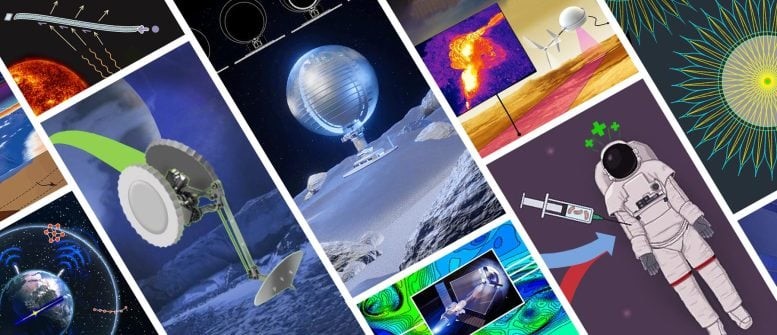
Figure 1. NASA's Vision for 2025: From Fusion Propulsion to Lunar Glass Habitats.
The newly selected concepts include feasibility studies to explore the Sun’s influence on our solar system, build sustainable lunar habitats from glass, explore Saturn’s icy moon, and more. All NIAC studies are in the early stages of conceptual development and are not considered official NASA missions. Figure 1 shows NASA's Vision for 2025: From Fusion Propulsion to Lunar Glass Habitats.
Groundbreaking Technologies from Visionary Scientists
Ryan Weed, Helicity Space LLC in Pasadena, California, proposes a constellation of spacecraft powered by the Helicity Drive, a compact and scalable fusion propulsion system. This technology could enable rapid, multidirectional exploration of the heliosphere and beyond, providing unprecedented insights on how the Sun interacts with our solar system and interstellar space. Demonstrating the feasibility of fusion propulsion could also benefit deep space exploration, including crewed missions to Mars.
Martin Bermudez, Skyeports LLC in Sacramento, California, presents the concept of constructing a large-scale lunar glass habitat in a low-gravity environment. This concept, called LUNGS (Lunar Glass Structure), involves melting lunar glass compounds to create a large spherical shell structure, offering a promising solution for establishing self-sustaining, large-scale habitats on the lunar surface.
Justin Yim, University of Illinois in Urbana, proposes a jumping robot named LEAP (Legged Exploration Across the Plume) to explore Enceladus, a small, icy moon of Saturn covered in geysers. LEAP robots could collect pristine, ocean-derived material directly from Enceladus’ jets and measure particle properties across multiple jets by traveling between them.
“All advancements begin as an idea. The NIAC program allows NASA to invest in unique ideas, fostering innovation and supporting the nation's aerospace economy,” said John Nelson, program executive for NASA’s Innovative Advanced Concepts.
Meet the 2025 NIAC Fellows
The NIAC researchers, known as fellows, will investigate the fundamental premise of their concepts, identify potential challenges, and seek opportunities to bring these concepts to life.
In addition to the projects mentioned above, the following selectees received 2025 NIAC Phase I grants:
NASA’s Space Technology Mission Directorate funds the NIAC program, responsible for developing the agency’s new cross-cutting technologies and capabilities to achieve its current and future missions.
Pioneering Fusion Propulsion: A New Era of Space Exploration
NASA is exploring the development of fusion propulsion systems, such as the Helicity Drive, which could revolutionize space travel. Aimed at powering spacecraft with compact and scalable fusion reactors, this technology promises to enable rapid, multidirectional exploration of the solar system and beyond. The Helicity Drive could also play a critical role in deep space missions, including crewed missions to Mars, allowing for more efficient travel across vast distances and potentially unlocking new ways of studying the Sun’s influence on our solar system.
Lunar Glass Habitats: Sustainable Living on the Moon
One of the most innovative proposals being explored is the construction of lunar habitats using lunar glass. The concept, known as LUNGS (Lunar Glass Structure), involves using the Moon’s natural glass compounds to create large, spherical shells that would serve as self-sustaining living spaces for astronauts. By melting lunar glass in the Moon’s low-gravity environment, these habitats could be designed to withstand the harsh conditions of the lunar surface, offering a promising solution for long-term lunar exploration and colonization.
Robotic Exploration of Enceladus: Jumping into the Unknown
Justin Yim from the University of Illinois proposes a revolutionary robotic exploration mission to Saturn’s icy moon, Enceladus. His concept involves LEAP (Legged Exploration Across the Plume), a jumping robot capable of navigating Enceladus' geysers to collect pristine, ocean-derived material. These robots would be able to gather critical information about the moon’s subsurface oceans and measure the properties of particles spewed from its geysers, providing valuable data on the potential habitability of other moons in our solar system.
Pushing Boundaries with NIAC’s Visionary Fellows
The NASA Innovative Advanced Concepts (NIAC) program supports visionary researchers who aim to transform the future of space exploration. These fellows explore groundbreaking ideas that could address the challenges of deep space exploration. In addition to fusion propulsion and lunar glass habitats, other notable proposals include space-based quantum gravity measurements, hybrid hydrogen-powered aviation systems, and even inflatable starshades to detect Earth-like exoplanets. Through this program, NASA fosters creative solutions to push the boundaries of what is possible.
The Path to NASA’s Future: Collaboration and Innovation
NASA's vision for 2025 relies on collaboration across various research institutions, private companies, and its own mission directorates. With funding from the Space Technology Mission Directorate, the NIAC program is an incubator for next-generation technologies that will shape the future of space exploration. By investing in novel ideas like robotic exploration of distant moons and fusion-powered propulsion, NASA aims to make significant strides toward understanding the cosmos and creating sustainable living environments beyond Earth. These technologies will not only expand our knowledge of space but also support humanity’s future in the universe.
Source: SciTECHDaily
Cite this article:
Priyadharshini S (2025), "From Fusion Propulsion to Lunar Glass Houses: NASA's Bold Vision For 2025", AnaTechMaz, pp. 201
Recent Post
-
James Webb Confirms Hubble's Calculation of the Universe's Expansion
In recent years, significant advancements in our...
-

NASA's Synthetic Universe: Bringing Roman's Vision to Life
Astronomers have unveiled over a million simulated images showcasing how NASA’s Nancy ...
-
The Era of The International Space Station Is Coming to A Close – Here's What NASA Has in Store Next
NASA has set its final goals and objectives for low Earth orbit (LEO), focusing on...
-
Could This Asteroid Be a Fragment of The Moon
“We suspected that this asteroid could have originated from...
-
Hubble's Remarkable New Portrait of Andromeda: A 200 million-Star Tapestry
Since the launch of NASA’s Hubble Space Telescope...
-
From Fusion Propulsion to Lunar Glass Houses: NASA's Bold Vision For 2025
“Our next steps and giant leaps rely on innovation,...
-
Cosmic 'Ghost Towns': Three Small Galaxies Reveal Secrets of The Ancient Universe
Ultra-faint dwarf galaxies are some of the most elusive...
-
NASA Reveals a Secret Universe of Supermassive Black Holes
Despite their reputation for being completely dark—so...
-

Scientists are puzzled as Earth's core may be shifting its shape
Unusual seismic wave changes deep within the planet ...
-
A spacecraft exploring cosmic evolution captures an 'Einstein ring'
The object appears as a massively distorted image of a distant...
-
Australia's Cutting-Edge Technology Detects Mysterious Signals from Deep Space
Australia's innovative telescope technology, CRACO, is enabling...
-
Hydrogel Absorbs Cosmic Rays to Shield Space Travelers
Space is a hazardous environment. During spaceflight,...
-
Firefly's Blue Ghost Captures a Stunning Selfie of Earth During Its Journey to the Moon
Firefly Aerospace's Blue Ghost lunar lander is en route to the Moon and recently captured...
-
A Mysterious Signal Illuminates a Dead Galaxy, Leaving Astronomers Puzzled
Researchers propose that it might originate from an ...
-
Around 4,000 Supernovae Could Potentially Alter Our Entire Understanding of Dark Energy
The Palomar 48-inch telescope at the Palomar Observatory in California, with the Milky ...