

Hubble's Remarkable New Portrait of Andromeda: A 200 million-Star Tapestry
Andromeda: A Galactic Neighbor of Remarkable Importance
Since the launch of NASA’s Hubble Space Telescope, astronomers have cataloged over a trillion galaxies throughout the universe. Yet, one galaxy stands out as our Milky Way’s closest and most significant neighbor — the Andromeda galaxy. On crisp autumn nights, it appears as a faint, oval-shaped smudge in the sky, about the size of the moon when observed with the naked eye.
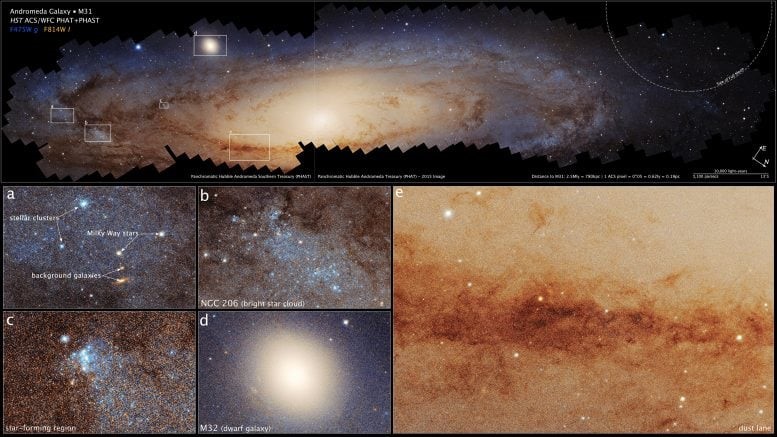
Figure 1. Hubble's Stunning New Portrait of Andromeda: A Tapestry of 200 million Stars.
Around a century ago, astronomer Edwin Hubble revealed that what was once considered a “spiral nebula” was actually a distinct galaxy, positioned roughly 2.5 million light-years away from our own Milky Way. Figure 1 shows Hubble's Stunning New Portrait of Andromeda: A Tapestry of 200 million Stars.
Visualizing a Galactic Giant
Without Andromeda to study as an example of a spiral galaxy, astronomers would have a far more limited understanding of the structure and evolution of our own Milky Way. This is because Earth resides within the Milky Way, much like trying to grasp the layout of New York City from the middle of Central Park.
“With Hubble, we can delve into enormous detail about what's happening on a grand scale across the entire disk of the galaxy. No other large galaxy offers this level of insight,” said principal investigator Benjamin Williams, a research associate professor of astronomy at the University of Washington.
Hubble’s exceptional imaging capabilities allow it to resolve over 200 million stars in the Andromeda galaxy, detecting only those brighter than our Sun. These stars appear as grains of sand scattered across a vast beach. However, the telescope cannot capture everything—Andromeda’s total population is estimated to be 1 trillion stars, with many smaller, dimmer stars falling below Hubble’s detection limit.
A Decade-Long Galactic Exploration
Capturing an image of Andromeda was an immense challenge due to its size in the sky, far larger than the galaxies Hubble usually observes, many of which are billions of light-years away. This full mosaic was conducted over two Hubble programs, requiring more than 1,000 Hubble orbits over a span of a decade.
The project began with the Panchromatic Hubble Andromeda Treasury program, which obtained images across near-ultraviolet, visible, and near-infrared wavelengths, focusing on the northern half of Andromeda.
Completing the Galactic Portrait
This effort was followed by the newly published Panchromatic Hubble Andromeda Southern Treasury, which added images of about 100 million stars in the southern half of the galaxy. This southern region, being structurally unique, offers deeper insights into Andromeda’s merger history, compared to the northern disk already mapped.
Together, the two programs cover the entire disk of Andromeda, which is seen almost edge-on, tilted by 77 degrees relative to our view from Earth. The galaxy’s immense size meant that the mosaic was composed of around 600 separate fields of view, resulting in an image with at least 2.5 billion pixels.
Andromeda’s Asymmetrical Mysteries
“The asymmetry between the two halves, now clearly visible in this image, is incredibly intriguing,” said Zhuo Chen, a postdoctoral researcher in astronomy at the University of Washington and lead author of the accompanying paper. “It’s fascinating to see the detailed structures of an external spiral galaxy mapped across such a vast area.”
The complementary Hubble survey programs provide valuable data on the age, heavy-element abundance, and stellar masses within Andromeda. These observations will help astronomers understand whether Andromeda merged with one or more galaxies in the past. Hubble’s precise measurements offer a clearer view of Andromeda’s merger history and disk evolution.
“This ambitious photography of the Andromeda galaxy sets a new standard for detailed studies of large spiral galaxies,” said Chen.
Diverse Histories of Neighbor Galaxies
While both the Milky Way and Andromeda likely formed around the same time billions of years ago, evidence shows that they have followed very different evolutionary paths, despite being neighbors in the cosmos. Andromeda appears to have a higher population of younger stars and features such as coherent streams of stars, indicating more active recent star formation and interactions compared to the Milky Way.
“This detailed examination of resolved stars will help us reconstruct Andromeda’s past mergers and interactions,” Williams said.
Source: SciTECHDaily
Cite this article:
Priyadharshini S (2025), "Hubble's Remarkable New Portrait of Andromeda: A 200 million-Star Tapestry",AnaTechMaz, pp. 200
Recent Post
-
James Webb Confirms Hubble's Calculation of the Universe's Expansion
In recent years, significant advancements in our...
-
NASA's Synthetic Universe: Bringing Roman's Vision to Life
Astronomers have unveiled over a million simulated images showcasing how NASA’s Nancy ...
-
The Era of The International Space Station Is Coming to A Close – Here's What NASA Has in Store Next
NASA has set its final goals and objectives for low Earth orbit (LEO), focusing on...
-
Could This Asteroid Be a Fragment of The Moon
“We suspected that this asteroid could have originated from...
-
Hubble's Remarkable New Portrait of Andromeda: A 200 million-Star Tapestry
Since the launch of NASA’s Hubble Space Telescope...
-
From Fusion Propulsion to Lunar Glass Houses: NASA's Bold Vision For 2025
“Our next steps and giant leaps rely on innovation,...
-
Cosmic 'Ghost Towns': Three Small Galaxies Reveal Secrets of The Ancient Universe
Ultra-faint dwarf galaxies are some of the most elusive...
-
NASA Reveals a Secret Universe of Supermassive Black Holes
Despite their reputation for being completely dark—so...
-

Scientists are puzzled as Earth's core may be shifting its shape
Unusual seismic wave changes deep within the planet ...
-
A spacecraft exploring cosmic evolution captures an 'Einstein ring'
The object appears as a massively distorted image of a distant...
-
Australia's Cutting-Edge Technology Detects Mysterious Signals from Deep Space
Australia's innovative telescope technology, CRACO, is enabling...
-
Hydrogel Absorbs Cosmic Rays to Shield Space Travelers
Space is a hazardous environment. During spaceflight,...
-
Firefly's Blue Ghost Captures a Stunning Selfie of Earth During Its Journey to the Moon
Firefly Aerospace's Blue Ghost lunar lander is en route to the Moon and recently captured...
-
A Mysterious Signal Illuminates a Dead Galaxy, Leaving Astronomers Puzzled
Researchers propose that it might originate from an ...
-
Around 4,000 Supernovae Could Potentially Alter Our Entire Understanding of Dark Energy
The Palomar 48-inch telescope at the Palomar Observatory in California, with the Milky ...