

Quantum Dots May Revolutionize Night Vision Technology
Infrared Imaging at a Crossroads: Balancing Performance and Toxic Metal Restrictions
Infrared camera makers are increasingly challenged by environmental regulations that limit the use of toxic heavy metals in detectors. This leaves manufacturers navigating a difficult trade-off between achieving high performance and adhering to compliance standards.

Figure 1. Quantum Dots Set to Transform Night Vision.
Stricter regulations have slowed the adoption of infrared technology in civilian markets, despite growing demand in self-driving cars, medical imaging, and national security. Figure 1 shows Quantum Dots Set to Transform Night Vision.
Now, researchers at NYU Tandon School of Engineering have proposed a promising solution. In a study published in ACS Applied Materials & Interfaces, they demonstrate that environmentally friendly quantum dots can replace mercury, lead, and other restricted substances, enabling infrared detection without harmful materials.
Blazing-Fast Infrared Detection with Quantum Dots
The new quantum-dot-based devices deliver impressive performance: they detect infrared light on the microsecond scale—hundreds of times faster than a human blink—and can sense signals as faint as a nanowatt.
Transparent Electrodes Complete the System
This research builds on previous work by the team developing transparent electrodes from silver nanowires. These electrodes allow infrared light to pass through while efficiently collecting electrical signals, solving a key part of the infrared camera system.
Together, the quantum dots and transparent electrodes provide an environmentally friendly solution for both sensing and signal collection in infrared imaging systems.
Towards Large-Scale Infrared Arrays
The combination is especially promising for large-area infrared imaging arrays, which need high-performance detection across millions of pixels. Transparent electrodes let light reach the quantum-dot detectors while enabling efficient signal extraction.
As Sahu explains, “Every infrared camera in a Tesla or smartphone needs detectors that meet environmental standards while remaining cost-effective. Our approach could make these technologies far more accessible.”
While the performance of these devices still lags behind top heavy-metal-based detectors in some aspects, ongoing improvements in quantum dot synthesis and device engineering are expected to narrow the gap.
The Challenge with Traditional Infrared Detectors
Current infrared cameras rely on materials like mercury and lead, which are highly effective but toxic. Environmental regulations are increasingly restricting these substances, creating a trade-off for manufacturers: maintain high performance or comply with safety standards. This has slowed the adoption of infrared technology in civilian markets such as self-driving vehicles, medical imaging, and national security.
Quantum Dots Offer a Safer Alternative
Researchers at NYU Tandon School of Engineering have developed quantum-dot-based detectors that can sense infrared light without toxic metals. Combined with transparent electrodes for efficient signal collection, these devices provide fast, sensitive, and environmentally friendly infrared detection. This innovation could pave the way for large-scale, cost-effective infrared imaging in everyday technologies while meeting strict environmental standards.
Source: SciTECHDaily
Cite this article:
Priyadharshini S (2025), Quantum Dots May Revolutionize Night Vision Technology, AnaTechMaz, pp.375
Recent Post
-

Existing Internet Cables Successfully Support Quantum Networks
Quantum networking may be closer to practical use thanks to engineers...
-

Quantum Computer Assembled Like LEGO Bricks by Scientists
Building on this idea, researchers at The Grainger College of Engineering, University of Illinois ....
-

Scientists Unveil a Brand-New State of Quantum Matter
The phase was first observed in a material created at UC Irvine by postdoctoral researcher and...
-

El Salvador Moves $678M in Bitcoin to Counter Quantum Computing Risk
El Salvador’s Bitcoin Office moved its 6,274 Bitcoin, worth $678 million,....
-

Quantinuum Teams with Sanger Institute to Encode Genome on Quantum Computer
The Wellcome Sanger Institute has teamed up with Quantinuum,...
-

IBM and AMD Team Up to Build Next-Gen Quantum Supercomputing Infrastructure
IBM and AMD have joined forces to create next-generation...
-

AQT-Led QCDC Project Provides Europe Cloud Access to Quantum Computers
Led by Juris Ulmanis, QCDC Project Leader and Director...
-

Quantum Breakthrough: Physicists Solve 15-Year-Old, 5-Atom Mystery
At the quantum scale, matter behaves in unusual ways, with the Efimov effect being one of the most...
-
Quantum Computers Simulate Black Holes to Explore Cosmic Mysteries
A team of four researchers at RIKEN has successfully used two....
-
World’s First Programmable Photonic Waveguide Offers New Flexibility for Quantum Light
In a major breakthrough for photonics, researchers have developed the ...
-
Physicists Discover a Method to Unravel Quantum Mysteries Without Using Supercomputers
Researchers at the University at Buffalo have made a major leap in...
-
New Laser-Based Quantum Radio Can Receive Signals Without Electricity or Antennas
Physicists at the University of Warsaw have created the world’s first...
-

New Spin on a Classic Material May Boost Quantum Computing and Slash Data Center Energy Use
Researchers in the United States have demonstrated that an innovative ...
-
Quantum Dots May Revolutionize Night Vision Technology
Infrared camera makers are increasingly challenged by environmental regulations that ...
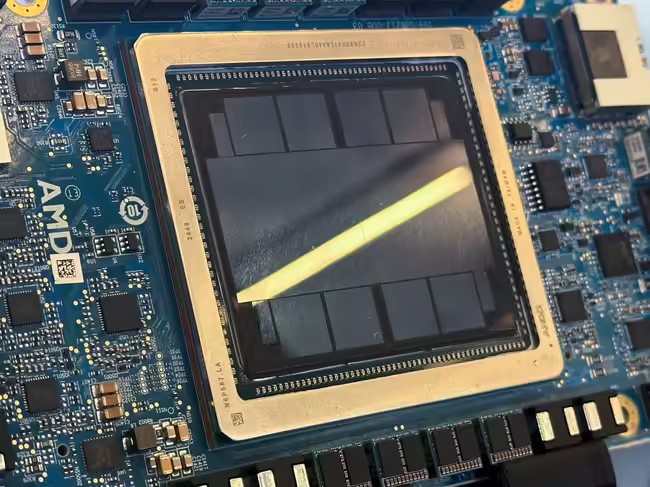
IBM Says Major Quantum Error-Correction Algorithm Now Runs on Standard AMD Processors
IBM announced on Friday that it has successfully run a crucial....