

Existing Internet Cables Successfully Support Quantum Networks
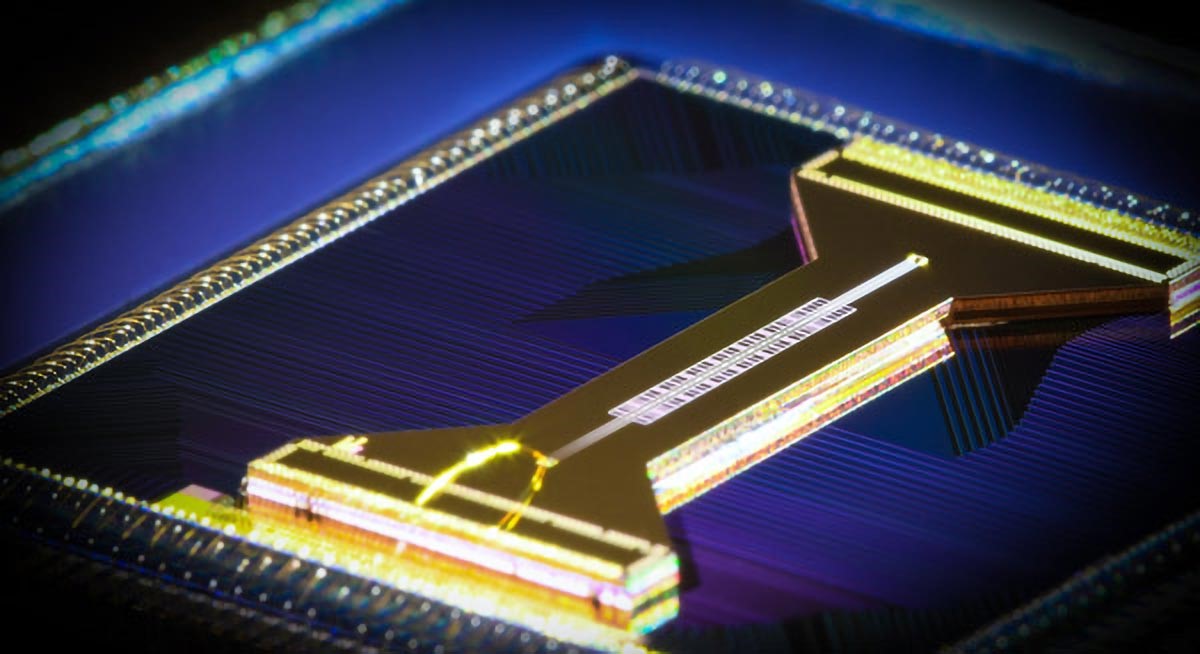
Quantum networking may be closer to practical use thanks to engineers at the University of Pennsylvania, who have developed a “Q-chip” capable of transmitting quantum data over existing internet networks.

Figure 1. Quantum Networks Achieved Over Existing Internet Cables.
The team hopes this breakthrough will pave the way for a future “quantum internet” with transformative potential. Figure 1 shows Quantum Networks Achieved Over Existing Internet Cables.
“This is reminiscent of the early days of the classical internet in the 1990s, when universities first connected their networks,” says Robert Broberg, a doctoral student in electrical and systems engineering at Penn and coauthor of the study.
“That connectivity led to transformations no one could have imagined. A quantum internet could have a similar impact.”
Quantum networks function through pairs of entangled particles, where altering one particle instantly affects the other. By harnessing this property, researchers aim to link quantum computers and combine their processing power.
Yet the very nature of quantum entanglement makes building these networks extremely challenging. As Erwin Schrödinger discovered, quantum particles lose their quantum properties when observed, making network calibration a nearly impossible task.
“Conventional networks rely on measuring data to guide it to its destination,” explains Broberg. “In purely quantum networks, you can’t do that, because measuring the particles destroys their quantum state.”
Despite this hurdle, the Penn team demonstrated that their Q-chip can transmit quantum signals over live commercial fiber. They achieved this by coordinating quantum signals with classical signals from ordinary light particles.
“The classical signal moves slightly ahead of the quantum signal,” explains Yichi Zhang, the study’s lead author and a member of Penn’s Materials Science and Engineering faculty.
“The classical ‘header’ works like a train’s engine, with the quantum information following behind in sealed containers,” says Zhang.
“You can’t open the containers without destroying their contents, but the engine ensures the entire train reaches its destination safely.”
The team’s design can automatically correct for noise while transmitting quantum signals using the same addressing and management tools as classical data. This means an entire quantum network could operate on the familiar Internet Protocol (IP) that underpins today’s online world.
“By demonstrating that an integrated chip can manage quantum signals on a live commercial network like Verizon’s—while using the same protocols that run the classical internet—we’ve taken an important step toward large-scale experiments and a practical quantum internet,” says Liang Feng, senior author of the study and MSE professor.
Unlike controlled laboratory setups, commercial optical fibers are exposed to environmental factors such as temperature fluctuations, seismic activity, and vibrations from construction and transportation. To overcome this, the researchers developed an error-correction approach that leverages the classical signals sent just ahead of the quantum ones. Their tests showed the system maintained an inferred accuracy above 97%.
“Because we can measure the classical signal without disturbing the quantum one, we can determine what corrections are needed without directly measuring the quantum state—thus preserving it,” Feng explains.
While the signals cannot be amplified without disrupting quantum entanglement, the team believes that the chip’s silicon-based design will allow for scalable, low-cost production, laying the groundwork for broader quantum networks.
Source: COSMOS
Cite this article:
Priyadharshini S (2025), Existing Internet Cables Successfully Support Quantum Networks, AnaTechMaz, pp.361
Recent Post
-
Existing Internet Cables Successfully Support Quantum Networks
Quantum networking may be closer to practical use thanks to engineers...
-

Quantum Computer Assembled Like LEGO Bricks by Scientists
Building on this idea, researchers at The Grainger College of Engineering, University of Illinois ....
-

Scientists Unveil a Brand-New State of Quantum Matter
The phase was first observed in a material created at UC Irvine by postdoctoral researcher and...
-

El Salvador Moves $678M in Bitcoin to Counter Quantum Computing Risk
El Salvador’s Bitcoin Office moved its 6,274 Bitcoin, worth $678 million,....
-

Quantinuum Teams with Sanger Institute to Encode Genome on Quantum Computer
The Wellcome Sanger Institute has teamed up with Quantinuum,...
-

IBM and AMD Team Up to Build Next-Gen Quantum Supercomputing Infrastructure
IBM and AMD have joined forces to create next-generation...
-

AQT-Led QCDC Project Provides Europe Cloud Access to Quantum Computers
Led by Juris Ulmanis, QCDC Project Leader and Director...
-

Quantum Breakthrough: Physicists Solve 15-Year-Old, 5-Atom Mystery
At the quantum scale, matter behaves in unusual ways, with the Efimov effect being one of the most...
-
Quantum Computers Simulate Black Holes to Explore Cosmic Mysteries
A team of four researchers at RIKEN has successfully used two....
-
World’s First Programmable Photonic Waveguide Offers New Flexibility for Quantum Light
In a major breakthrough for photonics, researchers have developed the ...
-
Physicists Discover a Method to Unravel Quantum Mysteries Without Using Supercomputers
Researchers at the University at Buffalo have made a major leap in...
-
New Laser-Based Quantum Radio Can Receive Signals Without Electricity or Antennas
Physicists at the University of Warsaw have created the world’s first...
-

New Spin on a Classic Material May Boost Quantum Computing and Slash Data Center Energy Use
Researchers in the United States have demonstrated that an innovative ...
-

Quantum Dots May Revolutionize Night Vision Technology
Infrared camera makers are increasingly challenged by environmental regulations that ...
IBM Says Major Quantum Error-Correction Algorithm Now Runs on Standard AMD Processors
IBM announced on Friday that it has successfully run a crucial....