

New Spin on a Classic Material May Boost Quantum Computing and Slash Data Center Energy Use
Researchers in the United States have demonstrated that an innovative twist on a well-known material could significantly advance quantum computing while making modern data centers far more energy efficient.A team from Penn State University revisited barium titanate, a material first discovered in 1941 and celebrated for its exceptional electro-optic properties in bulk crystal form.
“It has one of the largest electro-optic coefficients known at room temperature,” explained Venkat Gopalan, professor of materials science and engineering and co-author of the study. “But it never transitioned into commercial use. What we’ve shown is that by straining this classic material in just the right way, it can achieve entirely new capabilities.”

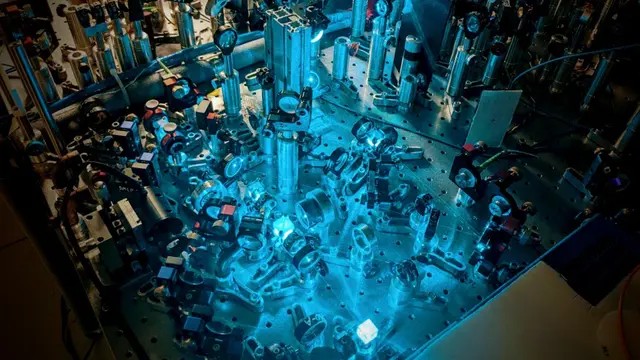
Figure 1. Slash Data Center Energy Use.
Turning a Classic Material into a Modern Breakthrough
Electro-optic materials like barium titanate serve as bridges between electricity and light, converting electrical signals (carried by electrons) into optical signals (carried by photons). While its potential has been known for decades, barium titanate was largely sidelined by lithium niobate, a more stable and easily fabricated—though less capable—alternative. Figure 1 shows Slash Data Center Energy Use.
Now, by reshaping barium titanate into ultrathin, strained films, the Penn State team has unlocked a dramatic improvement: the material can convert electron-based signals into light-based ones over ten times more efficiently than previous designs, even at cryogenic temperatures.
From Quantum Circuits to Greener Data Centers
This enhanced conversion efficiency could be crucial for quantum computing, where information from superconducting circuits—operating at extremely low temperatures—must eventually be converted into light to travel between distant quantum systems through optical fibers, forming the backbone of future quantum networks.
But the implications go far beyond quantum technologies. The same process could revolutionize data centers, which power everything from AI models to cloud services and currently consume enormous amounts of electricity—much of it just to stay cool.
By enabling photon-based communication inside data centers, the technology could drastically cut heat generation and energy use. “Photons carry information without generating heat like electrons do,” noted the researchers. “That makes them far more energy efficient for large-scale data processing.”
Aiden Ross, co-lead author and graduate research assistant at Penn State, emphasized the broader vision: “Integrated photonic technologies are becoming increasingly attractive for companies running massive data centers, especially as AI adoption accelerates. Using photons instead of electrons would let us transmit many data streams simultaneously—without the immense cooling infrastructure today’s centers require.”
This fresh approach to an 80-year-old material, researchers say, may bridge the gap between quantum innovation and sustainable computing, reshaping the technological foundations of tomorrow’s connected world.
Reference:
- https://interestingengineering.com/science/twist-on-classic-material-advance-quantum-computing
Cite this article:
Keerthana S (2025), New Spin on a Classic Material May Boost Quantum Computing and Slash Data Center Energy Use, AnaTechMaz, pp.373
Recent Post
-

Existing Internet Cables Successfully Support Quantum Networks
Quantum networking may be closer to practical use thanks to engineers...
-

Quantum Computer Assembled Like LEGO Bricks by Scientists
Building on this idea, researchers at The Grainger College of Engineering, University of Illinois ....
-

Scientists Unveil a Brand-New State of Quantum Matter
The phase was first observed in a material created at UC Irvine by postdoctoral researcher and...
-

El Salvador Moves $678M in Bitcoin to Counter Quantum Computing Risk
El Salvador’s Bitcoin Office moved its 6,274 Bitcoin, worth $678 million,....
-

Quantinuum Teams with Sanger Institute to Encode Genome on Quantum Computer
The Wellcome Sanger Institute has teamed up with Quantinuum,...
-

IBM and AMD Team Up to Build Next-Gen Quantum Supercomputing Infrastructure
IBM and AMD have joined forces to create next-generation...
-
AQT-Led QCDC Project Provides Europe Cloud Access to Quantum Computers
Led by Juris Ulmanis, QCDC Project Leader and Director...
-

Quantum Breakthrough: Physicists Solve 15-Year-Old, 5-Atom Mystery
At the quantum scale, matter behaves in unusual ways, with the Efimov effect being one of the most...
-
Quantum Computers Simulate Black Holes to Explore Cosmic Mysteries
A team of four researchers at RIKEN has successfully used two....
-
World’s First Programmable Photonic Waveguide Offers New Flexibility for Quantum Light
In a major breakthrough for photonics, researchers have developed the ...
-
Physicists Discover a Method to Unravel Quantum Mysteries Without Using Supercomputers
Researchers at the University at Buffalo have made a major leap in...
-
New Laser-Based Quantum Radio Can Receive Signals Without Electricity or Antennas
Physicists at the University of Warsaw have created the world’s first...
-
New Spin on a Classic Material May Boost Quantum Computing and Slash Data Center Energy Use
Researchers in the United States have demonstrated that an innovative ...
-

Quantum Dots May Revolutionize Night Vision Technology
Infrared camera makers are increasingly challenged by environmental regulations that ...
IBM Says Major Quantum Error-Correction Algorithm Now Runs on Standard AMD Processors
IBM announced on Friday that it has successfully run a crucial....