

Quantum Computers Simulate Black Holes to Explore Cosmic Mysteries
Quantum computers and traditional computers are becoming closer in their capacity to simulate the scrambling of quantum information.
A team of four researchers at RIKEN has successfully used two small quantum computers to simulate quantum information scrambling, a fundamental process in quantum information science. This achievement demonstrates one of the practical applications that emerging quantum computers could offer. While still in the early stages, quantum computing is beginning to show real-world potential and is expected to revolutionize computing as the technology matures.
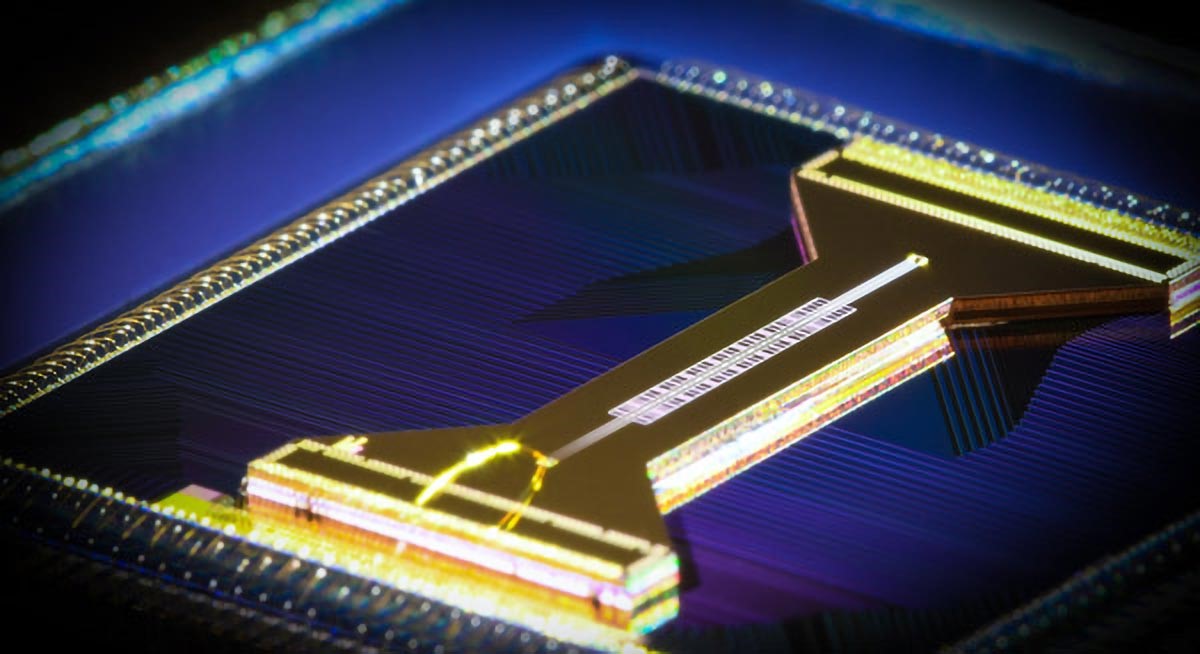
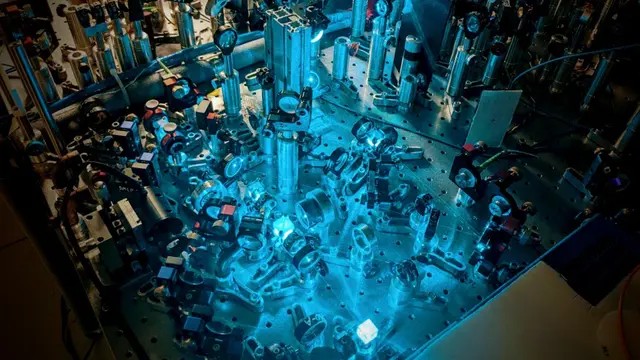
Figure 1. Trapped-ion quantum computer used for simulating quantum-information scrambling.
Modeling Quantum Information Scrambling
A key potential application of quantum computers is modeling the scrambling of quantum information—a process in which information spreads throughout a quantum system, from exotic materials like strange metals to extreme environments like black holes. Initially localized, the information gradually disperses through interactions until it permeates the entire system [1]. While the information remains in principle, reconstructing it becomes extremely challenging, requiring access to the full system. Black holes exemplify this phenomenon, acting as the ultimate scramblers of quantum information. Figure 1 shows Trapped-ion quantum computer used for simulating quantum-information scrambling.
Understanding quantum-information scrambling is crucial for addressing some of the deepest questions in quantum physics.
“Quantum-information scrambling interests us because it allows for additional calculations, like those in statistical physics,” explains Kazuhiro Seki of the RIKEN Center for Quantum Computing (RQC).
Simulating this scrambling is one effective approach, and quantum computers are particularly well-suited for these simulations compared to traditional computers.
Simulations on 20-Qubit Quantum Computers
Seki, Seiji Yunoki, and two colleagues at RIKEN used two 20-qubit quantum computers to simulate quantum-information scrambling circuits. These qubits, formed from trapped ions, were accessed via cloud-based state-of-the-art systems.
The team ran three simulations, including generating scrambled states and performing quantum statistical mechanical calculations [1]. While conventional computers could handle these simulations, the complexity is nearing the point where quantum computers become essential.
“We used only 20 qubits for this study,” Yunoki explains. “With more than 50 qubits, similar calculations could exceed the capacity of classical computers.” A 20-qubit trapped-ion quantum computer was installed at RIKEN in February 2025, with plans to expand it to around 50 qubits in the coming years.
References:
- https://scitechdaily.com/quantum-computers-mimic-black-holes-to-probe-cosmic-secrets/
Cite this article:
Janani R (2025), Quantum Computers Simulate Black Holes to Explore Cosmic Mysteries, AnaTechMaz, pp.369
Recent Post
-

Existing Internet Cables Successfully Support Quantum Networks
Quantum networking may be closer to practical use thanks to engineers...
-

Quantum Computer Assembled Like LEGO Bricks by Scientists
Building on this idea, researchers at The Grainger College of Engineering, University of Illinois ....
-
Scientists Unveil a Brand-New State of Quantum Matter
The phase was first observed in a material created at UC Irvine by postdoctoral researcher and...
-

El Salvador Moves $678M in Bitcoin to Counter Quantum Computing Risk
El Salvador’s Bitcoin Office moved its 6,274 Bitcoin, worth $678 million,....
-

Quantinuum Teams with Sanger Institute to Encode Genome on Quantum Computer
The Wellcome Sanger Institute has teamed up with Quantinuum,...
-

IBM and AMD Team Up to Build Next-Gen Quantum Supercomputing Infrastructure
IBM and AMD have joined forces to create next-generation...
-
AQT-Led QCDC Project Provides Europe Cloud Access to Quantum Computers
Led by Juris Ulmanis, QCDC Project Leader and Director...
-

Quantum Breakthrough: Physicists Solve 15-Year-Old, 5-Atom Mystery
At the quantum scale, matter behaves in unusual ways, with the Efimov effect being one of the most...
-
Quantum Computers Simulate Black Holes to Explore Cosmic Mysteries
A team of four researchers at RIKEN has successfully used two....
-
World’s First Programmable Photonic Waveguide Offers New Flexibility for Quantum Light
In a major breakthrough for photonics, researchers have developed the ...
-
Physicists Discover a Method to Unravel Quantum Mysteries Without Using Supercomputers
Researchers at the University at Buffalo have made a major leap in...
-
New Laser-Based Quantum Radio Can Receive Signals Without Electricity or Antennas
Physicists at the University of Warsaw have created the world’s first...
-

New Spin on a Classic Material May Boost Quantum Computing and Slash Data Center Energy Use
Researchers in the United States have demonstrated that an innovative ...
-

Quantum Dots May Revolutionize Night Vision Technology
Infrared camera makers are increasingly challenged by environmental regulations that ...
IBM Says Major Quantum Error-Correction Algorithm Now Runs on Standard AMD Processors
IBM announced on Friday that it has successfully run a crucial....