

Tiny Diamonds, Major Breakthrough: Laser-Free Quantum Spin Detection
Researchers at HZB have created an innovative method to detect quantum spin states in diamonds by using electrical signals rather than light, potentially simplifying quantum sensors and computing devices.
Diamonds with special optically active defects called color centers can function as sensitive sensors or quantum bits by storing information in their electron spins. Traditionally, detecting these spin states relies on complex optical techniques. Researchers at HZB have now introduced a simpler method that uses photovoltage to read the spin states of individual defects, potentially enabling much smaller and more compact quantum sensors.
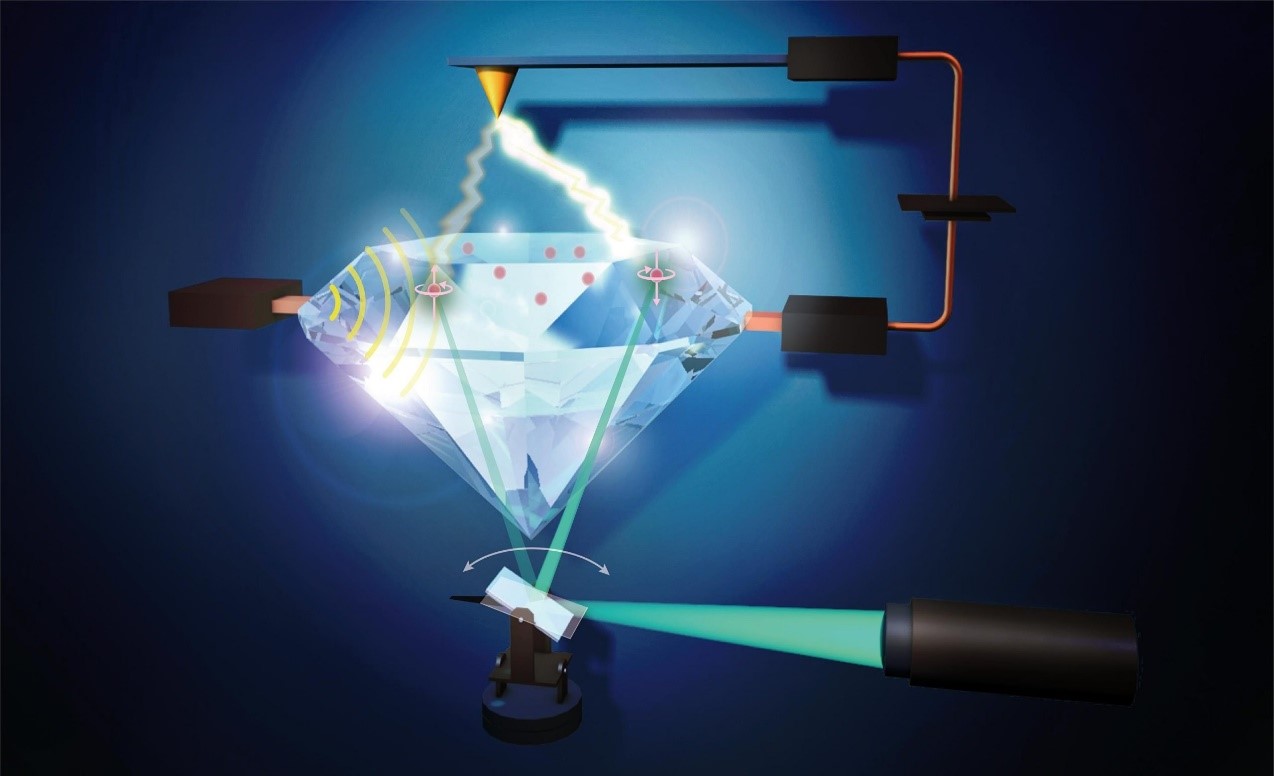
Figure 1. Green Laser Excites NV Centers; Scanning Tip Measures Spin-Dependent Potential
Utilizing Defects to Detect Spin States
Defects in solids are usually considered flaws, but in diamonds, they provide unique benefits. By adding nitrogen vacancy (NV) centers to the crystal, researchers create defects with electron spin states that can be manipulated via microwaves. These spin states can store information, making NV-doped diamonds valuable both as highly sensitive sensors and as qubits for quantum computing. Figure 1 shows Green Laser Excites NV Centers; Scanning Tip Measures Spin-Dependent Potential.
Limitations of Optical Spin Detection
Previously, detecting the spin state of an NV center relied on capturing photons emitted by the defect. Because a spin flip usually produces only a single photon, the resulting signal is very weak, making the detection setup technically difficult and complex.
Voltage-Driven Breakthrough
A team at HZB tackled this challenge by leveraging the electrical charge of defect centers alongside their spin states, explains Dr. Boris Naydenov. They adapted Kelvin probe force microscopy (KPFM), a form of atomic force microscopy, to measure these charges. By using a laser to excite the NV centers, free charge carriers are generated, which interact with surface states and produce a detectable voltage around the NV center—enabling electrical detection of the spin state.
Detecting Spins via Electrical Charge
“The photovoltage varies with the electron spin state of the NV center, enabling the detection of individual spins,” explains Sergei Trofimov, who conducted the measurements during his PhD. Additionally, this new technique allows capturing spin dynamics by coherently controlling the spin states with microwave excitation.
Detecting Spins via Electrical Charge
“The photovoltage varies with the electron spin state of the NV center, enabling the detection of individual spins,” explains Sergei Trofimov, who conducted the measurements during his PhD. Additionally, this new technique allows capturing spin dynamics by coherently controlling the spin states with microwave excitation.
“This breakthrough paves the way for creating ultra-small, compact diamond-based devices that require only appropriate electrical contacts instead of complicated microscopic optics and single-photon detectors,” says Prof. Klaus Lips, head of the Spins in Energy Conversion and Quantum Information Science department [2]. He adds that the new readout technique could also be applied to other solid-state systems where electron spin resonance of defects is observed.
References:
- https://scitechdaily.com/tiny-diamonds-big-spark-a-laser-free-leap-in-quantum-spin-detection/
- https://lifeboat.com/blog/2025/04/tiny-diamonds-big-spark-a-laser-free-leap-in-quantum-spin-detection
Cite this article:
Janani R (2025), Tiny Diamonds, Major Breakthrough: Laser-Free Quantum Spin Detection, AnaTechMaz, pp.254
Recent Post
-

Scientists Accomplish World’s First Real-Time Molecular Reaction Using Quantum Technology
In a major scientific milestone, researchers at the University of Sydney have, for the first time, used ...
-
Historic First: Quantum Simulation Captures Atoms in Motion During Light-Driven Reactions
Researchers at the University of Sydney have achieved a world-first by performing a quantum....
-

China Unveils the World’s First Quantum Cryptography System, Claiming It to Be ‘Unhackable’
As quantum computing technology rapidly evolves, traditional...
-

The World’s Most Advanced Quantum Research Supercomputer Operates Using High-Performance NVIDIA Chips
NVIDIA has launched a groundbreaking initiative in supercomputing with the establishment of the Global Research...
-

From Earth to Entanglement: Norwegian Scientists Transform Simple Clay into A Foundation for Quantum Computing
In a groundbreaking international collaboration, researchers from Brazil, the Czech Republic, and France—led by ...
-
Photons Empower Revolutionary Quantum Sensors with The Ability to Detect the Invisible
Imagine trying to measure something so small, faint, or delicate that even the most advanced scientific instruments ...
-
Breakthrough: Quantum Computers Become 90% More Energy-Efficient, Compact, and Faster
Canadian quantum tech company Nord Quantique has introduced a groundbreaking technique for quantum error....
-
Quantum Techniques Transform Noisy Lasers into Ultra-Stable Beams That Push the Boundaries of Physics
Scientists have discovered a novel technique to transform fluctuating laser beams into ultra-stable ones,..
-
Scientists Manipulate Crystal Symmetry to Create a Quantum "Supermetal" That Could Revolutionize Energy Efficiency
As the world seeks faster computing and greener energy solutions, the demand for high-performance, ...
-

Quantum Simulation Reveals How Reality Might Collapse Like a House of Cards
Physicists have conducted a groundbreaking cosmic simulation that explores one ....
-

Breaking the Quantum Code: Solving the 20-Year Mystery of Entanglement Purity
Scientists have made a significant advancement in quantum technology....
-

Quantum Speed Boost: Additional Qubits Cut Measurement Time While Maintaining Precision
Quantum scientists have solved a longstanding challenge by developing....
-

How 1,432 GPUs Broke Google’s 53-Qubit Quantum Computer
Researchers made a significant breakthrough in quantum computing by....
-
Tiny Diamonds, Major Breakthrough: Laser-Free Quantum Spin Detection
Researchers at HZB have created an innovative method to detect quantum....
Micro Ring Laser Breaks Quantum Barriers
Researchers in China have made a significant breakthrough in quantum photonic....