

Breakthrough: Quantum Computers Become 90% More Energy-Efficient, Compact, and Faster
Canadian quantum tech company Nord Quantique has introduced a groundbreaking technique for quantum error correction (QEC) that promises to make quantum computers significantly smaller, faster, and up to 90% more energy-efficient.
The company’s new approach, known as the Tesseract Code, integrates bosonic qubit technology with multimode encoding, enabling it to guard against a range of common quantum errors—including bit flips, phase flips, control errors, and leakage errors—that typically affect the stability and accuracy of quantum systems.
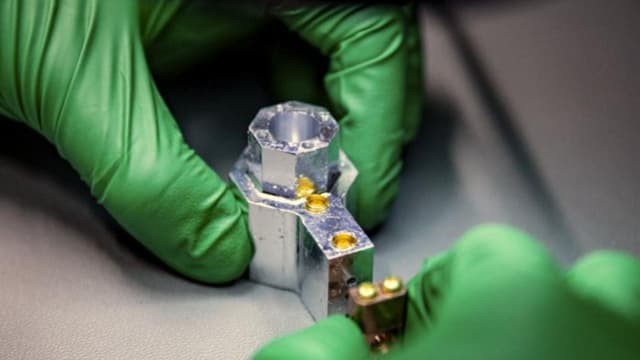
Figure 1.Quantum Computers.
Quantum computers differ from traditional machines by using qubits instead of binary bits. These qubits can exist in multiple states simultaneously, a phenomenon known as superposition, allowing quantum systems to perform calculations exponentially faster. However, this complexity also makes them prone to errors, especially under the ultra-low temperatures required for operation.
Deploying QEC systems to manage these errors can be both costly and energy-intensive, but Nord Qu antique’s Tesseract Code addresses both challenges at once. Figure 1 shows Quantum Computers.
How the Tesseract Code Works
According to the company, their system features an autonomous error correction protocol capable of conducting mid-circuit measurements. This enables the system to detect and eliminate faulty computational runs using a process called erasure-based error suppression.
“Using physical qubits to introduce redundancy increases the size, complexity, and energy demands of the system,” said Julien Camirand-Lemyre, CEO of Nord Quantique. “With multimode encoding, we can achieve powerful error correction without relying on vast numbers of physical qubits.”
In a recent demonstration, Nord’s system successfully discarded 12.6% of flawed data across 32 error correction cycles without any measurable performance loss. The company believes that adding more modes will further enhance its error correction performance.
Transformative Efficiency Gains
The Tesseract Code allows quantum systems to be both fault-tolerant and highly efficient [1]. Nord Quantique estimates its 1,000-logical-qubit quantum computer will occupy only 20 square meters—small enough to fit within a modern data center.
In terms of performance and energy efficiency, the company claims its system can run the RSA-830 cryptographic algorithm at 1 MHz speed in just one hour using only 120 kWh. In contrast, a traditional high-performance computing system would require nine days and around 280,000 kWh to complete the same task.
Additionally, Nord’s innovation allows for a 1:1 ratio of physical to logical qubits, streamlining quantum architecture. The company plans to deliver a 1,000-qubit system built on this principle by 2029.
Reference:
- https://interestingengineering.com/innovation/quantum-computers-made-90-more-efficient
Cite this article:
Keerthana S (2025), Breakthrough: Quantum Computers Become 90% More Energy-Efficient, Compact, And Faster, AnaTechMaz, pp,247
Recent Post
-

Scientists Accomplish World’s First Real-Time Molecular Reaction Using Quantum Technology
In a major scientific milestone, researchers at the University of Sydney have, for the first time, used ...
-
Historic First: Quantum Simulation Captures Atoms in Motion During Light-Driven Reactions
Researchers at the University of Sydney have achieved a world-first by performing a quantum....
-

China Unveils the World’s First Quantum Cryptography System, Claiming It to Be ‘Unhackable’
As quantum computing technology rapidly evolves, traditional...
-

The World’s Most Advanced Quantum Research Supercomputer Operates Using High-Performance NVIDIA Chips
NVIDIA has launched a groundbreaking initiative in supercomputing with the establishment of the Global Research...
-

From Earth to Entanglement: Norwegian Scientists Transform Simple Clay into A Foundation for Quantum Computing
In a groundbreaking international collaboration, researchers from Brazil, the Czech Republic, and France—led by ...
-
Photons Empower Revolutionary Quantum Sensors with The Ability to Detect the Invisible
Imagine trying to measure something so small, faint, or delicate that even the most advanced scientific instruments ...
-
Breakthrough: Quantum Computers Become 90% More Energy-Efficient, Compact, and Faster
Canadian quantum tech company Nord Quantique has introduced a groundbreaking technique for quantum error....
-
Quantum Techniques Transform Noisy Lasers into Ultra-Stable Beams That Push the Boundaries of Physics
Scientists have discovered a novel technique to transform fluctuating laser beams into ultra-stable ones,..
-
Scientists Manipulate Crystal Symmetry to Create a Quantum "Supermetal" That Could Revolutionize Energy Efficiency
As the world seeks faster computing and greener energy solutions, the demand for high-performance, ...
-

Quantum Simulation Reveals How Reality Might Collapse Like a House of Cards
Physicists have conducted a groundbreaking cosmic simulation that explores one ....
-
Breaking the Quantum Code: Solving the 20-Year Mystery of Entanglement Purity
Scientists have made a significant advancement in quantum technology....
-

Quantum Speed Boost: Additional Qubits Cut Measurement Time While Maintaining Precision
Quantum scientists have solved a longstanding challenge by developing....
-
How 1,432 GPUs Broke Google’s 53-Qubit Quantum Computer
Researchers made a significant breakthrough in quantum computing by....
-
Tiny Diamonds, Major Breakthrough: Laser-Free Quantum Spin Detection
Researchers at HZB have created an innovative method to detect quantum....
Micro Ring Laser Breaks Quantum Barriers
Researchers in China have made a significant breakthrough in quantum photonic....