

Scientists Manipulate Crystal Symmetry to Create a Quantum "Supermetal" That Could Revolutionize Energy Efficiency
Crystal Symmetry Twist Unlocks Energy-Efficient Quantum Supermetal
As the world seeks faster computing and greener energy solutions, the demand for high-performance, energy-efficient electronics has never been greater. From smartphones and data centers to electric vehicles and quantum technologies, the devices powering modern life consume vast amounts of energy. Cutting that consumption without compromising performance remains a key scientific challenge.
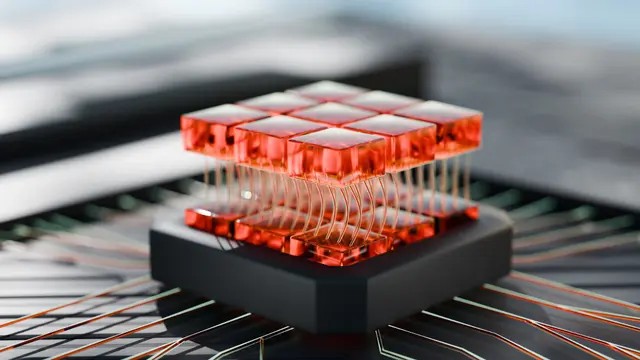
Figure 1. Abstract Quantum Material
Physicists at Rice University have taken a significant step toward solving it. A team led by Ming Yi and Emilia Morosan has developed a novel quantum material with remarkable electronic properties that could pave the way for ultra-efficient electronics. Figure 1. Abstract Quantum Material.
The breakthrough centers on a specially engineered quantum metal known as a Kramers nodal line metal. By carefully altering the material’s atomic structure through precise chemical adjustments, the researchers were able to induce unique quantum behaviors.
Rewriting Material Behavior with Symmetry
The team introduced a small amount of indium into tantalum disulfide (TaS₂), a layered compound. This slight change disrupted the crystal symmetry of the material and gave rise to an unusual pattern of electron flow—a hallmark of Kramers nodal line behavior.
In this new phase, electrons with opposite spins moved along distinct momentum-space paths, much like traffic lanes divided by a median. These paths remained separate until converging at a special point known as a nodal line—a symmetry-protected state enabling novel electronic conduction.
“Creating a material that satisfies the strict symmetry conditions for these properties was difficult, but the results were well worth the effort,” said Morosan, professor of electrical and computer engineering, chemistry, and director of the Rice Center for Quantum Materials.
A Superconducting Supermetal
In addition to its unique topological characteristics, the material also exhibited superconductivity—allowing it to transmit electricity without energy loss [1]. This rare combination of topological and superconducting traits makes it a strong contender for future topological superconductors, which could dramatically enhance quantum computing stability and power grid efficiency.
The team fine-tuned the material’s composition to optimize both its crystal structure and quantum behavior, aiming for a design that maximizes performance through strategic chemical control.
Connecting Theory and Experiment
To back their findings, the researchers used advanced theoretical models that accurately mirrored experimental results. These calculations confirmed the material’s electronic topology, providing strong support for the discovery.
By designing and tuning this new Kramers nodal line metal, the team has deepened the understanding of quantum materials and brought the world a step closer to next-generation, energy-saving technologies.
“This pioneering research represents the innovative spirit at the heart of the Smalley-Curl Institute,” said Junichiro Kono, the institute’s director and co-author of the study. “It showcases how interdisciplinary collaboration in physics, materials science, and engineering can lead to groundbreaking discoveries in quantum materials.”
Reference:
- https://interestingengineering.com/energy/scientists-unlock-energy-saving-quantum-supermetal
Cite this article:
Keerthana S (2025), Scientists Manipulate Crystal Symmetry to Create a Quantum "Supermetal" That Could Revolutionize Energy Efficiency, AnaTechMaz, pp. 249
Recent Post
-

Scientists Accomplish World’s First Real-Time Molecular Reaction Using Quantum Technology
In a major scientific milestone, researchers at the University of Sydney have, for the first time, used ...
-
Historic First: Quantum Simulation Captures Atoms in Motion During Light-Driven Reactions
Researchers at the University of Sydney have achieved a world-first by performing a quantum....
-

China Unveils the World’s First Quantum Cryptography System, Claiming It to Be ‘Unhackable’
As quantum computing technology rapidly evolves, traditional...
-

The World’s Most Advanced Quantum Research Supercomputer Operates Using High-Performance NVIDIA Chips
NVIDIA has launched a groundbreaking initiative in supercomputing with the establishment of the Global Research...
-

From Earth to Entanglement: Norwegian Scientists Transform Simple Clay into A Foundation for Quantum Computing
In a groundbreaking international collaboration, researchers from Brazil, the Czech Republic, and France—led by ...
-
Photons Empower Revolutionary Quantum Sensors with The Ability to Detect the Invisible
Imagine trying to measure something so small, faint, or delicate that even the most advanced scientific instruments ...
-
Breakthrough: Quantum Computers Become 90% More Energy-Efficient, Compact, and Faster
Canadian quantum tech company Nord Quantique has introduced a groundbreaking technique for quantum error....
-
Quantum Techniques Transform Noisy Lasers into Ultra-Stable Beams That Push the Boundaries of Physics
Scientists have discovered a novel technique to transform fluctuating laser beams into ultra-stable ones,..
-
Scientists Manipulate Crystal Symmetry to Create a Quantum "Supermetal" That Could Revolutionize Energy Efficiency
As the world seeks faster computing and greener energy solutions, the demand for high-performance, ...
-

Quantum Simulation Reveals How Reality Might Collapse Like a House of Cards
Physicists have conducted a groundbreaking cosmic simulation that explores one ....
-

Breaking the Quantum Code: Solving the 20-Year Mystery of Entanglement Purity
Scientists have made a significant advancement in quantum technology....
-

Quantum Speed Boost: Additional Qubits Cut Measurement Time While Maintaining Precision
Quantum scientists have solved a longstanding challenge by developing....
-
How 1,432 GPUs Broke Google’s 53-Qubit Quantum Computer
Researchers made a significant breakthrough in quantum computing by....
-
Tiny Diamonds, Major Breakthrough: Laser-Free Quantum Spin Detection
Researchers at HZB have created an innovative method to detect quantum....

Micro Ring Laser Breaks Quantum Barriers
Researchers in China have made a significant breakthrough in quantum photonic....