

Photons Empower Revolutionary Quantum Sensors with The Ability to Detect the Invisible
Imagine trying to measure something so small, faint, or delicate that even the most advanced scientific instruments struggle, like gauging the thickness of a human hair from a distance or peering inside soft tissues without making contact.
This challenge has long frustrated scientists, as traditional tools often fall short when the light is too weak, the sample is too fragile, or the surrounding noise is too intense.
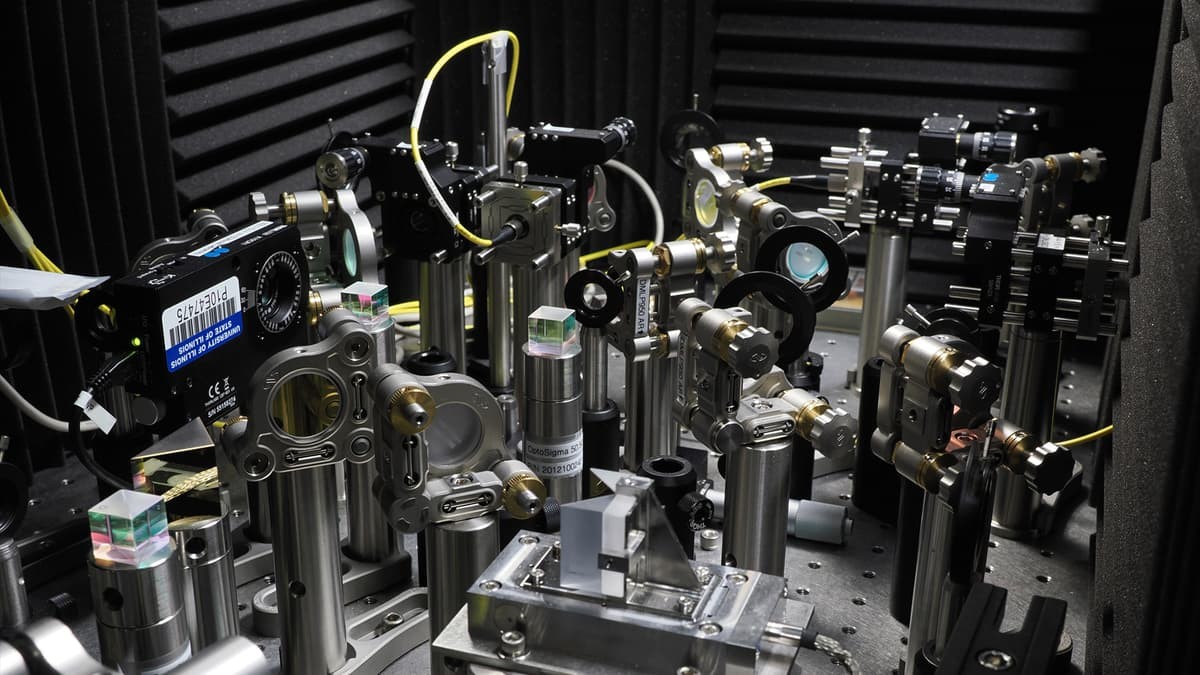
Figure 1.Quantum Sensors.
Now, researchers at the University of Illinois Urbana-Champaign (UIUC) have developed a groundbreaking device that uses quantum physics to measure the nearly invisible with remarkable precision. Figure 1shows Quantum Sensors.
Their innovation—a quantum interferometer—can rapidly and accurately detect nanometer-scale changes, even in complex or noisy environments. These advance holds promise for transforming how we study everything from living cells to cutting-edge materials.
“Our system outperforms other quantum interferometers in both speed and precision, enabling us to observe time-sensitive signals like nanometer-scale vibrations,” said Colin Lualdi, the lead researcher and a graduate student at UIUC.
Why Traditional Interferometers Fall Short
To understand the power of this new quantum tool, it helps to grasp how interferometry works.Picture two stones dropped into a calm pond. Their ripples intersect—sometimes amplifying (constructive interference), sometimes canceling out (destructive interference). Light waves behave similarly.
Conventional interferometers split light into two paths—one passing through a sample, the other serving as a reference. When the beams reunite, the resulting interference pattern reveals minute changes in distance or material properties.
This technique has been vital in breakthroughs such as detecting gravitational waves and examining the retina. However, it has limitations. When samples absorb too much light, or when stray environmental light creates interference, the patterns become unclear. Sensitive materials like metallic films or biological tissues often can’t withstand strong light, making precise measurements difficult.
The Quantum Leap: Two-Photon Interferometry
The new interferometer sidesteps these issues by using entangled photons—pairs of light particles whose properties are linked. One photon travel through the sample, while its partner takes a reference path. Their reunion forms a clear interference pattern, even in high-noise or low-light conditions.
“As long as you detect both entangled photons during the measurement, your interference contrast remains perfectly intact. That’s a major advantage of quantum physics,” Lualdi explained.
To enhance performance, the team introduced extreme color entanglement—pairing photons with dramatically different wavelengths, like red and blue. The greater the difference, the more sensitive the measurement.
But instead of using a full spectrum, which is complex and inefficient, they achieved strong entanglement using just two narrow color bands. “Thanks to entanglement, we can get high sensitivity with only a sliver of red and blue, instead of the full rainbow,” Lualdi said.
Powerful Results, Broad Impact
The result is a powerful tool capable of mapping fine details on light-sensitive or reflective surfaces within seconds. In one experiment, the team measured a thin metallic film’s thickness and confirmed their results with atomic force microscopy—a gold standard in precision measurement. The two methods aligned perfectly.
This new quantum device could revolutionize fields from materials science to medicine—where it may enable non-invasive imaging of delicate tissues.
Reference:
- https://interestingengineering.com/science/entangled-photons-in-quantum-interferometer
Cite this article:
Keerthana S (2025), Photons Empower Revolutionary Quantum Sensors with The Ability to Detect the Invisible, AnaTechMaz, pp,246
Recent Post
-

Scientists Accomplish World’s First Real-Time Molecular Reaction Using Quantum Technology
In a major scientific milestone, researchers at the University of Sydney have, for the first time, used ...
-
Historic First: Quantum Simulation Captures Atoms in Motion During Light-Driven Reactions
Researchers at the University of Sydney have achieved a world-first by performing a quantum....
-

China Unveils the World’s First Quantum Cryptography System, Claiming It to Be ‘Unhackable’
As quantum computing technology rapidly evolves, traditional...
-

The World’s Most Advanced Quantum Research Supercomputer Operates Using High-Performance NVIDIA Chips
NVIDIA has launched a groundbreaking initiative in supercomputing with the establishment of the Global Research...
-

From Earth to Entanglement: Norwegian Scientists Transform Simple Clay into A Foundation for Quantum Computing
In a groundbreaking international collaboration, researchers from Brazil, the Czech Republic, and France—led by ...
-
Photons Empower Revolutionary Quantum Sensors with The Ability to Detect the Invisible
Imagine trying to measure something so small, faint, or delicate that even the most advanced scientific instruments ...
-
Breakthrough: Quantum Computers Become 90% More Energy-Efficient, Compact, and Faster
Canadian quantum tech company Nord Quantique has introduced a groundbreaking technique for quantum error....
-
Quantum Techniques Transform Noisy Lasers into Ultra-Stable Beams That Push the Boundaries of Physics
Scientists have discovered a novel technique to transform fluctuating laser beams into ultra-stable ones,..
-
Scientists Manipulate Crystal Symmetry to Create a Quantum "Supermetal" That Could Revolutionize Energy Efficiency
As the world seeks faster computing and greener energy solutions, the demand for high-performance, ...
-

Quantum Simulation Reveals How Reality Might Collapse Like a House of Cards
Physicists have conducted a groundbreaking cosmic simulation that explores one ....
-

Breaking the Quantum Code: Solving the 20-Year Mystery of Entanglement Purity
Scientists have made a significant advancement in quantum technology....
-

Quantum Speed Boost: Additional Qubits Cut Measurement Time While Maintaining Precision
Quantum scientists have solved a longstanding challenge by developing....
-
How 1,432 GPUs Broke Google’s 53-Qubit Quantum Computer
Researchers made a significant breakthrough in quantum computing by....
-
Tiny Diamonds, Major Breakthrough: Laser-Free Quantum Spin Detection
Researchers at HZB have created an innovative method to detect quantum....
Micro Ring Laser Breaks Quantum Barriers
Researchers in China have made a significant breakthrough in quantum photonic....