

Record-Breaking Superconductor Advances the Future of Energy
Scientists have achieved a major milestone in superconductivity by creating a material that remains superconducting at the highest temperature ever recorded under normal atmospheric pressure, bringing researchers another step closer to practical, real-world superconducting technologies.
The breakthrough, led by physicists at the University of Houston, pushes the operating temperature of an ambient-pressure superconductor to –122.15°C (–187.87°F). While still extremely cold, the new record improves the previous benchmark by nearly 20°C, ending a decades-long plateau in superconductivity research.
Superconductors allow electricity to flow with zero electrical resistance, eliminating energy losses that occur in conventional conductors. This unique property could transform technologies ranging from power grids and magnetic levitation to medical imaging, quantum computing, and electric vehicles. However, most superconductors require either extremely low temperatures, enormous pressures, or both, making widespread commercial use difficult.
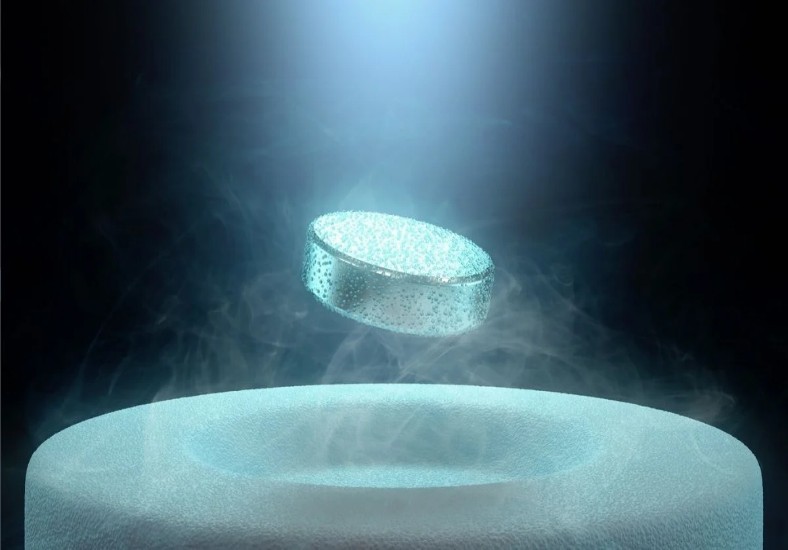
Figure 1. Superconductor.
The record-setting material is Hg1223, a copper-oxide (cuprate) superconductor composed of mercury, barium, calcium, and copper oxide layers. Since its discovery in 1993, Hg1223 has held the record for the highest superconducting temperature at normal pressure. Researchers have now surpassed that benchmark by applying an innovative processing technique known as pressure quenching. Figure 1 shows Superconductor.
In the experiment, scientists first compressed the material to 30 gigapascals using a diamond anvil cell before rapidly releasing the pressure. This rapid decompression locked the material into a metastable state, preserving beneficial atomic arrangements even after returning to normal atmospheric conditions.
Rather than allowing the crystal structure to fully relax, the quick pressure release creates tiny structural defects that appear to stabilize superconductivity at significantly higher temperatures. Advanced X-ray analysis confirmed the altered atomic structure responsible for the improved performance.
Although other superconductors have reached much warmer temperatures, they require pressures approaching 190 gigapascals—comparable to conditions deep inside Earth's interior—making them impractical for everyday applications. By contrast, the new achievement demonstrates that meaningful improvements are possible while maintaining normal operating pressure after processing.
Researchers believe the discovery represents an important advance toward the ultimate goal of room-temperature, ambient-pressure superconductivity [1]. Such materials could dramatically improve energy transmission, enable highly efficient electronics, accelerate electric vehicle charging, enhance quantum technologies, and support advanced magnetic levitation systems.
While commercially viable superconductors remain a long-term objective, the new world record highlights how innovative materials engineering can continue pushing the boundaries of physics. Each advance brings scientists closer to developing superconductors capable of transforming the way electricity is generated, transmitted, and used in everyday life.
References
- https://www.sciencealert.com/physicists-just-set-a-new-world-record-for-superconductors
Cite this article:
Keerthana S (2026), Record-Breaking Superconductor Advances the Future of Energy, AnaTechMaz, pp.436.
Recent Post
-
Record-Breaking Superconductor Advances the Future of Energy
Scientists have achieved a major milestone in superconductivity by creating a material that....
-
US Startup Introduces Scalable Sodium-Ion Energy Storage Solution
US-based energy storage company ESS has introduced Bridge, a....
-
New Quantum Material Enables Directional Electrical Flow
Researchers from Penn State and Saint Louis University have demonstrated that a magnetic quantum....
-
Micron Invests $3 Billion to Strengthen America's Chip Supply Chain
Micron Technology has announced plans to invest up to $3....
-
New $16 Million Investment Boosts US Defense-Grade Chip Production
The U.S. Department of Defense has awarded $16 million to BAE Systems to restore domestic...
-
Air-to-Water Material Offers a New Source of Clean Drinking Water
As climate change intensifies water shortages across many parts of the world, scientists are....