

Hidden Giant Exoplanet Revealed After 11 Years
A giant exoplanet remained hidden for more than a decade within one of the most closely studied star systems. Named Beta Pictoris d, the newly identified gas giant orbits a young star 63 light-years from Earth. Roughly 100 times fainter than the previously discovered Beta Pictoris b, it is the faintest exoplanet ever directly imaged from the ground. Astronomers later realized the planet had been quietly embedded in telescope data for up to 11 years before its discovery.
The discovery came by chance. Researchers were originally studying the known exoplanet Beta Pictoris b to track how it had evolved over time. During that analysis, they unexpectedly uncovered Beta Pictoris d, a much fainter gas giant that had remained hidden in years of archived observations.
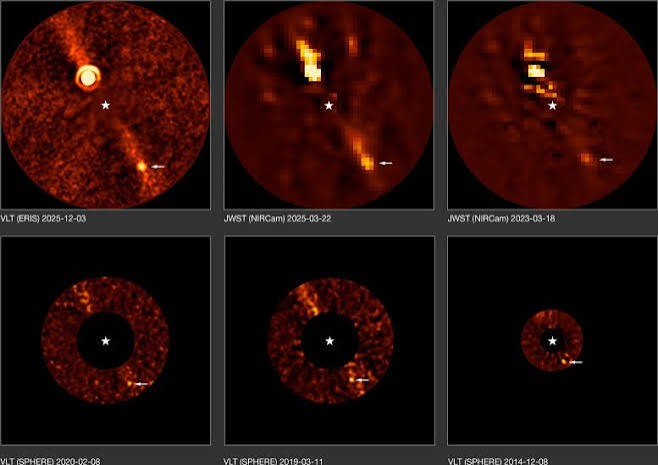
Figure 1. Tracking Beta Pictoris d.
A Surprising Point of Light
Images captured by the ERIS instrument on the European Southern Observatory’s Very Large Telescope revealed an unexpected point of light distinct from Beta Pictoris b. Initially noticed during routine analysis, the faint signal was soon confirmed to be a previously unknown exoplanet, marking a surprising discovery hidden within years of observations. Figure 1 shows Tracking Beta Pictoris d.
A Young Planetary System Emerges
The Beta Pictoris system is only about 20 million years old, making it an ideal laboratory for studying how planetary systems evolve. Its young age allows astronomers to observe giant planets and a surrounding debris disk while smaller rocky worlds may still be forming through ongoing collisions of asteroids, comets, and other leftover material.
After reviewing archival data from the European Southern Observatory, researchers found that Beta Pictoris d had appeared in multiple observations spanning 11 years, including images from the SPHERE instrument on the Very Large Telescope. Although the planet was often obscured by the much brighter Beta Pictoris b, the archived images confirmed that it had been hiding in plain sight for more than a decade before its discovery.
By tracking the object across more than a decade of archival images, astronomers confirmed that it moves with the Beta Pictoris system and follows its own orbit, ruling out the possibility that it is a distant background star. The observations suggest that Beta Pictoris d orbits its star at an average distance of about 26 astronomical units—roughly 26 times the Earth–Sun distance—and likely takes around 91 years to complete a single orbit, although its exact path is still being refined.
A Faint Gas Giant Comes into View
Beta Pictoris d is a gas giant like its neighboring planets, Beta Pictoris b and c, but it is significantly smaller and fainter. While planets b and c each have about 10 times Jupiter’s mass, Beta Pictoris d is estimated to be only 2–4 Jupiter masses, making it much cooler and far less luminous in infrared light.
Its extremely faint appearance made the planet exceptionally challenging to detect through direct imaging, a technique that captures light emitted by the planet itself while blocking the overwhelming glare of its host star. About 100 times dimmer than Beta Pictoris b, Beta Pictoris d is now recognized as the faintest exoplanet ever directly imaged from the ground.
A Cooler, Fainter Gas Giant
An independent research team led by Aidan Gibbs also discovered Beta Pictoris d using the James Webb Space Telescope (JWST), providing strong confirmation through a completely separate set of observations and techniques. The team detected the planet with NIRSpec and later verified it using additional NIRSpec and MIRI data.
Instead of relying solely on imaging, the researchers identified the planet by analyzing the unique chemical signatures in its atmosphere. Its spectrum revealed the presence of methane, carbon monoxide, and water vapor, allowing scientists to distinguish the planet from the surrounding debris disk, whose dust can mimic faint planetary signals. The ground-based team also confirmed the planet in archived JWST NIRCam observations, further strengthening the discovery.
Molecules Reveal a Planetary Atmosphere
After identifying Beta Pictoris d, the researchers revisited older observations from the SPHERE instrument and found that the planet had been present in the data all along. Knowing its location and expected orbital motion made the faint signals much easier to recognize, revealing that the planet had remained hidden in archival observations for years.
The discovery highlights the scientific value of reanalyzing existing telescope data, suggesting that many more undiscovered planets and other celestial objects may still be waiting to be uncovered in the Very Large Telescope (VLT) archives.
A Rare Three-Planet System
The Beta Pictoris system is now only the second known planetary system, after HR 8799, where astronomers have directly imaged three exoplanets. Such systems are exceptionally rare, as direct imaging is typically limited to young, massive planets orbiting far from their host stars.
Because all three planets formed from the same disk of gas and dust around the same young star, they provide a unique opportunity to compare how differences in mass, temperature, atmosphere, and orbit influence planetary evolution [1]. Researchers also believe Beta Pictoris d may explain the debris disk’s unusual structure, as its gravity could be responsible for carving the disk’s sharply defined inner edge and shaping its surrounding material.
The Hunt for Hidden Worlds
The upcoming Extremely Large Telescope (ELT) is expected to greatly enhance astronomers’ ability to directly image smaller, fainter exoplanets that are currently hidden by the intense glare of their host stars. Scientists believe many well-known planetary systems with directly imaged giant planets may also contain lower-mass worlds that have so far remained undetected.
With its advanced capabilities, the ELT could uncover these hidden companions, offering deeper insights into how planetary systems form and evolve while expanding the growing inventory of directly imaged exoplanets.
Beta Pictoris d is a relatively low-mass gas giant, estimated to be 2–4 times the mass of Jupiter, making it much smaller, cooler, and around 100 times fainter than its neighboring giant planets, Beta Pictoris b and c. Its extreme faintness made it exceptionally difficult to detect through direct imaging, a technique that captures light emitted by the planet while suppressing the overwhelming glare of its host star. As a result, Beta Pictoris d has become the faintest exoplanet ever directly imaged from the ground.
An independent team using the James Webb Space Telescope (JWST) also detected the planet, providing strong confirmation of the discovery. By analyzing atmospheric spectra rather than relying solely on images, the researchers identified methane, carbon monoxide, and water vapor, allowing them to distinguish the planet from the surrounding debris disk. After pinpointing its location, scientists also recovered the planet in earlier SPHERE and JWST archival observations, revealing that it had remained hidden in existing data for years.
The discovery makes Beta Pictoris only the second planetary system, after HR 8799, in which three exoplanets have been directly imaged. Because all three planets formed around the same young star, they offer a rare opportunity to compare how giant planets evolve under identical formation conditions. Researchers also believe Beta Pictoris d may be responsible for shaping the system’s debris disk through its gravitational influence.
Looking ahead, the Extremely Large Telescope (ELT) is expected to detect even smaller and fainter planets that are currently concealed by stellar glare [1]. Astronomers suspect that many well-known planetary systems may harbor additional hidden worlds, making archival observations and next-generation telescopes key to uncovering new exoplanets.
Reference:
- https://scitechdaily.com/giant-alien-world-found-hiding-in-plain-sight-for-11-years/
Cite this article:
Janani R (2026), Hidden Giant Exoplanet Revealed After 11 Years, AnaTechMaz, pp.953.
Recent Post
-
Star Circles the Milky Way’s Black Hole at 8% Light Speed
A rapidly moving star orbiting the Milky Way’s central supermassive black hole offers scientists a rare...
-
Earth Twice as Vulnerable to Extreme Solar Storms, Scientists Warn
Earth may be significantly more vulnerable to extreme solar......
-
Hidden Black Holes May Be Triggering Supernova Explosions
Researchers suggest that some Type Ia supernovae may be triggered when primordial black holes....
-

Hidden Dark Matter Force Could Transform Our View of the Universe
Dark matter is known to shape galaxies and the large-scale structure of the Universe through gravity, but.....
-
NASA Astronaut Returns After Completing 3,856 Earth Orbits
After circling Earth 3,856 times and traveling more than 102 million miles, NASA astronaut Chris.....
-
Europa’s Ocean Could Be Trapped Beneath Thick Ice
New simulations suggest Europa’s thick ice shell may act as a stronger barrier than previously thought,.....
-
Scientists Detect Ongoing Activity Beneath Venus’s Surface
Venus may still be actively reshaping its surface. New computer simulations indicate that massive....
-
Hidden Giant Exoplanet Revealed After 11 Years
A giant exoplanet remained hidden for more than a decade within one of the most closely studied...
-
UK Invests £3 Million to Aid the Search for Alien Life
A £3 million investment from the UK Space Agency is supporting the development of advanced....