

Europa’s Ocean Could Be Trapped Beneath Thick Ice
New simulations suggest Europa’s thick ice shell may act as a stronger barrier than previously thought, limiting access to its hidden ocean. Although the moon may hold vast amounts of liquid water, escaping water could quickly freeze before reaching the surface.
The study challenges the idea that Europa’s underground ocean could easily feed shallow surface reservoirs through ice fractures. Research led by Rutgers scientist Lujendra Ojha suggests that rising water may freeze rapidly inside cracks, blocking pathways before liquid can reach closer to the surface.
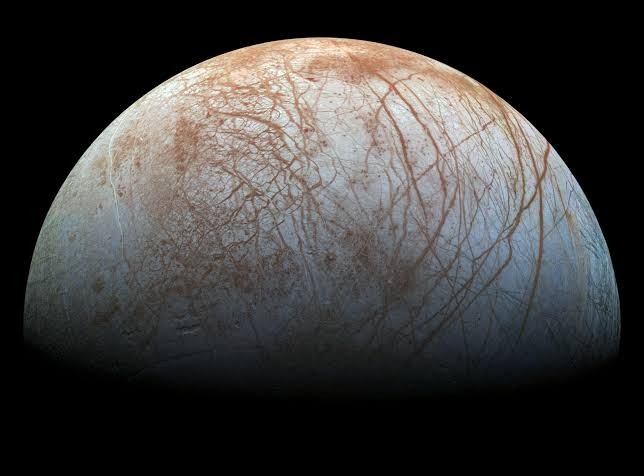
Figure 1. Europa’s Hidden Ocean.
Question Europa’s Easy Ocean Access
Published in Nature Astronomy, the study used simulations to examine how Europa’s ocean water could travel through cracks in its icy shell. By including turbulence in their models, researchers found that direct movement of water from the deep ocean to near-surface regions is likely far more limited than previously believed. Figure 1 shows Europa’s Hidden Ocean.
Researchers investigated whether Europa’s deep ocean water could travel upward through the ice shell without freezing. Their calculations suggest that this process is much more difficult than previously thought, challenging the idea that liquid water can easily reach near-surface regions.
Europa’s Hidden Ocean and the Search for Life
Europa remains a top candidate in the search for habitable environments because of its hidden salty ocean, chemical ingredients, and internal heat. However, new research suggests that shallow water pockets may form independently within the ice shell rather than directly connecting to the deep ocean, meaning they may not reveal the ocean’s true conditions.
Water transported from Europa’s deep ocean could contain valuable clues about its internal chemistry, including salts, minerals, and organic compounds. In contrast, water formed by local ice melting may mainly reflect surface ice processes and offer limited insight into the moon’s habitability.
Earth’s Volcanic Comparison Falls Short
Researchers studied water-filled fractures called dikes that could potentially transport liquid through Europa’s ice shell. However, they found that comparing this process to Earth’s volcanic activity may be misleading, as water moving through ice follows very different physical rules than magma flowing through rock.
Turbulence Quickly Cools Rising Water
The new simulations show that turbulence plays a critical role in Europa’s ice fractures. Instead of flowing smoothly, rising water swirls and repeatedly contacts the freezing ice walls, rapidly losing heat and freezing before it can travel far toward the surface.
Ice Crystals May Seal Europa’s Fractures
The simulations suggest that rapidly cooling water inside Europa’s ice shell could become supercooled, forming frazil ice crystals that gradually clog and seal fractures. As a result, even larger cracks would struggle to transport enough liquid to the surface, making direct ocean-to-surface pathways far less likely than previously thought.
The study suggests that localized heating from tidal forces, friction, or other internal processes is a more likely source of shallow liquid water on Europa. These mechanisms could create isolated melt pockets within the ice shell without forming a direct connection to the deep ocean.
Europa Clipper and JUICE to Test the Theory
Upcoming missions will put Europa’s hidden ocean theory to the test. NASA’s Europa Clipper and the European Space Agency’s JUICE spacecraft will closely study the moon’s ice shell, geology, composition, and interior, helping scientists determine whether shallow water is connected to the deep ocean or forms within the ice itself.
Future Missions Must Interpret Europa’s Water Carefully
Europa Clipper will use ice-penetrating radar and other instruments to search for shallow liquid water and study the moon’s ice shell [1]. The new research suggests that even if such reservoirs are found, they may not be directly connected to Europa’s global ocean, helping future missions interpret signs of potential habitability more accurately.
Reference:
- https://scitechdaily.com/europas-hidden-ocean-may-be-locked-beneath-a-frozen-wall/
Cite this article:
Janani R (2026), Europa’s Ocean Could Be Trapped Beneath Thick Ice, AnaTechMaz, pp.951.
Recent Post
-
Star Circles the Milky Way’s Black Hole at 8% Light Speed
A rapidly moving star orbiting the Milky Way’s central supermassive black hole offers scientists a rare...
-
Earth Twice as Vulnerable to Extreme Solar Storms, Scientists Warn
Earth may be significantly more vulnerable to extreme solar......
-
Hidden Black Holes May Be Triggering Supernova Explosions
Researchers suggest that some Type Ia supernovae may be triggered when primordial black holes....
-
Hidden Dark Matter Force Could Transform Our View of the Universe
Dark matter is known to shape galaxies and the large-scale structure of the Universe through gravity, but.....
-
NASA Astronaut Returns After Completing 3,856 Earth Orbits
After circling Earth 3,856 times and traveling more than 102 million miles, NASA astronaut Chris.....
-
Europa’s Ocean Could Be Trapped Beneath Thick Ice
New simulations suggest Europa’s thick ice shell may act as a stronger barrier than previously thought,.....
-
Scientists Detect Ongoing Activity Beneath Venus’s Surface
Venus may still be actively reshaping its surface. New computer simulations indicate that massive....
-
Hidden Giant Exoplanet Revealed After 11 Years
A giant exoplanet remained hidden for more than a decade within one of the most closely studied...
-
UK Invests £3 Million to Aid the Search for Alien Life
A £3 million investment from the UK Space Agency is supporting the development of advanced....