

Researchers Discover a Surprisingly Practical Method to Mine Asteroids for Mars Missions
Asteroids drifting through space may one day supply the metals and fuel needed to support human settlements on Mars, potentially reducing dependence on Earth and lowering the cost of long-term space missions.
Rewatching Armageddon raises a real question beneath the Hollywood drama: if we could capture an asteroid, what could we actually do with it? Far from the idea of destroying it, the real potential lies in using it as a resource for building new worlds.
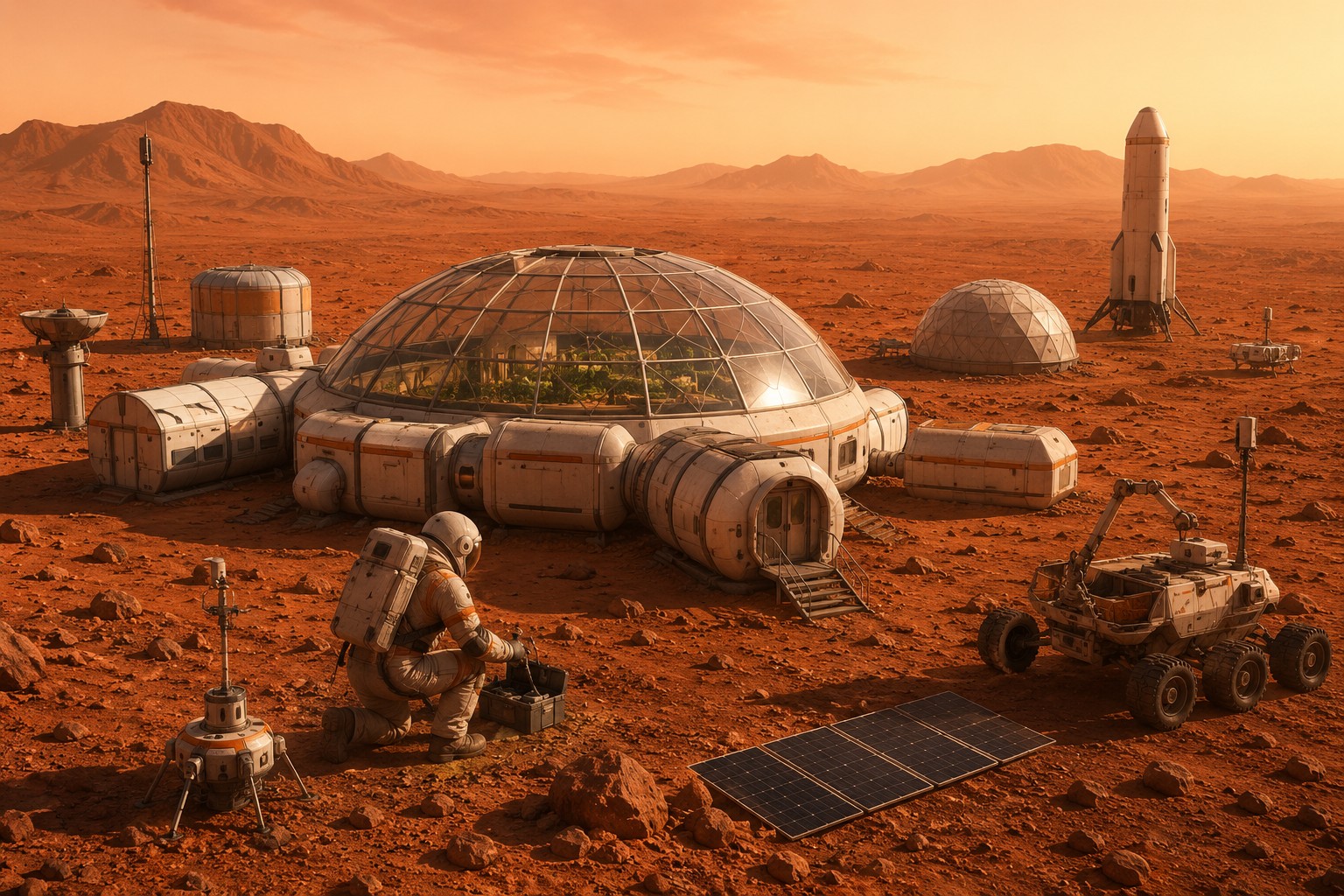
Figure 1. NASA concept art of a proposed Mars habitat alongside surrounding surface features on the Martian landscape.
In fact, establishing a Mars colony is as much a logistics challenge as it is an engineering one, and those supply-chain realities may ultimately decide whether humans become a multi-planetary species or remain tied to Earth. Figure 1 shows NASA concept art of a proposed Mars habitat alongside surrounding surface features on the Martian landscape.
Logistical Hurdles in Establishing a Mars Colony
A Mars colony would require far more than food and oxygen—it would need a constant supply of metals like steel, aluminum, and iron to build structures, maintain equipment, and replace worn-out parts. Relying on Earth for these materials is impractical given the enormous cost of space launches and the long, months-long travel time to Mars.
Researchers at EPFL in Switzerland have explored whether asteroid mining could solve this problem by sourcing metals directly from space. With millions of asteroids in the solar system—especially metal-rich M-type asteroids made of iron, nickel, and other valuable elements—the study examines whether they could be accessed and transported to Mars efficiently. Their findings suggest it may be possible, but only under carefully defined conditions.
Asteroid-Based Supply Chains and Advances in Space Fuel Technology
The team used a computer model to evaluate thousands of possible configurations across asteroid–Mars supply networks, factoring in travel energy, extractable metal quantities, and the fuel required for return missions.
A key insight in their analysis is that certain carbon-rich asteroids contain water ice and carbon compounds that could potentially be processed into rocket propellant in space [1]. By producing fuel directly from these resources, future missions could avoid the need to transport return fuel from Earth, a factor that is fully integrated into their supply chain optimization.
Potential Targets and the Future of the Space Economy
The study identifies specific asteroids that are accessible with current spacecraft technology, where travel energy and return costs are low enough to make mining missions potentially viable. It highlights that careful target selection is critical, since choosing the wrong asteroid could result in more fuel being spent than the value of materials gained.
While the research does not claim asteroid mining is ready today, it shows that the concept is technically achievable in principle. It outlines a future supply chain in which metals are delivered from space to Mars, supported by propellant produced directly from asteroid resources—laying the groundwork for the logistics a future Martian colony would depend on.
Reference:
- https://scitechdaily.com/researchers-found-a-surprisingly-realistic-way-to-mine-asteroids-for-mars/
Cite this article:
Janani R (2026), Researchers Discover a Surprisingly Practical Method to Mine Asteroids for Mars Missions, AnaTechmaz, pp.864
Recent Post
-
NASA’s Psyche Spacecraft Prepares for an Extremely Close Flyby of Mars
NASA’s Psyche is preparing for a dramatic close flyby of Mars to....
-
James Webb Telescope Uncovers the Universe’s Hidden Cosmic Web in Remarkable Detail
Using the James Webb Space Telescope, astronomers have...
-
NASA’s Psyche Probe Set for an Extremely Close Flyby of Mars
NASA’s Psyche spacecraft is gearing up for a daring flyby of Mars to gain a crucial speed boost on its long...
-
Stubborn Mars Rock Clung to NASA’s Curiosity Rover
NASA’s Curiosity Rover accidentally pulled a rock loose from the Martian surface and then spent several...
-

Scientists Say the Brain Can Keep Improving at Any Age
A new long-term study suggests that brain health can continue improving throughout life through....
-
Strange Molecular Signal Could Be the Strongest Hint of Alien Life Yet
Scientists may have uncovered a hidden chemical pattern that could help identify alien life beyond....
-
Europe Introduces a Major Competitor to SpaceX’s Starship Program
A DLR analysis indicates that while Starship could shape the...
-
Researchers Discover a Surprisingly Practical Method to Mine Asteroids for Mars Missions
Asteroids drifting through space may one day supply the metals....

NASA’s Roman Telescope May Uncover the Milky Way’s Missing Neutron Stars
Astronomers believe the Milky Way should contain vast numbers of...
-
NASA’s Roman Space Telescope Moves Closer to Launch
NASA’s Nancy Grace Roman Space Telescope is moving closer to launch and could soon begin an...
-
Scientists Develop Revolutionary Supermaterial That Could Replace Plastic
Scientists have developed a new method for producing bacterial....
-
NASA’s Hubble Captures Unexpected Comet Breakup in Space
In a rare and fortunate observation, NASA’s Hubble Space...
-

Scientists Detect Possible Dark Matter Signature in a Black Hole Collision
Researchers have developed a new method that could use black...
-
NASA’s Hubble Unexpectedly Captured a Comet Breaking Apart
In a remarkable stroke of chance, NASA’s Hubble Space Telescope captured a comet breaking apart...