

James Webb Telescope Uncovers the Universe’s Hidden Cosmic Web in Remarkable Detail
Using the James Webb Space Telescope, astronomers have produced the clearest map yet of the universe’s hidden cosmic web, tracing its structure back to a time when the universe was only about one billion years old. The research, led by scientists at University of California, Riverside, offers an unprecedented view of the enormous network that connects galaxies across the cosmos.
The cosmic web is the universe’s vast underlying framework, made of giant filaments and sheets of dark matter and gas surrounding enormous empty regions known as voids. These interconnected structures form the large-scale architecture of the universe, linking galaxies and galaxy clusters across immense cosmic distances.
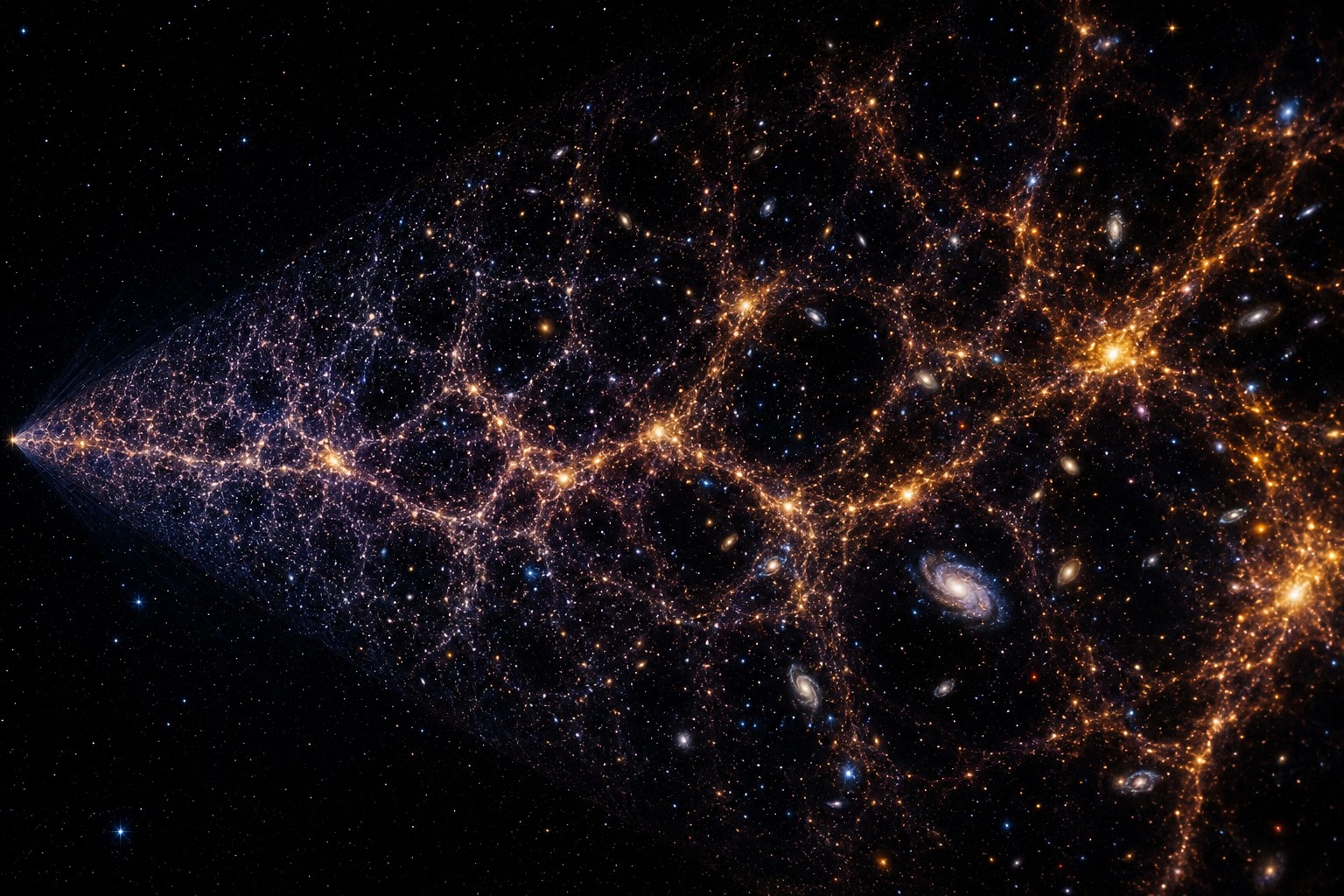
Figure 1. COSMOS-Web Map Reveals the Universe Across 14 Billion Years
The study, published in The Astrophysical Journal, used data from the largest survey ever carried out by the James Webb Space Telescope, known as COSMOS-Web. Using this extensive dataset, researchers investigated how galaxies formed and evolved within the universe’s interconnected cosmic web over 13.7 billion years of cosmic history. Figure 1 shows COSMOS-Web Map Reveals the Universe Across 14 Billion Years.
James Webb Space Telescope Broadens Our View of the Universe
Since its launch in 2021, the James Webb Space Telescope has revolutionized astronomy with its extraordinary sensitivity and image quality. Its infrared instruments can detect faint, distant galaxies invisible to earlier telescopes, allowing scientists to peer farther back in time and through thick clouds of cosmic dust.
To fully use these capabilities, an international team created COSMOS-Web, the largest General Observer program ever selected for JWST. The survey maps a continuous area of sky about the size of three full Moons and was specifically designed to study the cosmic web. According to Hossein Hatamnia, JWST has dramatically changed humanity’s view of the universe, while COSMOS-Web provides the wide and deep perspective needed to observe the cosmic web across cosmic history. For the first time, researchers can examine how galaxies evolved within clusters and filament-like structures from when the universe was only a billion years old to the nearby universe.
The nearby universe refers to the region within roughly one billion light-years of Earth. A light-year is the distance light travels in one year, equal to about 5.88 trillion miles.
New Cosmic Web Map Uncovers Hidden Structures
Bahram Mobasher said the new data from the James Webb Space Telescope offers a dramatically clearer view of large-scale cosmic structures than earlier observations from the Hubble Space Telescope. When scientists compared the two datasets, structures that once appeared blurred together could now be separated and studied in far greater detail.
Mobasher explained that JWST’s improved depth and resolution now allow researchers to observe the cosmic web during a period when the universe was only a few hundred million years old — an era that had previously remained largely inaccessible. Features that once looked like single structures can now be resolved into many distinct components, revealing details that earlier observations could not capture.
According to Hossein Hatamnia, this breakthrough comes from two major advantages of JWST working together. The telescope can detect far more faint galaxies within the same region of sky, while also measuring their distances with much greater precision [1]. This allows astronomers to place galaxies into the correct stage of cosmic history, producing a much sharper and more accurate map of the cosmic web.
COSMOS-Web Data Released to the Public
Continuing the COSMOS project’s commitment to open science, the research team has made the large-scale cosmic structure maps publicly accessible.
According to Bahram Mobasher, the publicly released materials include the pipeline used to create the map, a catalog containing 164,000 galaxies and their cosmic density measurements, and a video illustrating how the cosmic web evolved over billions of years.
Reference:
- https://scitechdaily.com/james-webb-telescope-reveals-the-universes-hidden-cosmic-web-in-stunning-detail/
Cite this article:
Janani R (2026), James Webb Telescope Uncovers the Universe’s Hidden Cosmic Web in Remarkable Detail, AnaTechMaz, pp.857
Recent Post
-
NASA’s Psyche Spacecraft Prepares for an Extremely Close Flyby of Mars
NASA’s Psyche is preparing for a dramatic close flyby of Mars to....
-
James Webb Telescope Uncovers the Universe’s Hidden Cosmic Web in Remarkable Detail
Using the James Webb Space Telescope, astronomers have...
-
NASA’s Psyche Probe Set for an Extremely Close Flyby of Mars
NASA’s Psyche spacecraft is gearing up for a daring flyby of Mars to gain a crucial speed boost on its long...
-
Stubborn Mars Rock Clung to NASA’s Curiosity Rover
NASA’s Curiosity Rover accidentally pulled a rock loose from the Martian surface and then spent several...
-

Scientists Say the Brain Can Keep Improving at Any Age
A new long-term study suggests that brain health can continue improving throughout life through....
-

Strange Molecular Signal Could Be the Strongest Hint of Alien Life Yet
Scientists may have uncovered a hidden chemical pattern that could help identify alien life beyond....
-

Europe Introduces a Major Competitor to SpaceX’s Starship Program
A DLR analysis indicates that while Starship could shape the...
-
Researchers Discover a Surprisingly Practical Method to Mine Asteroids for Mars Missions
Asteroids drifting through space may one day supply the metals....

NASA’s Roman Telescope May Uncover the Milky Way’s Missing Neutron Stars
Astronomers believe the Milky Way should contain vast numbers of...
-
NASA’s Roman Space Telescope Moves Closer to Launch
NASA’s Nancy Grace Roman Space Telescope is moving closer to launch and could soon begin an...
-

Scientists Develop Revolutionary Supermaterial That Could Replace Plastic
Scientists have developed a new method for producing bacterial....
-
NASA’s Hubble Captures Unexpected Comet Breakup in Space
In a rare and fortunate observation, NASA’s Hubble Space...
-
Scientists Detect Possible Dark Matter Signature in a Black Hole Collision
Researchers have developed a new method that could use black...
-
NASA’s Hubble Unexpectedly Captured a Comet Breaking Apart
In a remarkable stroke of chance, NASA’s Hubble Space Telescope captured a comet breaking apart...