

World First as Silica Nanorotor Hits Quantum Ground State of Rotation
At the macroscopic level, motion never truly stops—objects vibrate and rotate due to thermal energy. As temperature rises, this motion intensifies; as it falls, motion slows. Classical physics suggests that at absolute zero, all motion should cease. Quantum mechanics, however, tells a different story. Even at the lowest possible temperatures, particles retain a residual energy—their quantum ground state—preventing complete stillness.
In a landmark achievement, a European research collaboration has successfully trapped a silica nanorotor in its rotational quantum ground state for the first time. Using intense laser light, the team confined the nanoparticle’s orientation within the limits set by quantum zero-point fluctuations, marking a significant advance toward rotational matter interferometry and ultra-sensitive quantum torque detection.
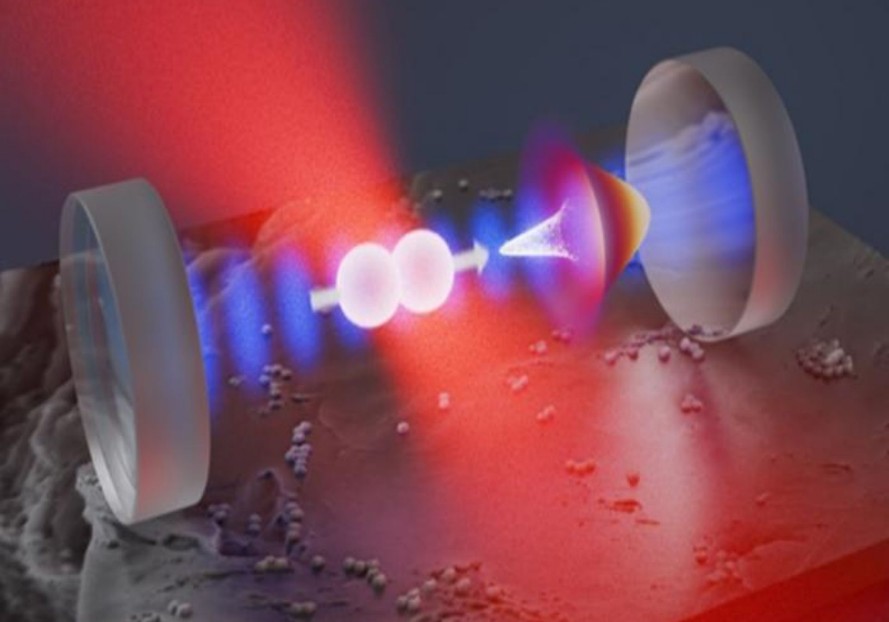
Figure 1. Silica Nanorotor.
Earlier work had already demonstrated ground-state cooling of translational motion in levitated nanoparticles, notably by researchers at the University of Vienna. However, controlling rotational motion has proven far more challenging. Prior efforts, including those at ETH Zurich, managed to cool rotation in only one dimension. Figure 1 shows Silica Nanorotor.
Cooling Rotation in Two Dimensions
In this latest study, scientists from the University of Vienna, TU Wien, and Ulm University took a major step forward. They trapped a nanoscale dumbbell-shaped rotor using a highly focused laser field. Initially, the particle exhibited libration—small, thermally driven angular oscillations. To suppress this motion, the researchers employed optical cooling techniques to bring the system close to absolute zero.
By extending this process across two axes, the team achieved quantum-limited alignment of the rotor’s orientation. The uncertainty in its direction was reduced to just 20 microradians—so precise that the rotor’s tip moved less than one-hundredth the diameter of a single atom. As one researcher described it, the alignment is comparable to a compass needle pointing with accuracy finer than the width of a bacterium.
Opening the Door to Quantum Technologies
Beyond its experimental significance, this breakthrough paves the way for a new class of quantum technologies. Rotational systems exhibit behaviors fundamentally different from linear motion. After each full rotation, the rotor returns to the same orientation, enabling unique quantum effects with no classical counterpart.
When the trapping light is switched off, the nanorotor can enter a superposition state, effectively rotating in multiple directions simultaneously [1]. Such phenomena could provide powerful new platforms for exploring the boundary between classical and quantum physics.
Moreover, these ultra-cold nanorotors are highly sensitive to minute torques, making them promising candidates for next-generation quantum sensors. The ability to manipulate rotational motion at the quantum level could lead to advances in precision measurement, fundamental physics experiments, and nanoscale technologies.
Importantly, the researchers note that their two-dimensional cooling technique is scalable. While larger objects are easier to cool, applying these methods to smaller systems could enable the observation of rotational quantum interference—bringing quantum behavior ever closer to everyday scales.
Reference:
- https://interestingengineering.com/science/world-first-quantum-ground-state-rotation-nanorotor
Cite this article:
Keerthana S (2026), World First as Silica Nanorotor Hits Quantum Ground State of Rotation, AnaTechMaz, pp.493
Recent Post
-

Quantum Circuits Harbor a Hidden Flaw—And It Could Change Everything
This raises a crucial question: if every step in a quantum circuit is...

Atomic Chains Convert Electric Fields into Detectable Quantum Signals
Researchers at Nanyang Technological University (NTU) have...

Scientists Uncover Quantum Boost for Energy Transfer at the Nanoscale
A newly uncovered mechanism is reshaping how scientists...

Researchers in the US Unveil Material That Can Toggle Between Quantum States
Researchers in the United States have confirmed the existence of a unique...
Silicon-Based Quantum Processor Achieves Full Logical Functionality
In a significant advance for quantum technology, researchers have developed...
-

“World-First Quantum Navigation Trial on UK Train Aims to Replace GPS”
The United Kingdom has taken a major step toward next-generation rail...
-

Next-Gen Navigation: NASA-Tested Quantum Tech Could Replace GPS Satellites
A compact quantum sensor no larger than a quart of milk...
-

Few-Shot Android Malware Detection Gets a Quantum Boost
A new study is pushing the boundaries of cybersecurity by combining quantum computing...
-

Custom Vector Lasing Powered by Möbius-Like Quasi-BICs
Researchers have developed a new method to generate vectorial laser beams...
-
US Scientists Create Noise-Free Phonon Lasers for Quantum Sensing
A team of researchers from the University of Rochester...
-

From 1,000 to 5 Qubits: Quantum Leap Paves the Way for Real-World Computing
Researchers at the California Institute of Technology, working...
-

“Quantum Leap: New Method Could Cut the Number of Qubits Needed”
A team of Australian researchers has unveiled a novel approach to quantum...
-
World First as Silica Nanorotor Hits Quantum Ground State of Rotation
At the macroscopic level, motion never truly stops—objects vibrate and rotate due to thermal energy. As...

New Quantum Discovery Could Lead to Self-Powered Electronics
Researchers have discovered a method to control a quantum phenomenon in advanced materials...
Scientists Revamp a Classic Material for Next-Generation Quantum Technology
Researchers led by Penn State University have discovered that a...