

Silicon-Based Quantum Processor Achieves Full Logical Functionality
In a significant advance for quantum technology, researchers have developed a silicon-based quantum processor capable of executing a full range of logical operations while actively detecting errors. The breakthrough marks an important step toward building reliable, scalable quantum computers.
A team from the Shenzhen International Quantum Academy has demonstrated that silicon—long the backbone of modern electronics—can now support complex quantum operations previously achieved mainly in superconducting systems. Their processor not only manipulates quantum information but also monitors it for errors in real time, addressing one of the biggest challenges in quantum computing.
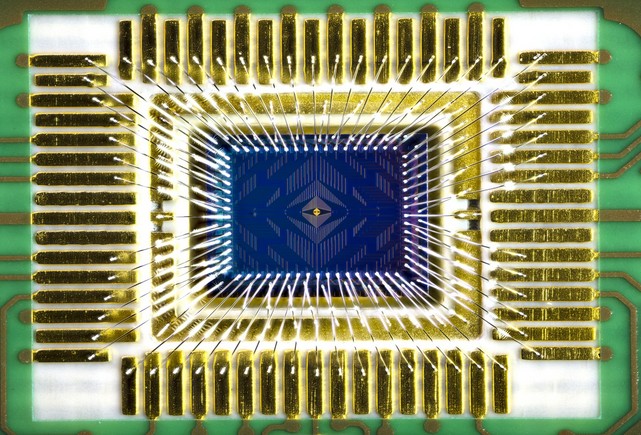
Figure 1. Quantum Processor.
Quantum systems are notoriously fragile. Even minor environmental disturbances can introduce noise, leading to calculation errors. To tackle this, scientists encode information into “logical qubits,” which are designed to identify and manage such errors. The new silicon chip successfully implements this concept, showing that fault-tolerant quantum computing may be within reach using existing semiconductor materials.
From Individual Qubits to Functional Logic
The processor was built by precisely embedding phosphorus atoms into silicon, enabling fine control over individual qubits. The researchers also introduced techniques to minimize signal interference—one of the primary sources of quantum errors. Figure 1 shows quantum processor.
Using just four physical qubits, the team created two logical qubits capable of detecting errors during operations. This setup allowed the system to identify unwanted disturbances as computations progressed, ensuring more reliable results.
Importantly, the study demonstrated a complete operational workflow: preparing error-protected quantum states, performing logical operations, and applying them within an algorithm. This end-to-end capability represents a key milestone in quantum system design.
To validate their approach, the researchers ran a quantum simulation to determine the lowest-energy state of a water molecule. The results closely aligned with theoretical predictions, highlighting the processor’s ability to handle meaningful computational tasks.
Toward Real-World Quantum Applications
The team employed the Variational Quantum Eigensolver, a widely used quantum algorithm, to carry out the molecular simulation [1]. The small deviation from expected values suggests that silicon-based quantum systems are becoming increasingly practical for real-world applications.
Beyond demonstrating technical feasibility, the work shows that silicon platforms can evolve from controlling a handful of qubits to executing coordinated, error-aware computations. This capability is essential for scaling up quantum machines.
Silicon’s compatibility with existing semiconductor manufacturing techniques further strengthens its position as a leading candidate for future quantum hardware. With this breakthrough, researchers have taken a decisive step toward integrating quantum computing into the technological mainstream.
Reference:
- https://interestingengineering.com/science/silicon-quantum-chip-logical-operations
Cite this article:
Keerthana S (2026), Silicon-Based Quantum Processor Achieves Full Logical Functionality, AnaTechMaz, pp.485
Recent Post
-

Quantum Circuits Harbor a Hidden Flaw—And It Could Change Everything
This raises a crucial question: if every step in a quantum circuit is...

Atomic Chains Convert Electric Fields into Detectable Quantum Signals
Researchers at Nanyang Technological University (NTU) have...

Scientists Uncover Quantum Boost for Energy Transfer at the Nanoscale
A newly uncovered mechanism is reshaping how scientists...

Researchers in the US Unveil Material That Can Toggle Between Quantum States
Researchers in the United States have confirmed the existence of a unique...
Silicon-Based Quantum Processor Achieves Full Logical Functionality
In a significant advance for quantum technology, researchers have developed...
-

“World-First Quantum Navigation Trial on UK Train Aims to Replace GPS”
The United Kingdom has taken a major step toward next-generation rail...
-

Next-Gen Navigation: NASA-Tested Quantum Tech Could Replace GPS Satellites
A compact quantum sensor no larger than a quart of milk...
-

Few-Shot Android Malware Detection Gets a Quantum Boost
A new study is pushing the boundaries of cybersecurity by combining quantum computing...
-

Custom Vector Lasing Powered by Möbius-Like Quasi-BICs
Researchers have developed a new method to generate vectorial laser beams...
-
US Scientists Create Noise-Free Phonon Lasers for Quantum Sensing
A team of researchers from the University of Rochester...
-

From 1,000 to 5 Qubits: Quantum Leap Paves the Way for Real-World Computing
Researchers at the California Institute of Technology, working...
-

“Quantum Leap: New Method Could Cut the Number of Qubits Needed”
A team of Australian researchers has unveiled a novel approach to quantum...
-
World First as Silica Nanorotor Hits Quantum Ground State of Rotation
At the macroscopic level, motion never truly stops—objects vibrate and rotate due to thermal energy. As...

New Quantum Discovery Could Lead to Self-Powered Electronics
Researchers have discovered a method to control a quantum phenomenon in advanced materials...
Scientists Revamp a Classic Material for Next-Generation Quantum Technology
Researchers led by Penn State University have discovered that a...