

Quantum Speed Hack: Additional Qubits Reduce Measurement Time Without Sacrificing Precision
New Breakthrough in Quantum Measurements
Researchers have developed a novel method to accelerate quantum measurements—an essential advancement for the future of quantum technologies.

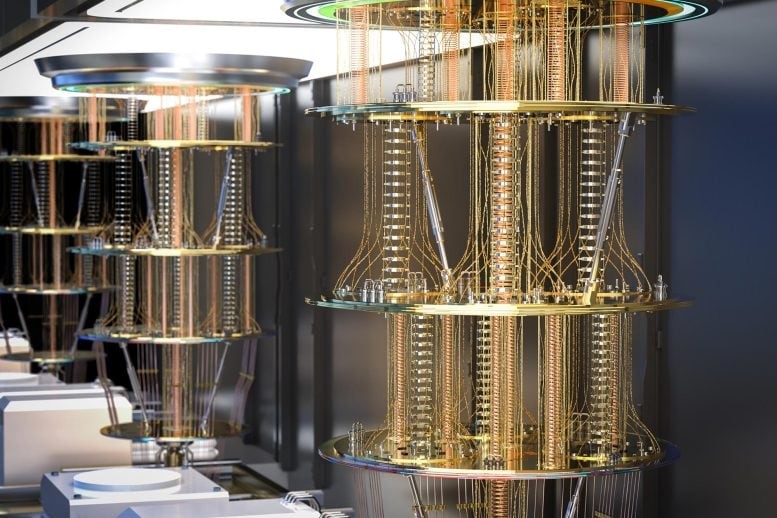
Figure 1. Quantum Speed Boost: More Qubits Cut Measurement Time Without Losing Accuracy.
Fast and precise quantum measurements are critical for the performance of next-generation quantum devices. However, quantum systems are incredibly delicate; even minimal disturbances during measurement can introduce significant errors. Until now, scientists faced a fundamental dilemma: they could enhance measurement accuracy or speed, but not both simultaneously. Figure 1 shows Quantum Speed Boost: More Qubits Cut Measurement Time Without Losing Accuracy.
How Extra Qubits Make a Difference
The team’s method leverages additional qubits—the basic units of quantum information—to “trade space for time.” Unlike classical bits that hold a value of either 0 or 1, qubits can exist in multiple states simultaneously due to superposition.
Normally, measuring a qubit requires a relatively long probing time to ensure high accuracy. By adding extra qubits to the measurement process, researchers can collect more information in a shorter time, greatly speeding up measurements without compromising precision.
Explaining the Concept Through an Everyday Analogy
Chris Corlett, a PhD student at the University’s School of Physics and first author of the paper, explained the idea this way:
“Imagine you see a picture of two glasses of water—one holding 25ml and the other 20ml—and you need to quickly decide which glass has more water. If you only have one second to look, it might be hard to tell. But if you have two seconds, you can be much more confident in your choice.
“In our method, adding an extra qubit increases the amount of information gathered in the same amount of time. It’s like doubling the volume of each glass to 50ml and 40ml, making the difference easier to see quickly.
“The great thing is this pattern continues with more qubits. For example, with three qubits, it’s like the glasses hold 75ml and 60ml, letting you confidently tell which is fuller in just 0.66 seconds. This simple analogy captures the intuition behind our breakthrough.”
Collaborative Discovery Across Leading Universities
Chris achieved this breakthrough while working closely with his supervisors, Professor Noah Linden, Professor of Theoretical Physics, and Dr. Paul Skrzypczyk, Associate Professor of Physics, alongside collaborators from the University of Oxford, Strathclyde University, and Sorbonne Université in Paris.
Remarkably, their method not only speeds up measurements but also maintains or even improves their quality. This approach is versatile and could be applied across a wide range of cutting-edge quantum hardware platforms. As the global race to develop the most advanced quantum technologies intensifies, this technique has strong potential to become a standard tool in quantum measurement protocols.
The Challenge of Quantum Measurement
Quantum computers rely on qubits, which are delicate and easily disturbed. Measuring these qubits accurately usually takes time, because rushing can introduce errors. Scientists have long faced a tough trade-off: speed up measurements but lose precision, or keep precision but slow down the process.
What Are Qubits and Superposition?
Unlike classical bits that are either 0 or 1, qubits can exist in multiple states simultaneously—a property called superposition. This unique feature lets quantum computers perform complex calculations, but it also makes measuring qubits tricky and time-consuming.
The Breakthrough—Adding Extra Qubits
Researchers found a clever way to add extra qubits into the measurement process. By increasing the number of qubits measured together, they “trade space for time.” This means they use more qubits to gather more information faster, cutting down the measurement time while still keeping the result accurate.
Understanding the Concept with an Analogy
Imagine two glasses of water—one slightly fuller than the other. If you only glance for a moment, it’s hard to tell which has more. But if the glasses were bigger, the difference would be easier to see quickly. Adding qubits is like making those glasses bigger, allowing faster and clearer measurements.
Implications and Future Potential
This new method works across various quantum hardware and could revolutionize how quantum devices measure qubits. By speeding up measurements without losing precision, it pushes quantum technology closer to real-world applications and might become a standard tool in the quantum computing race.
Source: SciTECHDaily
Cite this article:
Priyadharshini S (2025), Quantum Speed Hack: Additional Qubits Reduce Measurement Time Without Sacrificing Precision, AnaTechMaz, pp. 285
Recent Post
-

Scientists Create Ultra-Thin 2D Metals for The First Time, Going Beyond Graphene
TResearchers from the Institute of Physics (IOP) at the Chinese.....
-
Solving The Quantum Puzzle: 40-Year Entanglement Mystery Finally Unlocked
A breakthrough study published in Nature Physics by Victor Barizien and...

Dark Matter Unveiled? New Quantum Gravity Theory Redefines Einstein’s Concept of Spacetime
For decades, physicists have struggled to reconcile quantum mechanics and.....

Breakthrough in Quantum Computing: Scientists Overcome 25-Year Chip Fabrication Barrier
Quantum computers tap into the fundamental principles of quantum mechanics...
Quantum Rainfall: Ultracold Atoms Reveal the Secrets of Liquid Matter
In classical physics, surface tension arises from the cohesive forces.....
-
U.S. Military Initiates Effort to Identify the Top Quantum Computer
The U.S. Military has initiated a program to identify which companies...
-

Scientists Uncover New Type of “Hall Effect” That Could Transform Electronics
The classical Hall effect, first observed by Edwin Hall at Johns Hopkins...
-
Harvard Develops Chip-Sized Laser Powerful Enough to Reveal Hidden Worlds
The research was spearheaded by senior author Federico Capasso, the Robert...
-
Capturing Ghost Particles in 4D: How Quantum Sensors are Revolutionizing Collider Physics
To probe the fundamental nature of matter, energy, space, and time...
-

MIT’s Quarton Coupler: Supercharged Qubits Propel Quantum Computing Forward
Quantum computers hold the promise to transform fields like materials....
-
Breaking The Quantum Mirror: Hidden Chirality Discovered in A Symmetrical Crystal
This is somewhat like pointing the James Webb telescope at the quantum world...
-
MIT Captures Breathtaking First Images of Atoms Interacting in Open Space
MIT physicists have captured the first-ever direct images of individual...
-
Innovative Tunneling Method Uncovers Hidden Characteristics of High-Temperature Superconductors
Because their critical temperatures exceed the boiling point of.....
-
Quantum Computers Just Outperformed Supercomputers – Here's What They Achieved
In a significant scientific breakthrough, researchers at USC have...
Quantum Speed Hack: Additional Qubits Reduce Measurement Time Without Sacrificing Precision
Researchers have developed a novel method to accelerate quantum...