

Scientists Use AI To Make Ultrafast Laser Simulations Over 250 Times Faster
Researchers from Stanford University, University of California, Los Angeles, and SLAC National Accelerator Laboratory have created a deep-learning surrogate model that can dramatically accelerate simulations of nonlinear optical processes used in advanced ultrafast laser systems.
Modeling the complex optical behavior behind these laser technologies normally demands enormous computing power, making it difficult for experiments that require rapid feedback and fast adjustments. The new AI-based approach significantly reduces computation time while still maintaining high accuracy across many different laser pulse shapes.
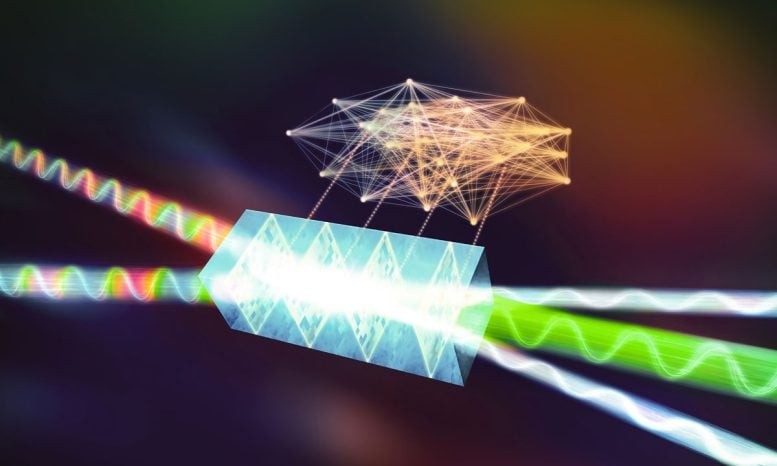
Figure 1. AI Models Nonlinear Laser Pulse Mixing in χ² Crystal
How Nonlinear Optics Powers Advanced X-Ray Generation
The research centers on second-order nonlinear optics, known as χ² processes, in which light waves interact inside specially engineered crystals to exchange energy and generate new frequencies or customized laser pulse shapes. These optical interactions are essential for many advanced laser and particle accelerator technologies. Figure 1 shows AI Models Nonlinear Laser Pulse Mixing in χ² Crystal.
At SLAC National Accelerator Laboratory’s upgraded Linac Coherent Light Source II, infrared laser pulses are converted into green light and then into ultraviolet light. The UV pulses strike a cathode to release electron bunches, which are later accelerated and shaped to produce extremely powerful X-ray pulses for scientific research. Because the timing and shape of the UV pulse directly influence the electron bunches, they also affect the quality of the resulting X-rays.
The newly developed AI surrogate model, described in Advanced Photonics, is designed to simulate this nonlinear χ² frequency conversion process far more efficiently. Traditional approaches solve the nonlinear Schrödinger equation using the split-step Fourier method, a highly accurate but computationally demanding technique that constantly switches between time-domain and frequency-domain calculations. In large laser simulations, this step alone can consume about 95 percent of the total computation time.
Deep Learning Eliminates the Most Time-Consuming Part of Laser Simulations
To overcome the biggest computational bottleneck, the researchers adapted long short-term memory (LSTM) neural networks — a form of recurrent AI model previously used to study pulse propagation in fiber optics [1]. They redesigned the system specifically for the more challenging χ² nonlinear optical environment, where multiple interacting light fields evolve together simultaneously.
The team evaluated the model using noncollinear sum-frequency generation (SFG), a demanding process in which three coupled optical fields interact under a wide range of pulse conditions. This provided a rigorous test of the AI system’s speed and accuracy.
A key innovation was keeping the calculations entirely within a compressed frequency-domain representation. By eliminating the need to constantly switch between time and frequency domains, the model dramatically reduced the computational workload and accelerated the simulations.
AI Delivers High-Accuracy Laser Simulations in Milliseconds
The AI surrogate model successfully reproduced both the timing and spectral characteristics of laser pulses across a broad range of challenging conditions, including strong phase modulation and complex spectral distortions. By using batched GPU inference, the system reduced average simulation times to just a few milliseconds per case, making it vastly faster than traditional simulation methods. Researchers also found that when the model accurately predicted the primary sum-frequency generation output, the secondary interacting optical fields closely matched results from conventional physics-based simulations.
The researchers ultimately aim to integrate these surrogate models directly into real-world laser systems. Because the framework is modular, different physical processes can be represented by separate trained AI blocks, allowing predictive simulations to operate alongside live experiments in real time.
In the future, combining fast machine-learning surrogates with active experimental facilities could enable advanced digital twins, adaptive control systems, and tighter connections with diagnostic tools across a wide range of laser-driven scientific research platforms.
reference:
- https://scitechdaily.com/scientists-use-ai-to-supercharge-ultrafast-laser-simulations-by-more-than-250x/
Cite this article:
Janani R (2026), Scientists Use AI To Make Ultrafast Laser Simulations Over 250 Times Faster, AnaTechMaz, pp.966
Recent Post
-
Japan–US Researchers Create the World’s First Silicon Spintronic Chip
Scientists from Japan and the United States have achieved a....
-

The Next AI Frontier: Systems Capable of Building Better AI
Artificial intelligence may soon play a direct role in creating its own successors, according to new...
-
New AI System Deciphers Laws of Physics to Revolutionize Optical Engineering
Researchers at Chalmers University of Technology have developed a....
-
Scientists Create a Living AI System Powered by Human Brain Cells
Researchers at Princeton University have developed a 3D...
-

AI Symptom Checkers Found to Have Dangerous Weakness, Study Warns
Researchers discovered that when people distrust AI, they tend to....
-
Scientists Use AI To Make Ultrafast Laser Simulations Over 250 Times Faster
Researchers from Stanford University, University of California, Los....
-
Anthropic Acquires AI Developer Tool Startup Stainless, Potentially Cutting Off Rivals Like OpenAI and Google
Stainless is a platform that....
-

Former eBay Employee Launches Fully AI-Driven Marketing Firm With 27 AI Agents
Former eBay employee Linara Bozieva launched an AI-driven....
-

Perplexity AI Users Report Faster Usage Limits as Company Cites Promo Code Abuse
Perplexity AI says some accounts connected to promotional....
-

Funding Surge Hits Indian Agentic AI Startups as Investors Back Autonomous Enterprise Tech
India’s rapidly expanding artificial intelligence ecosystem is.....
-

Google Joins AI Wearables Race with Smart Glasses Launch at I/O 2026
Google has stepped up competition in the AI wearables space by....
-

AI-Powered Blood Test Can Forecast Stroke and Heart Failure Up to 15 Years Ahead
Researchers at the University of Hong Kong’s LKS Faculty of...
-

BlueQubit AI Packs Years of Quantum Expertise Into a Single Prompt
BlueQubit aims to condense years of specialized quantum....
-

Gemini Audio Converts Conversations into Structured JSON Notes
Gemini Audio can transform audio recordings into structured,...
-
New Vera CPU Delivers Major Performance Gains for AI Computing
NVIDIA Vice President of Hyperscale and High-Performance Computing...
-