

Japan–US Researchers Create the World’s First Silicon Spintronic Chip
Scientists from Japan and the United States have achieved a major breakthrough in next-generation computing by developing the world’s first silicon-based spintronic probabilistic bit, or p-bit. The innovation marks a significant step toward building smarter and more efficient computers capable of tackling complex artificial intelligence and optimization problems.
The pioneering device was created through a collaboration between researchers at Tohoku University in Japan and the U.S. National Institute of Standards and Technology (NIST). It is the first spintronic p-bit ever fabricated directly on a silicon chip using standard semiconductor manufacturing techniques.
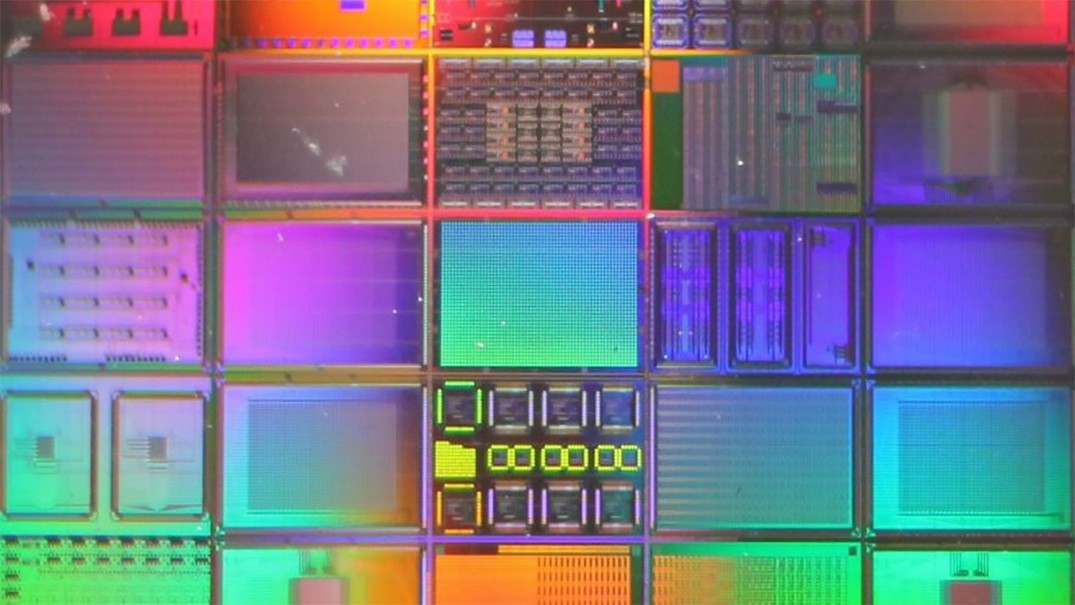
Figure 1. Silicon Spintronic Chip.
Unlike conventional computers, which rely on bits that exist strictly as either 0 or 1, probabilistic computers use p-bits that naturally fluctuate between the two states. This random behavior allows them to explore multiple possibilities simultaneously, making them particularly well suited for AI, machine learning, and optimization tasks.
At the heart of the breakthrough is spintronics, a technology that utilizes the quantum spin of electrons to process and store information. Because magnetic nanodevices naturally generate random fluctuations, researchers view spintronics as one of the most promising approaches for creating practical probabilistic computers. Figure 1 shows Silicon Spintronic Chip.
The research team, led by Dr. Ju-Young Yoon of Tohoku University’s Laboratory for Nanoelectronics and Spintronics, successfully integrated spintronic devices onto a silicon chip by combining advanced semiconductor and spintronic manufacturing techniques developed in both Japan and the United States.
To build the chip, the researchers employed SkyWater Technology’s 130-nanometer CMOS semiconductor process to fabricate transistors and lower interconnect layers. They then added superparamagnetic nanodevices and upper electrode structures using specialized spintronic fabrication facilities at Tohoku University.
Testing confirmed two essential characteristics required for p-bit operation [1]. The device demonstrated natural stochastic fluctuations between states, proving its ability to switch randomly between 0 and 1. Researchers also showed that the average output could be controlled using an input voltage, allowing the probabilistic behavior to be precisely tuned. This achievement represents the first experimental demonstration of a spintronic p-bit monolithically integrated on a silicon chip using conventional integrated circuit manufacturing processes.
The breakthrough opens a pathway toward large-scale spintronic probabilistic computers capable of solving problems that challenge traditional computing systems. As researchers continue improving device performance and integrating larger numbers of p-bits, practical p-computers could become powerful tools for artificial intelligence, machine learning, scientific modeling, and complex optimization tasks. By combining the strengths of silicon technology and spintronics, the new chip could help usher in a new era of computing where machines solve problems more efficiently by embracing uncertainty rather than avoiding it.
reference:
- https://interestingengineering.com/ai-robotics/japan-us-silicon-spintronic-chip-smart-computers
Cite this article:
Keerthana S (2026), Japan–US Researchers Create the World’s First Silicon Spintronic Chip, AnaTechMaz, pp.961
Recent Post
-
Japan–US Researchers Create the World’s First Silicon Spintronic Chip
Scientists from Japan and the United States have achieved a....
-

The Next AI Frontier: Systems Capable of Building Better AI
Artificial intelligence may soon play a direct role in creating its own successors, according to new...
-
New AI System Deciphers Laws of Physics to Revolutionize Optical Engineering
Researchers at Chalmers University of Technology have developed a....
-
Scientists Create a Living AI System Powered by Human Brain Cells
Researchers at Princeton University have developed a 3D...
-

AI Symptom Checkers Found to Have Dangerous Weakness, Study Warns
Researchers discovered that when people distrust AI, they tend to....
-
Scientists Use AI To Make Ultrafast Laser Simulations Over 250 Times Faster
Researchers from Stanford University, University of California, Los....
-

Anthropic Acquires AI Developer Tool Startup Stainless, Potentially Cutting Off Rivals Like OpenAI and Google
Stainless is a platform that....
-

Former eBay Employee Launches Fully AI-Driven Marketing Firm With 27 AI Agents
Former eBay employee Linara Bozieva launched an AI-driven....
-

Perplexity AI Users Report Faster Usage Limits as Company Cites Promo Code Abuse
Perplexity AI says some accounts connected to promotional....
-

Funding Surge Hits Indian Agentic AI Startups as Investors Back Autonomous Enterprise Tech
India’s rapidly expanding artificial intelligence ecosystem is.....
-
Google Joins AI Wearables Race with Smart Glasses Launch at I/O 2026
Google has stepped up competition in the AI wearables space by....
-

AI-Powered Blood Test Can Forecast Stroke and Heart Failure Up to 15 Years Ahead
Researchers at the University of Hong Kong’s LKS Faculty of...
-

BlueQubit AI Packs Years of Quantum Expertise Into a Single Prompt
BlueQubit aims to condense years of specialized quantum....
-

Gemini Audio Converts Conversations into Structured JSON Notes
Gemini Audio can transform audio recordings into structured,...
-
New Vera CPU Delivers Major Performance Gains for AI Computing
NVIDIA Vice President of Hyperscale and High-Performance Computing...
-