

Scientists Create a Living AI System Powered by Human Brain Cells
Researchers at Princeton University have developed a 3D bioelectronic system that combines living neurons with advanced electronics to recognize electrical patterns through programmable computation.
Unlike earlier brain-cell computing experiments that relied on flat 2D cultures or externally monitored 3D cell clusters, this new device integrates directly within the neural network itself, enabling closer interaction with the living cells. The breakthrough could help scientists better understand brain function while advancing low-energy computing technologies.
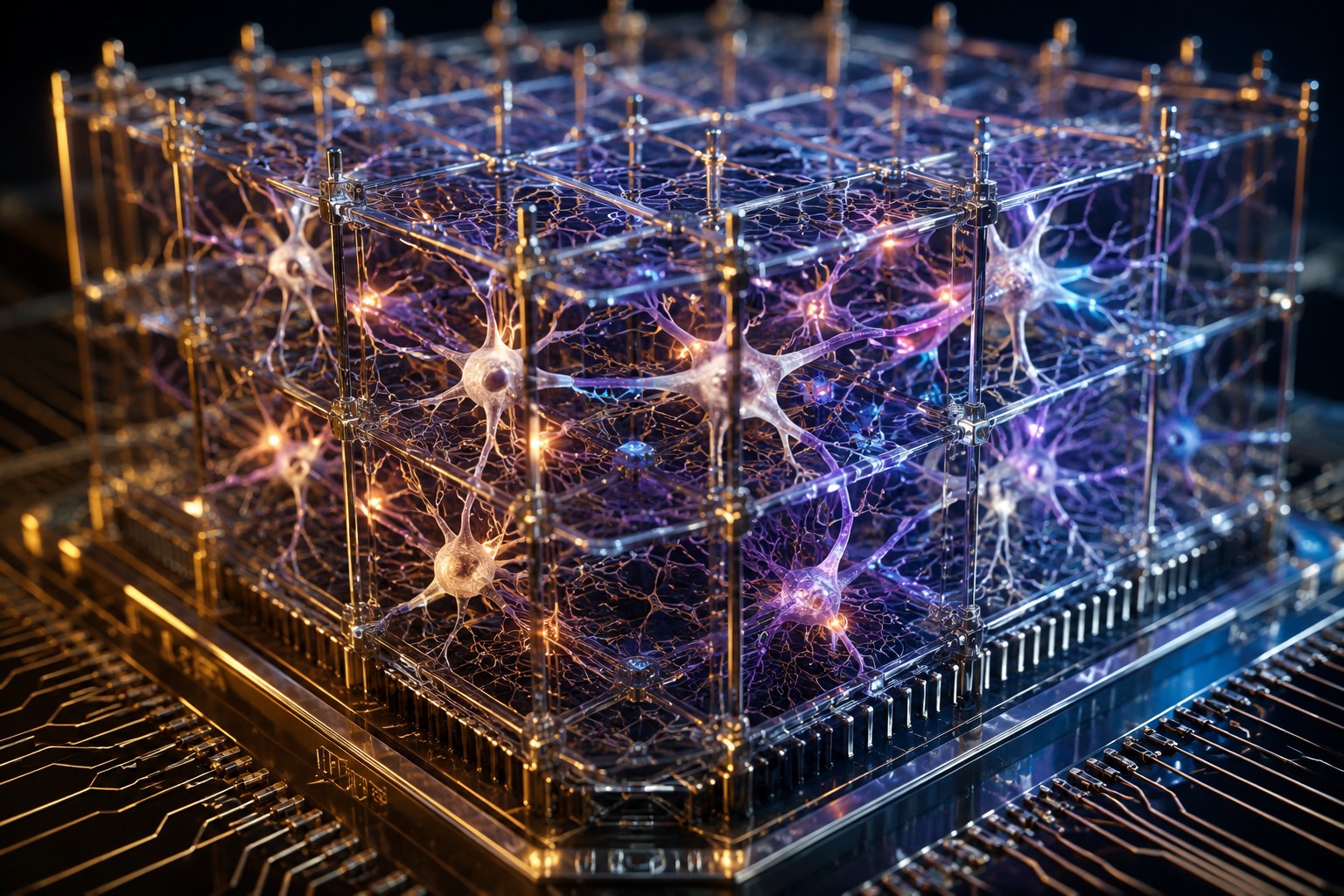
Figure 1. Illustration of a Biocomputing System Integrating Living Neurons with Advanced Electronics for Pattern Recognition.
Using advanced fabrication techniques, the researchers created a 3D framework of microscopic metal wires and electrodes connected by an ultra-thin epoxy layer. The flexible coating allows the structure to interact smoothly with soft, living neurons that grow throughout the scaffold. Over time, tens of thousands of neurons formed a dense 3D network capable of processing and recognizing patterns. Figure 1 shows Illustration of a Biocomputing System Integrating Living Neurons with Advanced Electronics for Pattern Recognition.
Living Neural Network Learns to Recognize Patterns
The researchers explained that the integrated platform enabled them to monitor and stimulate neuronal electrical activity with far greater precision than previous systems. Over a period of more than six months, they tracked how the neural network evolved, experimented with strengthening and weakening key neuronal connections, and trained an algorithm to recognize distinct electrical activity patterns.
In separate experiments, the system successfully distinguished between different spatial pulse patterns as well as different temporal pulse patterns [1]. The team plans to further develop the platform so it can perform increasingly complex computational tasks.
Fu noted that energy efficiency remains one of the biggest challenges facing modern AI systems, pointing out that the human brain uses only about one-millionth of the power required by today’s AI technologies to perform comparable tasks.
Mritunjay, the study’s first author, added that these 3D biological neural networks could not only reveal how the brain processes information so efficiently, but also support research into neurological disorders and future treatment strategies.
reference:
- https://scitechdaily.com/scientists-build-a-living-ai-device-using-real-brain-cells/
Cite this article:
Janani R (2026), Scientists Create a Living AI System Powered by Human Brain Cells, AnaTechMaz, pp.964.
Recent Post
-
Japan–US Researchers Create the World’s First Silicon Spintronic Chip
Scientists from Japan and the United States have achieved a....
-

The Next AI Frontier: Systems Capable of Building Better AI
Artificial intelligence may soon play a direct role in creating its own successors, according to new...
-
New AI System Deciphers Laws of Physics to Revolutionize Optical Engineering
Researchers at Chalmers University of Technology have developed a....
-
Scientists Create a Living AI System Powered by Human Brain Cells
Researchers at Princeton University have developed a 3D...
-

AI Symptom Checkers Found to Have Dangerous Weakness, Study Warns
Researchers discovered that when people distrust AI, they tend to....
-
Scientists Use AI To Make Ultrafast Laser Simulations Over 250 Times Faster
Researchers from Stanford University, University of California, Los....
-
Anthropic Acquires AI Developer Tool Startup Stainless, Potentially Cutting Off Rivals Like OpenAI and Google
Stainless is a platform that....
-

Former eBay Employee Launches Fully AI-Driven Marketing Firm With 27 AI Agents
Former eBay employee Linara Bozieva launched an AI-driven....
-
Perplexity AI Users Report Faster Usage Limits as Company Cites Promo Code Abuse
Perplexity AI says some accounts connected to promotional....
-

Funding Surge Hits Indian Agentic AI Startups as Investors Back Autonomous Enterprise Tech
India’s rapidly expanding artificial intelligence ecosystem is.....
-
Google Joins AI Wearables Race with Smart Glasses Launch at I/O 2026
Google has stepped up competition in the AI wearables space by....
-

AI-Powered Blood Test Can Forecast Stroke and Heart Failure Up to 15 Years Ahead
Researchers at the University of Hong Kong’s LKS Faculty of...
-

BlueQubit AI Packs Years of Quantum Expertise Into a Single Prompt
BlueQubit aims to condense years of specialized quantum....
-

Gemini Audio Converts Conversations into Structured JSON Notes
Gemini Audio can transform audio recordings into structured,...
-
New Vera CPU Delivers Major Performance Gains for AI Computing
NVIDIA Vice President of Hyperscale and High-Performance Computing...
-