

The Universe’s Most Energetic Particles May Be Stranger Than Scientists Expected
Researchers have found that ultraheavy atomic nuclei may help explain some of the most energetic cosmic rays ever detected on Earth. These particles are believed to originate from some of the universe’s most violent environments, such as neutron star mergers and the collapse of massive stars.
Ultrahigh-energy cosmic rays carry more energy than anything produced in human-made particle accelerators. Among the most notable detections is the “Amaterasu particle,” observed in 2021 by the Telescope Array in Utah, and the earlier “Oh-My-God particle” discovered in 1991. Despite their extreme energy levels, their exact origins and nature remain uncertain, leaving a major open question in astrophysics.
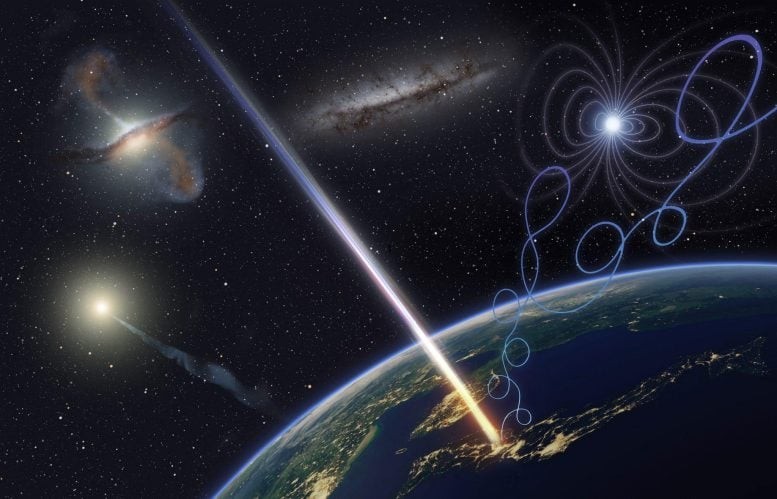
Figure 1. Artist’s Impression of an Ultra-High-Energy Cosmic Ray Striking Earth from Extreme Cosmic Sources
A new study from Penn State researchers, published in Physical Review Letters, proposes that some of the most powerful cosmic rays may consist of atomic nuclei heavier than iron. These nuclei are the dense cores of atoms made up of protons and neutrons, and they account for nearly all of an atom’s mass. Figure 1 shows Artist’s Impression of an Ultra-High-Energy Cosmic Ray Striking Earth from Extreme Cosmic Sources.
Ultraheavy Atomic Nuclei Could Account for the Most Extreme Cosmic Rays
Researchers suggest that ultraheavy atomic nuclei may retain their energy better than protons or lighter nuclei as they travel across intergalactic space, allowing them to reach Earth with extremely high energies even after covering vast cosmic distances. This insight could help scientists better identify the extreme astrophysical environments capable of producing such particles.
The study, involving collaborators from Penn State, the Yukawa Institute for Theoretical Physics in Japan, Virginia Tech, and other institutions, aims to narrow down potential cosmic sources of ultrahigh-energy cosmic rays. According to physicist Kohta Murase, the energy, direction, and magnetic deflection of detected particles like the “Amaterasu particle” can provide clues about their origins.
However, the Amaterasu particle presents a mystery, as it appears to have come from a region of space with no known astrophysical source powerful enough to generate such an energetic event.
A Six-Decade-Long Mystery in Astrophysics
According to researcher Kohta Murase, the origin and acceleration of ultrahigh-energy cosmic rays have remained one of astrophysics’ greatest unsolved mysteries for more than 60 years, ever since the first such particle was detected.
These extraordinary particles possess energies exceeding 100 exa-electron volts—around 10 million times greater than the energies produced by the Large Hadron Collider, the world’s most powerful particle accelerator. The Amaterasu particle alone carried roughly 240 exa-electron volts, packing the kinetic energy of a fast-moving tennis ball into a single subatomic particle.
Murase explained that the universe’s most energetic cosmic rays are believed to originate from extreme astrophysical events, such as neutron star mergers or the collapse of massive stars. By studying the energies, arrival directions, and likely compositions of large numbers of these particles, scientists can gain valuable clues about the cosmic environments that produce them and the mechanisms capable of accelerating them to such extraordinary energies.
Simulating the Journey of Particles Across the Cosmos
To determine which particles could endure the immense journey across intergalactic space, researchers performed advanced computer simulations examining how particles of different masses lose energy over cosmic distances.
Their findings showed that ultraheavy atomic nuclei may retain energy more effectively than protons or medium-mass nuclei at the extreme energies associated with events like the Amaterasu particle. This could allow them to travel enormous distances through space while still reaching Earth with exceptionally high energies.
Murase emphasized that the study does not suggest all ultrahigh-energy cosmic rays are ultraheavy nuclei, but it does indicate that some of the most energetic events could involve them. If confirmed, this would significantly influence how scientists search for the astrophysical sources responsible for these particles. The research also established new constraints on how much ultraheavy nuclei may contribute to the overall population of ultrahigh-energy cosmic rays observed on Earth.
Black Holes and Neutron Stars May Be the Source of Extreme Cosmic Rays
Murase explained that some of the most likely sources of ultraheavy cosmic-ray particles are catastrophic cosmic events, including the explosive deaths of massive stars that collapse into black holes or highly magnetized neutron stars, as well as neutron-star mergers that generate powerful gravitational waves.
These extreme events are also capable of producing gamma-ray bursts, among the most energetic explosions known in the universe. Researchers suggest that contributions from such sources may help explain differences observed between the northern and southern skies in the ultrahigh-energy cosmic-ray spectrum. If ultraheavy nuclei play a major role in these events, future observations should reveal cosmic-ray compositions containing elements heavier than iron.
Murase noted that future facilities, including the proposed AugerPrime and the Global Cosmic Ray Observatory, could help test these predictions about ultraheavy cosmic rays. Further observations of black holes and highly magnetized neutron stars may also provide deeper insight into the origins of these exceptionally energetic particles.
Reference:
- https://scitechdaily.com/the-universes-most-powerful-particles-may-be-even-stranger-than-scientists-thought/
Cite this article:
Janani R (2026), The Universe’s Most Energetic Particles May Be Stranger Than Scientists Expected, AnaTechMaz, pp.877
Recent Post
-
Ultra-Faint Dwarf Galaxies May Reveal the Universe’s Earliest Secrets
Ultra-faint dwarf galaxies orbiting the Milky Way may provide....
-
The Coldest Objects in the Galaxy Could Be Alien Megastructures Disguised as Stars
The James Webb Space Telescope has uncovered a dynamic daily ....
-
The Galaxy’s Coldest “Stars” May Actually Be Alien Megastructures
Astronomers are exploring how to detect potential Dyson swarms by searching for unusually cold....
-
NASA’s Psyche Spacecraft Uses Mars for a Powerful Gravity Assist
NASA’s Psyche successfully completed a close flyby of Mars on May 15, using the planet’s gravity as a...
-
Scientists Discover Evidence That Asteroids May Have Sparked Life on Earth
Researchers from the Korea Institute of Geoscience and Mineral....
-
Scientists Successfully Test a High-Power Thruster Designed for Crewed Missions to Mars
NASA’s latest electric propulsion system has broken a U.S.....
-
The Universe’s Most Energetic Particles May Be Stranger Than Scientists Expected
Researchers have found that ultraheavy atomic nuclei...
-
NASA Captures Unusual Solar Radio Burst That Refused to Fade
NASA scientists were stunned after the Sun emitted a strange radio signal that continued broadcasting...
-
Scientists Scan Famous Exoplanet K2-18b for Possible Signs of Alien Life
A major SETI Institute investigation found no evidence of...
Scientists Warn NASA May Be Missing Potential Evidence of Alien Life
Astrobiologists warn that the search for alien life may be constrained..