

The Galaxy’s Coldest “Stars” May Actually Be Alien Megastructures
Astronomers are exploring how to detect potential Dyson swarms by searching for unusually cold and clean infrared signals around long-lived stars. The concept, first proposed by Freeman Dyson in 1960, suggests that an advanced civilization could encircle its star with a collection of energy-harvesting structures capable of capturing most of its output.
A new preprint by Amirnezam Amiri of the University of Arkansas investigates what such megastructures might look like from Earth and identifies the types of stars where searches for these technosignatures could be most promising.
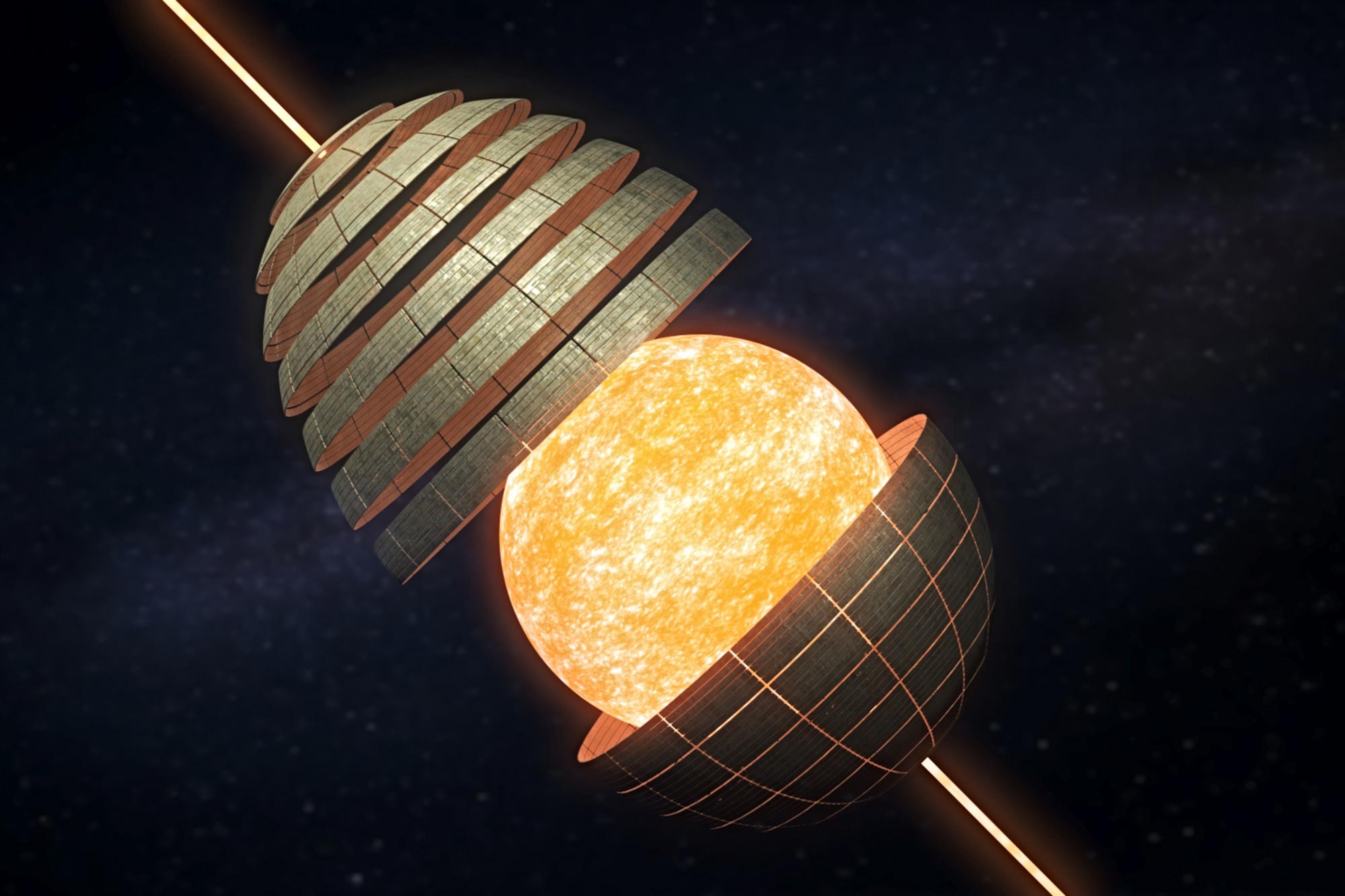
Figure 1. A Dyson Sphere Is a Hypothetical Alien Megastructure Designed to Capture a Star’s Energy and Reemit It as Infrared Heat.
Smaller Stars May Be Better Targets for Detection
Red dwarfs are considered strong candidates for hosting potential Dyson swarms because they are the most abundant stars in the Milky Way and burn their fuel extremely slowly, allowing them to exist for trillions of years. Their small size also means that a swarm could be built relatively close to the star, reducing the amount of material required. Figure 1 shows A Dyson Sphere Is a Hypothetical Alien Megastructure Designed to Capture a Star’s Energy and Reemit It as Infrared Heat.
White dwarfs may be even more favorable from an engineering perspective. As compact remnants of Sun-like stars, they are much smaller in size, allowing a Dyson swarm to orbit at very close distances. They can also provide stable energy output over billions of years, making them potentially efficient and long-lasting targets for advanced energy-harvesting structures.
Starlight Could Be Converted into Heat
Astronomers use the Hertzsprung–Russell (H-R) diagram to classify stars by temperature and luminosity, but a Dyson sphere would dramatically alter how a star appears on this chart by blocking its visible light. Although the star’s energy output would remain unchanged, conservation of energy means the surrounding structure would re-emit that energy as heat, primarily in the infrared.
As a result, a Dyson sphere would act like a shell that absorbs starlight, processes the energy, and radiates it back as thermal emission. This would shift the object toward lower temperatures on the H-R diagram while keeping its overall luminosity the same, since total energy output is preserved when measured across all wavelengths.
The key point is how dramatically such an object would shift on the Hertzsprung–Russell diagram. While a typical red dwarf already appears in the cooler, lower-right region with surface temperatures around 3000 K, a Dyson sphere would be far colder, with an estimated temperature of about 50 K—nearly two orders of magnitude lower.
Since no known natural stars occupy this extremely cold region of the diagram, an object detected there would stand out as a strong candidate for a possible Dyson swarm or other artificial structure.
Unusual Signals May Stand Out
Another potential indicator of a Dyson swarm is the absence of expected dust signatures. Normally, stars surrounded by dust or debris disks show characteristic silicate emission lines in their spectra, but a Dyson swarm made of engineered structures would not produce such dust, resulting in unusually “clean” spectral observations.
In a more realistic swarm design, gaps between solar collectors and variations in density would likely exist to make construction physically feasible. These irregularities could cause the star’s brightness to fluctuate in non-natural patterns as the structure rotates, producing erratic light curves that differ from those of ordinary stellar systems.
Potential Candidates Have Already Been Identified by Telescopes
Infrared-capable telescopes like the James Webb Space Telescope are well suited to searching for potential Dyson sphere signatures, while earlier missions such as WISE continue to contribute valuable data to these investigations.
In May 2024, a study from Project Hephaistos reported seven possible Dyson sphere candidates among about five million stars, all of them red dwarfs [1]. One candidate was later ruled out after its unusual signal was traced to a background supermassive black hole. However, five candidates remain under consideration and warrant further observation. The research adds new tools and insights to the ongoing search for technosignatures of advanced civilizations.
Reference:
- https://scitechdaily.com/the-coldest-stars-in-the-galaxy-might-actually-be-alien-megastructures/
Cite this article:
Janani R (2026), The Galaxy’s Coldest “Stars” May Actually Be Alien Megastructures, AnaTechMaz, pp.873
Recent Post
-
Ultra-Faint Dwarf Galaxies May Reveal the Universe’s Earliest Secrets
Ultra-faint dwarf galaxies orbiting the Milky Way may provide....
-
The Coldest Objects in the Galaxy Could Be Alien Megastructures Disguised as Stars
The James Webb Space Telescope has uncovered a dynamic daily ....
-
The Galaxy’s Coldest “Stars” May Actually Be Alien Megastructures
Astronomers are exploring how to detect potential Dyson swarms by searching for unusually cold....
-
NASA’s Psyche Spacecraft Uses Mars for a Powerful Gravity Assist
NASA’s Psyche successfully completed a close flyby of Mars on May 15, using the planet’s gravity as a...
-

Scientists Discover Evidence That Asteroids May Have Sparked Life on Earth
Researchers from the Korea Institute of Geoscience and Mineral....
-
Scientists Successfully Test a High-Power Thruster Designed for Crewed Missions to Mars
NASA’s latest electric propulsion system has broken a U.S.....
-
The Universe’s Most Energetic Particles May Be Stranger Than Scientists Expected
Researchers have found that ultraheavy atomic nuclei...
-
NASA Captures Unusual Solar Radio Burst That Refused to Fade
NASA scientists were stunned after the Sun emitted a strange radio signal that continued broadcasting...
-

Scientists Scan Famous Exoplanet K2-18b for Possible Signs of Alien Life
A major SETI Institute investigation found no evidence of...
Scientists Warn NASA May Be Missing Potential Evidence of Alien Life
Astrobiologists warn that the search for alien life may be constrained..