

Ultra-Faint Dwarf Galaxies May Reveal the Universe’s Earliest Secrets
Ultra-faint dwarf galaxies orbiting the Milky Way may provide important clues to one of cosmology’s greatest mysteries. These tiny, dim galaxies are believed to be ancient relics from the early Universe. Using advanced simulations, researchers from the Oskar Klein Centre and the LYRA collaboration found that these galaxies could reveal how conditions in the young cosmos determined which galaxies successfully formed stars and which remained dark and inactive.
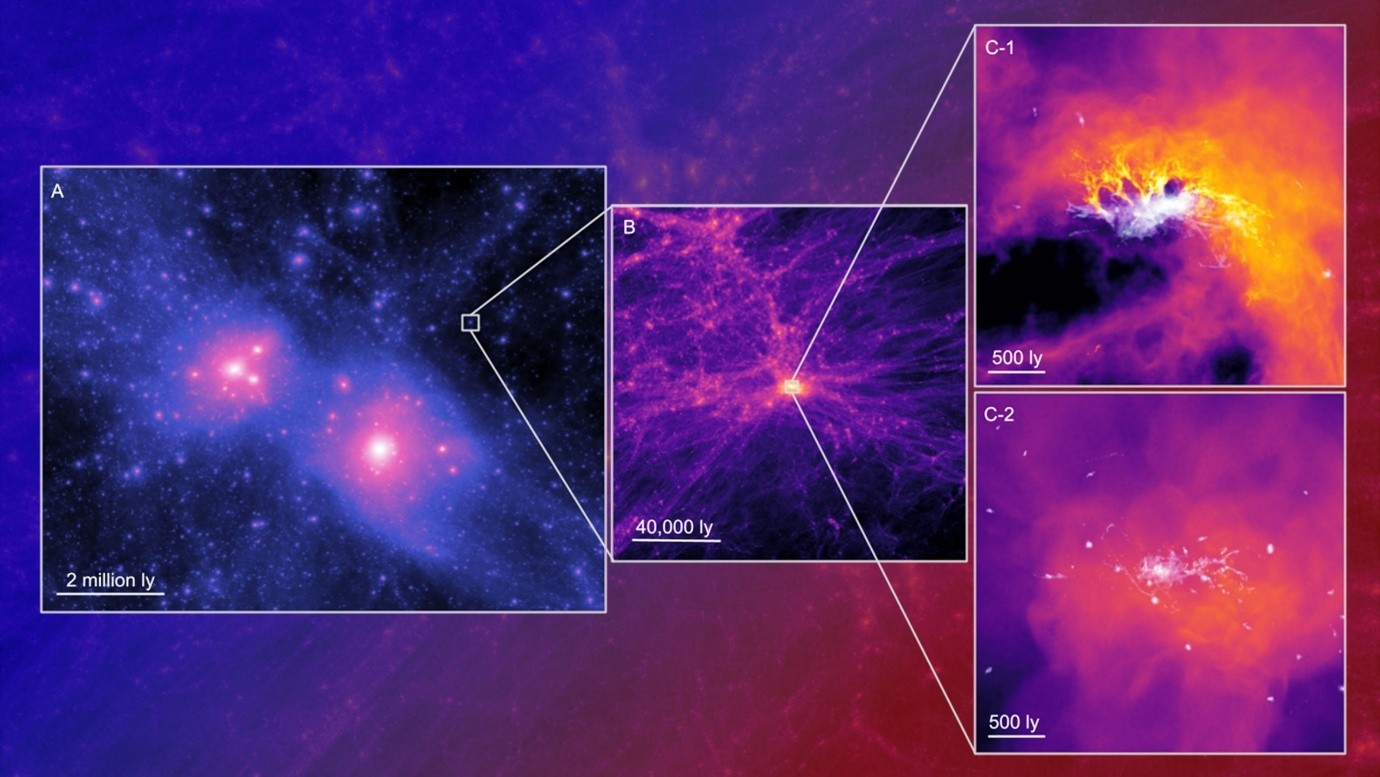
Figure 1. Dark Matter and Tiny Galaxies Simulated Across the Local Group
Published in the journal Monthly Notices of the Royal Astronomical Society, the study was led by Azadeh Fattahi in collaboration with researchers from Durham University and the University of Hawaiʻi. The team developed a new suite of high-resolution cosmological simulations focused on the faintest galaxies in the Universe, creating what researchers describe as the largest and most detailed simulated sample of ultra-faint dwarf galaxies to date. Figure 1 shows Dark Matter and Tiny Galaxies Simulated Across the Local Group.
Tiny Galaxies Push the Limits of Understanding
Dwarf galaxies are far smaller than the Milky Way and form within small dark matter halos predicted by standard cosmological theories. The faintest among them, known as ultra-faint dwarf galaxies, can be more than a million times less massive than the Milky Way, placing them at the limits of current understanding of galaxy formation and dark matter behavior. According to Azadeh Fattahi, their extremely small size has made them especially difficult to simulate accurately. Using advanced simulations, researchers were able to build a clearer and more systematic picture of how these fragile galaxies evolved throughout cosmic history. Shaun Brown compared the process to studying crops and weather, explaining that just as crop yields can reveal past climate conditions, the present-day properties of faint dwarf galaxies may offer valuable clues about the state of the Universe in its earliest epochs.
A New Window Into the Early Universe
The simulations are significant not only because they successfully recreate ultra-faint dwarf galaxies, but also because they suggest these nearby systems can act as records of the early Universe’s “climate.” By testing different models of radiation conditions in the young cosmos, the researchers explored how those environments influenced whether small dark matter halos were able to form stars or remained dark and inactive.
Shaun Brown explained that the team investigated two different models of the early Universe, focusing on conditions less than 500 million years after the Big Bang, to see how they influenced the smallest galaxies observed today more than 13 billion years later. The simulations revealed that ultra-faint dwarf galaxies are highly sensitive to these early conditions, unlike larger galaxies such as the Milky Way. According to the researchers, the environment of the young Universe could determine whether tiny dark matter halos evolved into visible galaxies or remained completely starless. This extreme sensitivity may allow astronomers to test competing ideas about early-Universe physics through future observations. Azadeh Fattahi noted that upcoming observations from the Vera C. Rubin Observatory are expected to discover many more ultra-faint dwarf galaxies around the Milky Way, providing valuable new data for these studies.
Future Observations May Put the Theory to the Test
Astronomers expect the Vera C. Rubin Observatory to discover nearly all of the satellite galaxies surrounding the Milky Way, and researchers believe these observations could reveal valuable details about conditions shortly after the Big Bang. The study suggests that examining nearby ultra-faint dwarf galaxies may help scientists reconstruct what the infant Universe was like, offering clues that are difficult to obtain through other observations. Azadeh Fattahi also noted that the findings are especially relevant given recent discoveries by the James Webb Space Telescope, which has identified unexpectedly massive and bright galaxies in the early Universe. While those distant galaxies challenge existing cosmological theories, nearby ultra-faint dwarf galaxies could provide a complementary way to investigate the physics of the young cosmos.
Massive Simulations Raise New Cosmic Questions
Modeling ultra-faint dwarf galaxies required enormous computational resources and months of processing time. Azadeh Fattahi explained that the simulations were both technically demanding and computationally expensive, ultimately running for more than six months [1]. The project generated roughly 300 terabytes of data, forcing researchers to upgrade and redesign older algorithms that were not built to manage datasets of that scale. Most of the simulations were carried out on COSMA 8, a supercomputer operated by Durham University Institute for Computational Cosmology as part of the UK’s DiRAC High Performance Computing Facility.
Azadeh Fattahi and her team plan to use the new simulation suite to investigate some of the biggest unresolved questions in cosmology and galaxy formation. Future studies will explore where the Universe’s first generation of stars may still be detectable and how ultra-faint dwarf galaxies could provide new insights into the true nature of dark matter.
Reference:
- https://scitechdaily.com/ultra-faint-dwarf-galaxies-could-unlock-secrets-of-the-early-universe/
Cite this article:
Janani R (2026), Ultra-Faint Dwarf Galaxies May Reveal the Universe’s Earliest Secrets, AnaTechMaz, pp.871
Recent Post
-
Ultra-Faint Dwarf Galaxies May Reveal the Universe’s Earliest Secrets
Ultra-faint dwarf galaxies orbiting the Milky Way may provide....
-
The Coldest Objects in the Galaxy Could Be Alien Megastructures Disguised as Stars
The James Webb Space Telescope has uncovered a dynamic daily ....
-
The Galaxy’s Coldest “Stars” May Actually Be Alien Megastructures
Astronomers are exploring how to detect potential Dyson swarms by searching for unusually cold....
-
NASA’s Psyche Spacecraft Uses Mars for a Powerful Gravity Assist
NASA’s Psyche successfully completed a close flyby of Mars on May 15, using the planet’s gravity as a...
-

Scientists Discover Evidence That Asteroids May Have Sparked Life on Earth
Researchers from the Korea Institute of Geoscience and Mineral....
-
Scientists Successfully Test a High-Power Thruster Designed for Crewed Missions to Mars
NASA’s latest electric propulsion system has broken a U.S.....
-
The Universe’s Most Energetic Particles May Be Stranger Than Scientists Expected
Researchers have found that ultraheavy atomic nuclei...
-
NASA Captures Unusual Solar Radio Burst That Refused to Fade
NASA scientists were stunned after the Sun emitted a strange radio signal that continued broadcasting...
-
Scientists Scan Famous Exoplanet K2-18b for Possible Signs of Alien Life
A major SETI Institute investigation found no evidence of...
Scientists Warn NASA May Be Missing Potential Evidence of Alien Life
Astrobiologists warn that the search for alien life may be constrained..