

Why Venus is So Dry
Venus is dry due to water loss to space as atomic hydrogen. In this illustration of the dominant loss process, an HCO+ ion recombines with an electron, producing fast-moving hydrogen atoms (orange) that use CO molecules (blue) as a launchpad to escape. Aurore Simonnet / Laboratory for Atmospheric and Space Physics / University of Colorado Boulder Despite being similar in size to Earth, Venus is significantly drier. New computer simulations might shed light on how our neighboring planet became so arid. Hydrogen atoms in Venus's atmosphere may be escaping into space due to a dissociative recombination process, where electrons are removed. This suggests Venus might be losing about twice as much water daily as previously thought. These findings, published in the journal Nature on May 6, could also provide insights into water loss on other planets in our galaxy.
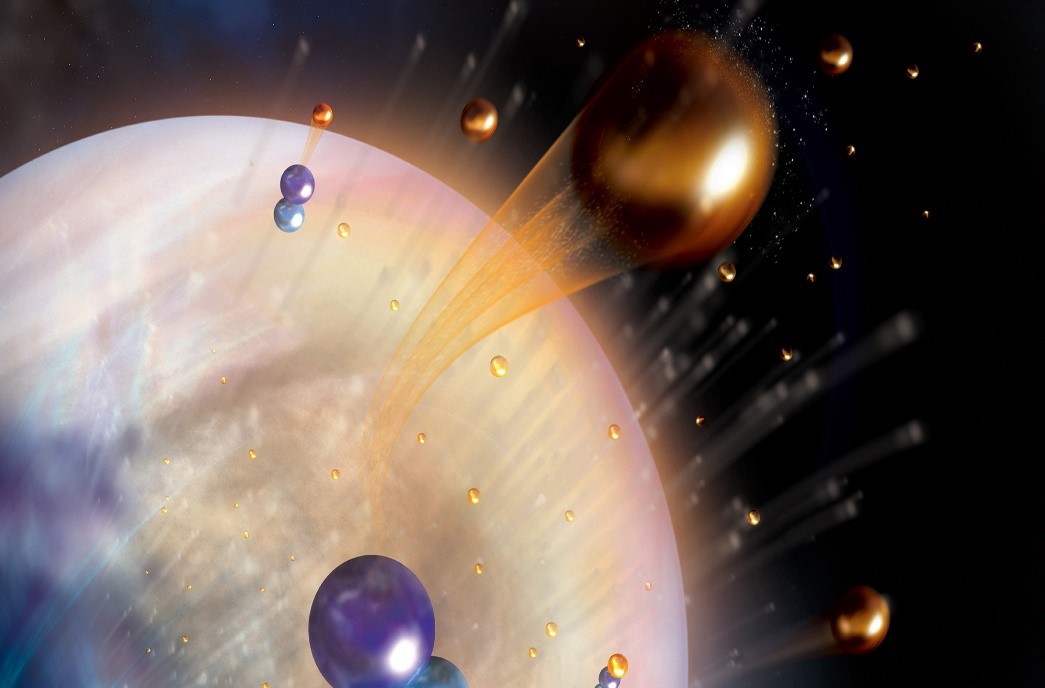
Figure 1. Why Venus is So Dry.
“Water is really important for life,” said study co-author and University of Colorado Boulder astrophysicist Eryn Cangi. “We need to understand the conditions that support liquid water in the universe and that may have produced the very dry state of Venus today.” Figure 1 is an illustration of why Venus is so dry.
The Mystery of The Missing Water
Earth is approximately 71 percent water. If all of that water were spread evenly across the planet, it would create a liquid layer about 1.9 miles deep. In contrast, if the same were done on Venus, the layer would be only 1.2 inches deep.
“Venus has 100,000 times less water than Earth, despite being nearly the same size and mass,” said study co-author and astrophysicist Michael Chaffin. However, Venus wasn't always this dry. Scientists believe that billions of years ago, when Venus was forming, it had about as much water as Earth. Eventually, clouds of carbon dioxide in Venus' atmosphere created a greenhouse effect, raising surface temperatures to 900 degrees Fahrenheit. This intense heat caused all of Venus' water to evaporate into steam, with most of it eventually drifting into space.[1]
Despite this ancient evaporation, it still doesn't fully explain why Venus is as dry as it is today or how it continues to lose water into space.
What’s kicking out the hydrogen?
To understand why Venus is so dry, the research team used computer models to analyze the chemical reactions occurring in the planet’s swirling atmosphere. “We’re trying to figure out what little changes occurred on each planet to drive them into these vastly different states,” said Cangi.
They discovered that a molecule composed of one hydrogen, one carbon, and one oxygen atom, called HCO+, might be causing the planet to lose water. In the upper atmosphere of a planet, water mixes with carbon dioxide to form these HCO+ molecules. Previous studies suggested that HCO+ might also explain why Mars lost much of its original water.
On Venus, HCO+ is continually produced in the atmosphere, but the individual hydrogen, carbon, and oxygen atoms have short lifespans. Atmospheric electrons recombine with these atoms, splitting them apart. When this happens, the hydrogen atoms escape into space, effectively removing one of the two components needed for water from Venus. The team calculated that Venus’s extreme dryness could only be explained if the planet had higher than expected levels of HCO+ in its atmosphere.
Probing Venus
Scientists have never observed HCO+ around Venus because they have not had the right instruments to detect this ion. None of the spacecraft that have visited Venus—such as NASA’s Mariner 2, the European Space Agency’s Venus Express, or Japan’s Akatsuki—carried instruments capable of detecting HCO+.
“One surprising conclusion of this work is that HCO+ should actually be among the most abundant ions in the Venus atmosphere,” said Chaffin. By the end of this decade, NASA plans to deploy a probe to Venus’s surface during the DAVINCI (Deep Atmosphere Venus Investigation of Noble Gases, Chemistry, and Imaging) mission. Although this probe won’t be able to detect HCO+, the team hopes that a future Venus mission might provide more clues about the planet’s missing water.
“There haven’t been many missions to Venus,” said Cangi. “But newly planned missions will leverage decades of collective experience and a growing interest in Venus to explore the extremes of planetary atmospheres, evolution, and habitability.”
Reference:
- https://www.popsci.com/science/venus-dry/
Cite this article:
Gokila G (2024), Why Venus is So Dry, AnaTechMaz, pp. 72
Recent Post
-
Astronomers Have Found the Nearest Black Hole to Earth
A newly discovered black hole, potentially closer to Earth than ...
-
SpaceX Experiences Its First Rocket Failure in A Decade, Resulting in Star link Satellites Left in Low Orbit
On the evening of July 11, a SpaceX Falcon 9 rocket ...
-
China Plans to Deflect a Near-Earth Asteroid In 2030
China is preparing to enter the field of planetary defence....
-
There Really Are Lava Tunnels on The Moon, And Humans May One Day Live in Them
NASA's astronauts have walked on the lunar surface ...
-
China’s New Lunar Far-Side Samples May Clarify Earth’s Dual-Faced Moon
Samples from the Moon’s far side, collected by China’s ...
-
Galactic Pulse: Pulsar Timing Arrays Reveal Long-Period Gravitational Waves
Astrophysicists have detected long-period gravitational ...
-
Moon Festivals, Moon Movies, and a Full Moon Celebrate the 55th Anniversary of Apollo 11 Landing
The cosmos is marking the 55th anniversary of the first lunar l...
-

New Space Storm Alert System Could Protect Earth's Technology
Space storms may soon be predicted with unprecedented accuracy, thanks......
-
This Ambitious New Space Mission Will Intersect with an 'Incoming Asteroid' On A Collision Course with Earth
In an effort to avoid the fate of the dinosaurs, the European Space Agency (ESA) has ...
-
Assembling The Cosmos: Hubble Reveals How Dwarf Galaxies Shape the Largest Galaxies
NGC 5238, a dwarf irregular galaxy captured by the Hubble Space Telescope, reveals a...
-
NASA Has Discovered Pure Sulfur Crystals on Mars for The First Time
In a significant breakthrough, NASA's Curiosity Mars...
-
Why Venus is So Dry
Venus is dry due to water loss to space as atomic hydrogen. In this illustration of the dominant ...
-
Galactic Game Changer: Unveiling the Hidden Satellites of the Milky Way
Researchers have identified two new satellite galaxies of the...
-
Webb Telescope Reveals Wild Weather on Cosmic Brown Dwarfs
WASHINGTON, July 15 (Reuters) – The weather report for the two brown dwarfs—the celestial ...
-
Astronomers Discover a Highly “Eccentric” Planet on Its Path to Becoming a Hot Jupiter
The planet’s extreme orbit provides insights into how massive,...