

China’s New Lunar Far-Side Samples May Clarify Earth’s Dual-Faced Moon
Samples from the Moon’s far side, collected by China’s Chang’e 6 spacecraft, could resolve a long-standing lunar mystery. On June 25, a significant lunar sample landed on Earth—a nearly two-kilogram collection of rock and dust drilled from the Moon’s surface by China’s Chang’e 6 lander. After collecting these samples, the lander rendezvoused with its mothership in lunar orbit, and the materials were transported back to Earth in a return module. They parachuted into Inner Mongolia, where scientists eagerly retrieved and began studying them.
The achievement mirrored the Chang’e 5 mission’s lunar-sample return from 2020, with one crucial distinction: this time, the samples came from the Moon’s far side, which always faces away from Earth. This required additional steps, such as using dedicated satellites in lunar orbit for communication. [1] However, the scientific rewards could be significant. Researchers are hopeful that these unique samples will provide insights into a long-standing planetary science mystery: why the far side of the Moon differs so dramatically from the near side.
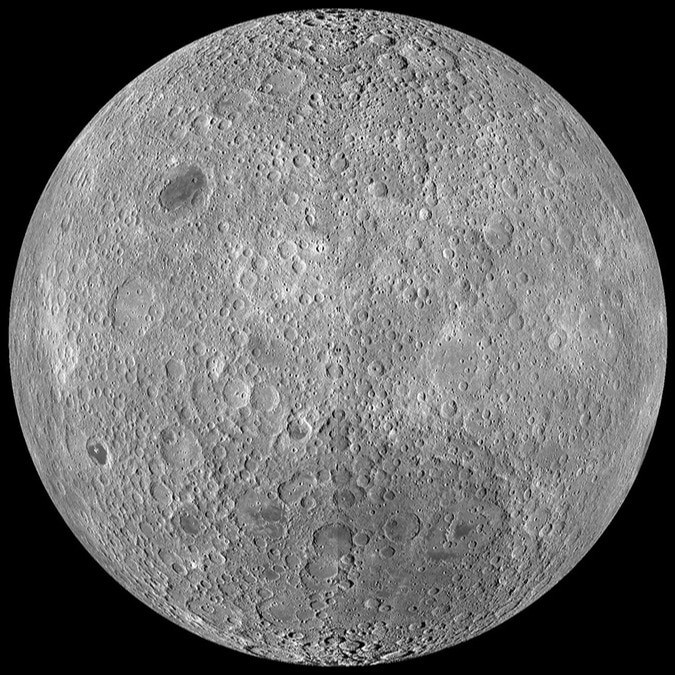
Figure 1. Earth’s Moon from the Far Side: A View of the Rugged Terrain and Thicker Crust Opposite Our Planet
We always see only one side of the Moon because it takes the same amount of time to rotate once as it does to orbit Earth. This synchronous rotation is a result of Earth’s strong tidal forces on the Moon. Consequently, the Moon is effectively divided into two hemispheres: the near side that faces us and the far side that remains hidden from view. Figure 1 shows Earth’s Moon from the Far Side: A View of the Rugged Terrain and Thicker Crust Opposite Our Planet.
Anyone who has looked at the Moon has seen the near side’s most striking features: large, roughly circular dark patches against a brighter background. Ancient astronomers named these dark areas “maria” (Latin for “seas”) due to their water-like appearance from Earth. In reality, they are basaltic plains—solidified lava from ancient volcanic eruptions. The brighter regions on the near side are older highlands, heavily cratered and more reflective, rising above the basaltic plains.
Astronomers once thought the Moon’s far side was similar to the near side. However, this assumption was overturned in 1959 when the Soviet Luna 3 spacecraft transmitted the first images of the far side. Though grainy and fuzzy, the photos revealed a starkly different landscape: the far side was predominantly rugged highlands, with only a few scattered dark spots, whereas the near side featured extensive maria. Subsequent observations reinforced this surprising contrast, with gravity data from the GRAIL spacecraft showing that the far side’s crust is about 20 kilometers thicker on average than that of the near side.
Why are the two lunar hemispheres so different? While Earth’s tidal forces might seem a plausible explanation, the true cause likely dates back to the Moon's formation. The prevailing theory, known as the giant impact hypothesis (or "big splat," a name I find particularly fitting), suggests that a Mars-sized body named Theia collided with Earth at a slanted angle shortly after our planet's formation 4.6 billion years ago. This colossal impact shattered Theia, sending its core into Earth's interior and ejecting its outer layers—along with significant amounts of terrestrial material—into orbit.
The superheated rock from the impact quickly cooled and formed the Moon. Although scientists debate the exact timeline, the Moon may have coalesced from the debris within a few months to a few years. Initially, it was much closer to Earth—possibly just one-tenth of its current distance—and tidal forces gradually pushed it further away over time.
At such a close range, tidal interactions were intense, likely causing the Moon to become tidally locked within a year, a process much faster than the formation and solidification of the crust. This rapid locking suggests that Earth's tidal forces alone couldn’t explain the dichotomy between the Moon’s hemispheres. Instead, something else must have contributed to the far side’s thicker crust as the Moon cooled.
Several hypotheses have been proposed, though none perfectly explain the current discrepancy. One idea is that a smaller, second moon formed from the debris and later collided with the larger Moon, depositing additional material on the far side. Another possibility is that internal processes within the early Moon led to a thicker crust on one side.
In 2014, astronomers proposed a new explanation for the Moon’s hemispheric differences, shifting the focus from Earth's tidal forces to the conditions on the young Moon itself. At that time, Earth loomed large in the Moon’s sky, covering about 40 degrees of angular diameter—20 times its current size. The immense heat from the early Earth, which had been significantly vaporized and melted by Theia’s impact, would have intensely warmed the Moon’s near side to around 1,000 degrees Celsius, while the far side remained much cooler. This stark thermal contrast could have contributed to the significant differences observed between the Moon's near and far sides.
This new hypothesis has significant implications. When the Moon was still molten, its atmosphere of incandescent rock and metal would have caused elements like calcium and aluminum—known for their high boiling points—to remain gaseous on the intensely heated near side, while they condensed on the cooler far side. These condensed elements would have interacted with others to form lighter minerals such as feldspar, leading to the formation of the thicker crust on the far side.
Interestingly, orbital surveys confirm a higher concentration of feldspar on the far side compared to the near side. This process may have also concentrated other minerals on the near side, including radioactive elements that contributed to additional heating, leading to volcanic activity and the formation of the dark maria. Consequently, the far side remains largely devoid of maria.
While this theory provides a compelling explanation for the lunar dichotomy, further evidence is required to confirm it. The recent samples from Chang’e 6 may offer crucial insights once analyzed in detail. It's a common misconception that the lunar far side is always dark. In reality, it receives as much sunlight as the near side during its two-week lunar day periods.[2] The phrase “dark side” might be better understood metaphorically: it’s the side we know less about due to its unobservable nature from Earth. However, with recent advancements, including mapping and sample collection, we are on the cusp of illuminating the mysteries of the far side. The era of understanding the Moon's far side is approaching, and our knowledge will soon shine brighter.
Reference:
- https://www.thehindu.com/sci-tech/science/chinese-lunar-probe-returns-to-earth-with-worlds-first-samples-from-the-far-side-of-the-moon/article68330861.ece
- https://www.scientificamerican.com/article/change-6-lunar-samples-could-solve-mysteries-of-the-moons-far-side/
Cite this article:
Janani R (2024), China’s New Lunar Far-Side Samples May Clarify Earth’s Dual-Faced Moon, AnaTechMaz, pp. 65
Recent Post
-
Astronomers Have Found the Nearest Black Hole to Earth
A newly discovered black hole, potentially closer to Earth than ...
-
SpaceX Experiences Its First Rocket Failure in A Decade, Resulting in Star link Satellites Left in Low Orbit
On the evening of July 11, a SpaceX Falcon 9 rocket ...
-
China Plans to Deflect a Near-Earth Asteroid In 2030
China is preparing to enter the field of planetary defence....
-
There Really Are Lava Tunnels on The Moon, And Humans May One Day Live in Them
NASA's astronauts have walked on the lunar surface ...
-
China’s New Lunar Far-Side Samples May Clarify Earth’s Dual-Faced Moon
Samples from the Moon’s far side, collected by China’s ...
-
Galactic Pulse: Pulsar Timing Arrays Reveal Long-Period Gravitational Waves
Astrophysicists have detected long-period gravitational ...
-
Moon Festivals, Moon Movies, and a Full Moon Celebrate the 55th Anniversary of Apollo 11 Landing
The cosmos is marking the 55th anniversary of the first lunar l...
-
New Space Storm Alert System Could Protect Earth's Technology
Space storms may soon be predicted with unprecedented accuracy, thanks......
-
This Ambitious New Space Mission Will Intersect with an 'Incoming Asteroid' On A Collision Course with Earth
In an effort to avoid the fate of the dinosaurs, the European Space Agency (ESA) has ...
-
Assembling The Cosmos: Hubble Reveals How Dwarf Galaxies Shape the Largest Galaxies
NGC 5238, a dwarf irregular galaxy captured by the Hubble Space Telescope, reveals a...
-
NASA Has Discovered Pure Sulfur Crystals on Mars for The First Time
In a significant breakthrough, NASA's Curiosity Mars...
-
Why Venus is So Dry
Venus is dry due to water loss to space as atomic hydrogen. In this illustration of the dominant ...
-
Galactic Game Changer: Unveiling the Hidden Satellites of the Milky Way
Researchers have identified two new satellite galaxies of the...
-
Webb Telescope Reveals Wild Weather on Cosmic Brown Dwarfs
WASHINGTON, July 15 (Reuters) – The weather report for the two brown dwarfs—the celestial ...
-
Astronomers Discover a Highly “Eccentric” Planet on Its Path to Becoming a Hot Jupiter
The planet’s extreme orbit provides insights into how massive,...