

Galactic Pulse: Pulsar Timing Arrays Reveal Long-Period Gravitational Waves
Astrophysicists have detected long-period gravitational waves using data from 68 pulsars, as reported by NANOGrav. This discovery, based on 15 years of data, confirms predictions of general relativity and offers insights into supermassive black holes and galaxy mergers. The research, involving over 190 scientists from the US and Canada, used large radio telescopes and has been corroborated by international teams in Europe, India, Australia, and China.
Revealing a Long-Awaited Gravitational Wave Signal
While earlier results from NANOGrav revealed an enigmatic timing signal common to all the observed pulsars, it was too faint to determine its origin. However, the 15-year data release indicates that the signal is consistent with slowly undulating gravitational waves passing through our Galaxy. “This is key evidence for gravitational waves at very low frequencies,” says Dr. Stephen Taylor of Vanderbilt University, who co-led the search and is the current Chair of the collaboration. “After years of work, NANOGrav is opening an entirely new window on the gravitational-wave universe.”
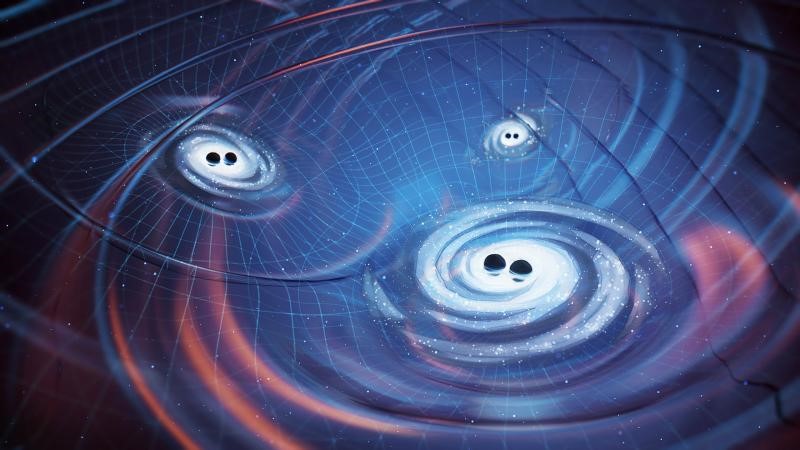
Figure 1. Artist’s rendering of pulsars influenced by gravitational waves from a supermassive black hole binary in a distant galaxy.
Turning Our Galaxy into a Gravitational-Wave Detector
In contrast to the brief high-frequency gravitational waves detected by ground-based instruments like LIGO (the Laser Interferometer Gravitational-Wave Observatory), this continuous low-frequency signal requires a detector much larger than Earth. To address this, astronomers transformed our region of the Milky Way Galaxy into a vast gravitational-wave antenna by utilizing exotic stars known as pulsars. NANOGrav’s 15-year endeavor gathered data from 68 pulsars to create a pulsar timing array, a type of detector designed for this purpose. Figure 1 shows Artist’s rendering of pulsars influenced by gravitational waves from a supermassive black hole binary in a distant galaxy.
Pulsars: Nature’s Precise Timekeepers
A pulsar is a dense remnant of a star's core after a supernova explosion, spinning rapidly and emitting radio waves that create a "pulsing" effect when observed from Earth. Millisecond pulsars, spinning hundreds of times per second, are highly stable and serve as precise cosmic timepieces. Over 15 years, NANOGrav has used the Arecibo Observatory, the Green Bank Telescope, and the Very Large Array for pulsar observations. “Pulsars are faint radio sources, requiring thousands of hours on large telescopes,” says Dr. Maura McLaughlin. “The NSF’s support has been crucial. We are now seeing the first evidence of gravitational waves with periods of years to decades.”
Validating Predictions of General Relativity
Einstein’s theory of general relativity predicts exactly how gravitational waves should impact pulsar signals. By distorting the fabric of space, gravitational waves cause slight but predictable changes in the timing of each pulse, delaying some while advancing others. These timing shifts show a correlation between pairs of pulsars that depends on their relative positions in the sky. “The extensive number of pulsars used in the NANOGrav analysis has allowed us to observe what we believe are the initial signs of the correlation pattern predicted by general relativity,” says Dr. Xavier Siemens of Oregon State University, co-Director of the NANOGrav PFC.
Laying the Groundwork for Future Discoveries
Observing so many pulsars demands significant investment in people, infrastructure, and time. Starting in 2004, a small group of astronomers began the foundational pulsar observations for this project. Over nearly two decades, this group expanded to form the NANOGrav collaboration, combining expertise to enhance data collection and analysis. They developed advanced instrumentation for the Arecibo and Green Bank telescopes and refined the pulsar timing array with precise pulsars. Concurrently, advancements in theory and data-analysis techniques, optimized for modern computing, supported their search for low-frequency gravitational waves.
Diverse Applications of Pulsar Timing Data
NANOGrav has found numerous applications for their extensive pulsar timing data, tackling various astrophysical questions. They have released both the data and the software used to produce it, making it easier for other scientists to replicate their results and contribute to improvements. This transparency also provides educational opportunities for students. By 2020, with over twelve years of data, NANOGrav scientists detected a faint "hum" common to all pulsars in the array, which persisted despite eliminating alternative explanations. This signal has now become clearer with additional observations, providing the first evidence of gravitational waves with periods ranging from years to decades.
Identifying the Source of the Gravitational-Wave Hum
Dr. Sarah Vigeland from the University of Wisconsin-Milwaukee, who, along with Dr. Taylor, is leading NANOGrav's effort to identify the source of the gravitational-wave signal, explains, “With evidence for gravitational waves now confirmed, our next step is to investigate the sources of this signal. One possibility is that it originates from pairs of supermassive black holes, each millions or billions of times the mass of our Sun. As these massive black holes orbit each other, they generate low-frequency gravitational waves.” Supermassive black holes are thought to be located at the centers of the universe's largest galaxies. When galaxies merge, their black holes eventually form a binary system at the center of the new galaxy, orbiting each other. As they spiral inwards and eventually merge, their gravitational waves spread outward like ripples in a pond, eventually reaching us.
Interpreting the Gravitational-Wave Background
Gravitational-wave signals from massive binary systems are expected to merge into a background “hum” that reveals a unique pattern in pulsar timing data. NANOGrav’s new papers provide evidence for this gravitational-wave background, which is enhancing our understanding of supermassive black hole growth and mergers. The findings suggest there could be hundreds of thousands or even millions of such black hole binaries in the Universe. Dr. Luke Kelley from the University of California, Berkeley, states, “Despite earlier concerns that these binaries might not produce detectable signals, we now have strong evidence of their existence and their eventual merger within a few million years.”
Grasping the Evolution of the Universe
Future research on this signal will enhance our understanding of the Universe's evolution, including galaxy collisions and black hole mergers. It may also reveal gravitational ripples from the Big Bang, offering insights into the Universe's formation and constraining potential exotic particles. “This milestone is crucial for NSF’s effort to use gravitational waves to explore astrophysical phenomena,” says Michael Cavagnero, NSF’s Physics Frontiers Centers Program Director.
NANOGrav anticipates identifying contributions from individual supermassive black hole binaries as data collection progresses. “We’re using a galaxy-sized gravitational-wave detector made of exotic stars,” says Dr. Scott Ransom from the National Radio Astronomy Observatory. “We’ve gone from hearing faint signals to recognizing them as cosmic music. As we refine our observations, we’ll uncover more details of this gravitational symphony, revolutionizing our understanding of the Universe’s history.” NSF support has been vital to NANOGrav’s achievements, including access to top radio telescopes. Future results will incorporate data from Canada’s CHIME telescope. “The NSF NANOGrav team has essentially created a galaxy-wide detector for gravitational waves,” says NSF Director Sethuraman Panchanathan, highlighting the nationwide impact of this scientific innovation.
International Collaboration and Future Discoveries
Astrophysicists worldwide are pursuing this gravitational-wave signal, with recent papers from the Parkes Pulsar Timing Array in Australia, the Chinese Pulsar Timing Array, and the European/Indian Pulsar Timing Arrays showing hints of the same signal. The International Pulsar Timing Array consortium is collaborating to merge their data, aiming to better characterize the signal and uncover new sources. “Our combined data will be much more powerful,” says Taylor. “We’re eager to see what secrets it will reveal about our Universe.”
Source: SciTecgDaily
Cite this article:
Janani R (2024), Galactic Pulse: Pulsar Timing Arrays Reveal Long-Period Gravitational Waves, AnaTechMaz, pp. 66
Recent Post
-
Astronomers Have Found the Nearest Black Hole to Earth
A newly discovered black hole, potentially closer to Earth than ...
-
SpaceX Experiences Its First Rocket Failure in A Decade, Resulting in Star link Satellites Left in Low Orbit
On the evening of July 11, a SpaceX Falcon 9 rocket ...
-

China Plans to Deflect a Near-Earth Asteroid In 2030
China is preparing to enter the field of planetary defence....
-
There Really Are Lava Tunnels on The Moon, And Humans May One Day Live in Them
NASA's astronauts have walked on the lunar surface ...
-
China’s New Lunar Far-Side Samples May Clarify Earth’s Dual-Faced Moon
Samples from the Moon’s far side, collected by China’s ...
-
Galactic Pulse: Pulsar Timing Arrays Reveal Long-Period Gravitational Waves
Astrophysicists have detected long-period gravitational ...
-

Moon Festivals, Moon Movies, and a Full Moon Celebrate the 55th Anniversary of Apollo 11 Landing
The cosmos is marking the 55th anniversary of the first lunar l...
-

New Space Storm Alert System Could Protect Earth's Technology
Space storms may soon be predicted with unprecedented accuracy, thanks......
-
This Ambitious New Space Mission Will Intersect with an 'Incoming Asteroid' On A Collision Course with Earth
In an effort to avoid the fate of the dinosaurs, the European Space Agency (ESA) has ...
-
Assembling The Cosmos: Hubble Reveals How Dwarf Galaxies Shape the Largest Galaxies
NGC 5238, a dwarf irregular galaxy captured by the Hubble Space Telescope, reveals a...
-

NASA Has Discovered Pure Sulfur Crystals on Mars for The First Time
In a significant breakthrough, NASA's Curiosity Mars...
-
Why Venus is So Dry
Venus is dry due to water loss to space as atomic hydrogen. In this illustration of the dominant ...
-
Galactic Game Changer: Unveiling the Hidden Satellites of the Milky Way
Researchers have identified two new satellite galaxies of the...
-
Webb Telescope Reveals Wild Weather on Cosmic Brown Dwarfs
WASHINGTON, July 15 (Reuters) – The weather report for the two brown dwarfs—the celestial ...
-
Astronomers Discover a Highly “Eccentric” Planet on Its Path to Becoming a Hot Jupiter
The planet’s extreme orbit provides insights into how massive,...