

SpaceX Experiences Its First Rocket Failure in A Decade, Resulting in Star link Satellites Left in Low Orbit
On the evening of July 11, a SpaceX Falcon 9 rocket exploded approximately one hour after liftoff from Vandenberg Space Force Base in California. The incident, attributed to a rapid unscheduled disassembly (RUD) of the upper engine, marked SpaceX's first accident in about eight years. This event also concluded a record-setting streak of nearly 300 successful missions, which included transporting cargo, satellites, and astronauts.
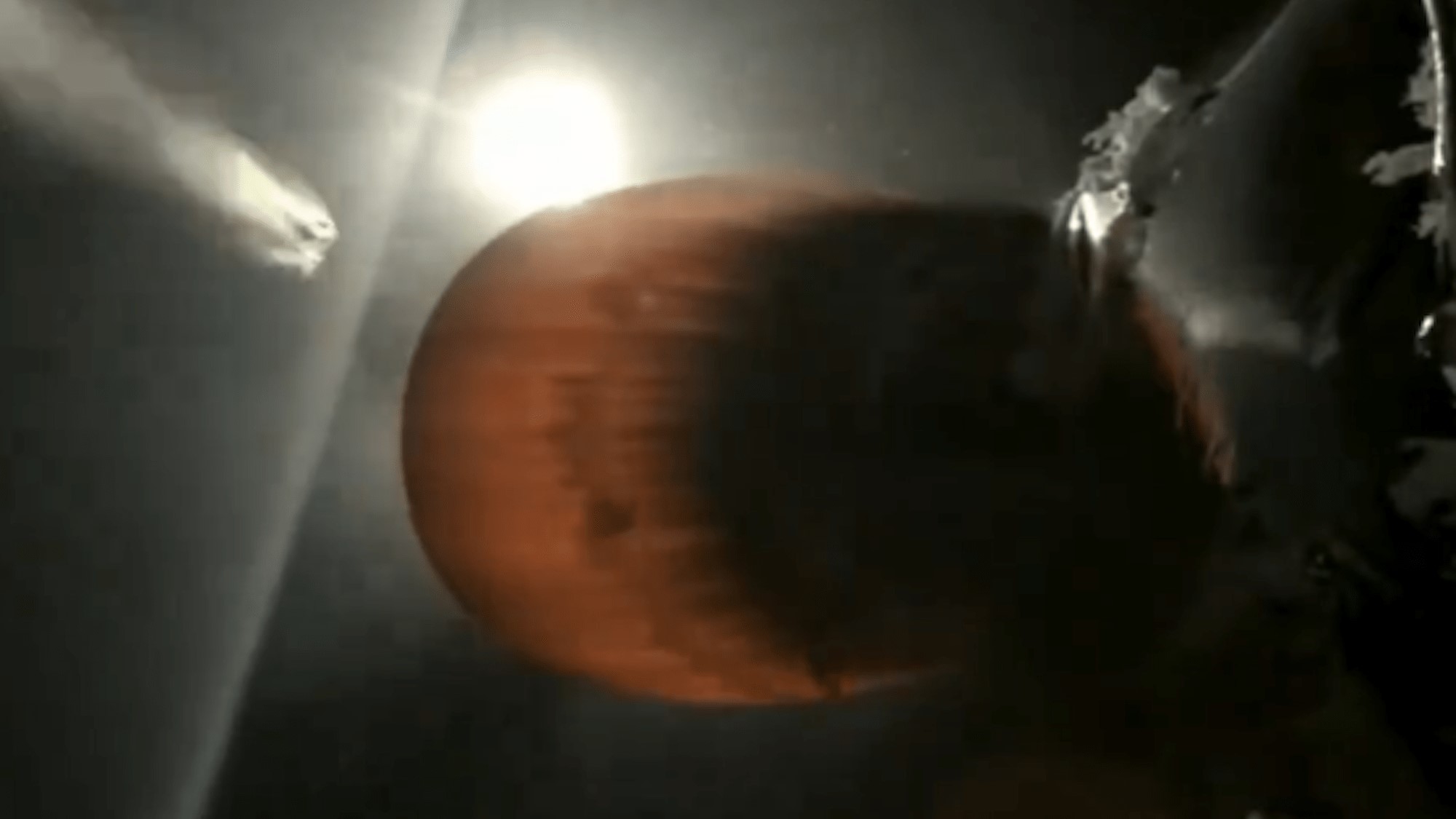
Figure 1. An accumulation of ice was seen around the rocket's Merlin Vacuum engine shortly before it exploded.
Figure 1 shows an accumulation of ice was seen around the rocket's merlin vacuum engine shortly before it exploded. SpaceX aimed to launch its latest batch of Starlink internet satellites on Thursday night. Although the 20 satellites were deployed, they ended up in a lower-than-planned orbit and not in the correct configuration. Astrophysicist Jonathan McDowell indicated that the payload likely released into an orbit ranging from 86 to 183 miles above Earth, rather than the intended circular orbit at a constant altitude of 183 miles. SpaceX managed to establish contact with at least 10 Starlink satellites initially, but later confirmed that they are not recoverable.[1]
"The team communicated with the satellites and attempted to maneuver them to raise their orbit using ion thrusters. However, due to the high drag environment at their perigee, the lowest point of their elliptical orbit," SpaceX stated on social media Thursday evening. The company later confirmed that the satellites will eventually re-enter Earth's atmosphere and "completely burn up."
The exact cause of the explosion will remain unknown until a thorough review of the accident is completed. However, as reported by Ars Technical on July 12, during the live cast of the launch, there was an unusual accumulation of ice observed around the Falcon 9's Merlin Vacuum engine (M-Vac). This engine utilizes a propellant mixture of cryogenic liquid oxygen and kerosene. While the video appeared to show the engine completing its initial burn successfully, the presence of ice may have played a role in a subsequent engine issue that occurred after SpaceX's live stream concluded.
Despite the recent setback, Falcon 9's current version, the Falcon 9 Block 5, remains unquestionably the most successful and reliable rocket ever developed. Since its debut in 2018, it has completed a total of 297 launches with a remarkable 99.7 percent success rate.
Falcon 9's previous and only other in-flight explosion occurred on June 28, 2015, when the liquid oxygen tank in its upper stage exploded shortly after liftoff, resulting in the loss of both the rocket and its uncrewed Dragon capsule cargo intended for the International Space Station. Following that incident, Falcon 9 was grounded for six months while SpaceX conducted a thorough review.
The timeline for when Falcon 9 rockets will resume their missions is currently uncertain. Besides its regular deliveries of Starlink satellites, SpaceX is preparing for billionaire Jared Isaacman's Polaris Dawn mission to achieve the first commercial spacewalk later this month. In August, SpaceX also plans to launch NASA's Crew-9 mission, which will ferry four astronauts to the International Space Station.
"SpaceX has an exceptional track record with Falcon 9," Isaacman stated on social media on July 12. "We will launch when SpaceX is ready, with full confidence in the rocket, spacecraft, and operations."
Reference:
- https://www.popsci.com/science/falcon-9-explosion/
- https://www.udayavani.com/english-news/spacex-rocket-accident-leaves-companys-starlink-satellites-in-wrong-orbit
Cite this article:
Gokila G (2024), SpaceX Experiences Its First Rocket Failure in A Decade, Resulting in Starlink Satellites Left in Low Orbit, AnaTechMaz, pp. 62
Recent Post
-
Astronomers Have Found the Nearest Black Hole to Earth
A newly discovered black hole, potentially closer to Earth than ...
-
SpaceX Experiences Its First Rocket Failure in A Decade, Resulting in Star link Satellites Left in Low Orbit
On the evening of July 11, a SpaceX Falcon 9 rocket ...
-
China Plans to Deflect a Near-Earth Asteroid In 2030
China is preparing to enter the field of planetary defence....
-
There Really Are Lava Tunnels on The Moon, And Humans May One Day Live in Them
NASA's astronauts have walked on the lunar surface ...
-
China’s New Lunar Far-Side Samples May Clarify Earth’s Dual-Faced Moon
Samples from the Moon’s far side, collected by China’s ...
-

Galactic Pulse: Pulsar Timing Arrays Reveal Long-Period Gravitational Waves
Astrophysicists have detected long-period gravitational ...
-

Moon Festivals, Moon Movies, and a Full Moon Celebrate the 55th Anniversary of Apollo 11 Landing
The cosmos is marking the 55th anniversary of the first lunar l...
-

New Space Storm Alert System Could Protect Earth's Technology
Space storms may soon be predicted with unprecedented accuracy, thanks......
-
This Ambitious New Space Mission Will Intersect with an 'Incoming Asteroid' On A Collision Course with Earth
In an effort to avoid the fate of the dinosaurs, the European Space Agency (ESA) has ...
-
Assembling The Cosmos: Hubble Reveals How Dwarf Galaxies Shape the Largest Galaxies
NGC 5238, a dwarf irregular galaxy captured by the Hubble Space Telescope, reveals a...
-
NASA Has Discovered Pure Sulfur Crystals on Mars for The First Time
In a significant breakthrough, NASA's Curiosity Mars...
-
Why Venus is So Dry
Venus is dry due to water loss to space as atomic hydrogen. In this illustration of the dominant ...
-
Galactic Game Changer: Unveiling the Hidden Satellites of the Milky Way
Researchers have identified two new satellite galaxies of the...
-
Webb Telescope Reveals Wild Weather on Cosmic Brown Dwarfs
WASHINGTON, July 15 (Reuters) – The weather report for the two brown dwarfs—the celestial ...
-

Astronomers Discover a Highly “Eccentric” Planet on Its Path to Becoming a Hot Jupiter
The planet’s extreme orbit provides insights into how massive,...