

China Plans to Deflect a Near-Earth Asteroid In 2030
China is preparing to enter the field of planetary defence. A recent paper by the China National Space Administration (CNSA) reveals that the country plans to conduct a test mission in 2030 to deflect a small asteroid from its current trajectory.
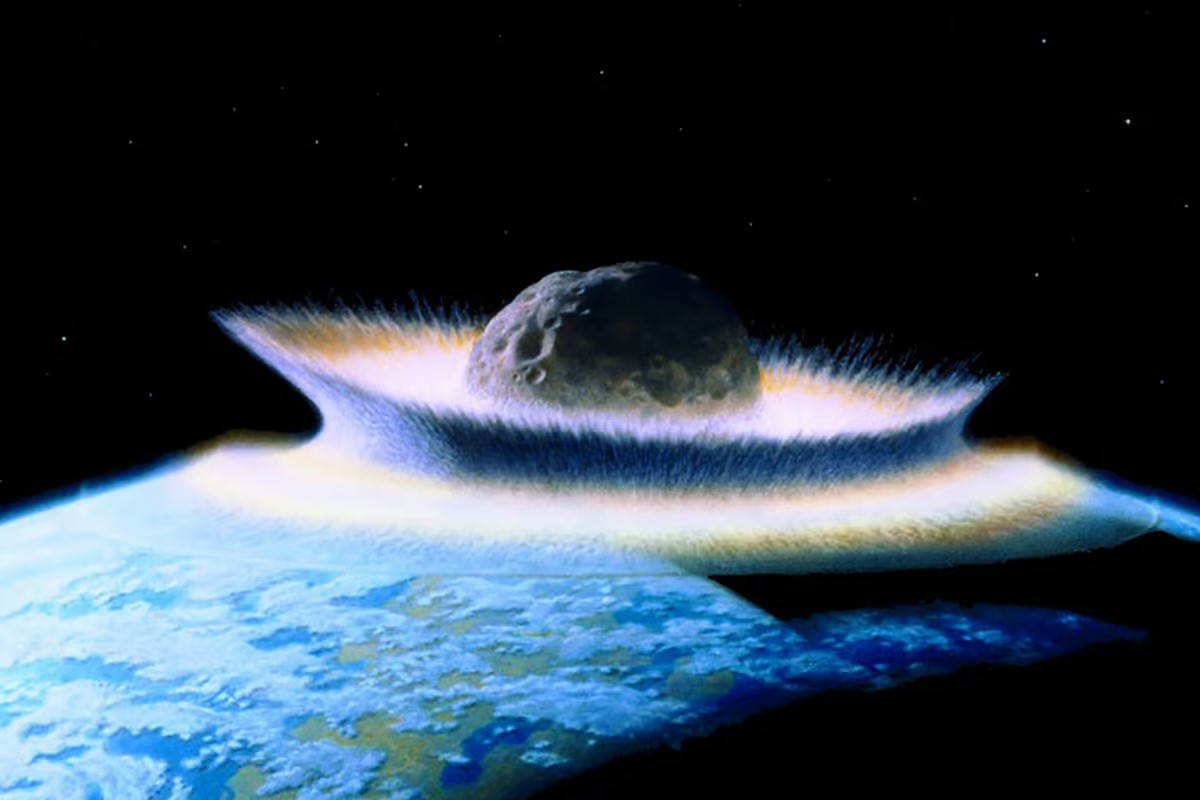
Figure 1. Artist's impression of a giant asteroid hitting the Earth – something China hopes its upcoming mission will one day help prevent.
If there is to be a space race, aiming to develop technology to protect Earth from rogue asteroids is a relatively benign goal. Of course, this assumes no one gets the idea of using the technology to redirect asteroids toward Earth, which veers into Bond villain territory. Figure 1 shows artist's impression of a giant asteroid hitting the earth – something China hopes its upcoming mission will one day help prevent.
Earth is hit by objects from outer space up to 50 times a day, though most are no larger than grains of sand and go unnoticed. However, larger objects occasionally collide with Earth, and on extremely rare occasions, these impacts are significant enough to cause extinction events, such as the one that wiped out the dinosaurs.[1]
Even medium-sized asteroids can cause immense damage without hitting the ground. In 2013, a meteor exploded over Chelyabinsk, Russia, with the force of a 500-kiloton nuclear bomb, shattering windows and damaging buildings. In 1908, an asteroid exploded over Tunguska, Siberia, with a force of up to 50 megatons.
In both cases (and others), humanity was extremely lucky. However, luck isn't a reliable strategy for future planning, which is why there is growing interest in identifying, tracking, and deflecting potentially dangerous asteroids before they pose a threat.
A paper published in the Journal of Deep Space Exploration by the CNSA outlines a planned mission to demonstrate China's capability to deflect an asteroid. The target is a near-Earth asteroid about 100 ft (30 m) in diameter, called (NEO) 2015 XF261, which passed within 31 million miles (50 million km) of Earth on June 9, 2024.[2]
The mission's goal is not only to deflect the asteroid but also to determine its shape, size, composition, and structure using spectral and laser 3D detectors, mid-field colour cameras, detection radars, and dust particle analysers.
These observations will occur over three to six months once the spacecraft enters orbit around the asteroid in 2030. After completing the observation phase, a kinetic impactor will be launched at the asteroid. The spacecraft will then remain on station for six to 12 months to measure the impact's effects, including changes in the asteroid's orbit, studying the impact crater, and analysing the ejected materials.
Reference:
- https://newatlas.com/space/china-asteroid-deflection-mission-2030/
- https://in.mashable.com/science/78767/china-plans-to-destroy-an-asteroid-for-planetary-defense-mission-by-2030-report
Cite this article:
Gokila G (2024), China Plans to Deflect a Near-Earth Asteroid In 2030, AnaTechMaz, pp. 63
Recent Post
-
Astronomers Have Found the Nearest Black Hole to Earth
A newly discovered black hole, potentially closer to Earth than ...
-
SpaceX Experiences Its First Rocket Failure in A Decade, Resulting in Star link Satellites Left in Low Orbit
On the evening of July 11, a SpaceX Falcon 9 rocket ...
-
China Plans to Deflect a Near-Earth Asteroid In 2030
China is preparing to enter the field of planetary defence....
-
There Really Are Lava Tunnels on The Moon, And Humans May One Day Live in Them
NASA's astronauts have walked on the lunar surface ...
-
China’s New Lunar Far-Side Samples May Clarify Earth’s Dual-Faced Moon
Samples from the Moon’s far side, collected by China’s ...
-

Galactic Pulse: Pulsar Timing Arrays Reveal Long-Period Gravitational Waves
Astrophysicists have detected long-period gravitational ...
-

Moon Festivals, Moon Movies, and a Full Moon Celebrate the 55th Anniversary of Apollo 11 Landing
The cosmos is marking the 55th anniversary of the first lunar l...
-

New Space Storm Alert System Could Protect Earth's Technology
Space storms may soon be predicted with unprecedented accuracy, thanks......
-
This Ambitious New Space Mission Will Intersect with an 'Incoming Asteroid' On A Collision Course with Earth
In an effort to avoid the fate of the dinosaurs, the European Space Agency (ESA) has ...
-
Assembling The Cosmos: Hubble Reveals How Dwarf Galaxies Shape the Largest Galaxies
NGC 5238, a dwarf irregular galaxy captured by the Hubble Space Telescope, reveals a...
-
NASA Has Discovered Pure Sulfur Crystals on Mars for The First Time
In a significant breakthrough, NASA's Curiosity Mars...
-

Why Venus is So Dry
Venus is dry due to water loss to space as atomic hydrogen. In this illustration of the dominant ...
-
Galactic Game Changer: Unveiling the Hidden Satellites of the Milky Way
Researchers have identified two new satellite galaxies of the...
-
Webb Telescope Reveals Wild Weather on Cosmic Brown Dwarfs
WASHINGTON, July 15 (Reuters) – The weather report for the two brown dwarfs—the celestial ...
-

Astronomers Discover a Highly “Eccentric” Planet on Its Path to Becoming a Hot Jupiter
The planet’s extreme orbit provides insights into how massive,...