

Artificial Eyes Created by U.S. Researchers Boost Machine Vision
Engineers at Penn State University have developed a groundbreaking artificial vision device that mimics the human eye, potentially solving one of the biggest challenges facing self-driving cars: adapting to rapidly changing lighting conditions. The innovation is based on a new type of photomemristor, a microscopic electronic component capable of both sensing light and storing information. Unlike conventional camera systems that capture images and send them to a separate processor for analysis, this technology performs both tasks simultaneously, enabling faster and more efficient visual processing.
"Self-driving cars are exposed to a mixture of light levels in real-world conditions," explained Larry Cheng, James L. Henderson Jr. Memorial Associate Professor of Engineering Science and Mechanics at Penn State. "Imagine driving at night when bright headlights from oncoming vehicles contrast sharply with a dark sky. These conditions can make it difficult for artificial optical systems to distinguish important details, such as traffic signals."
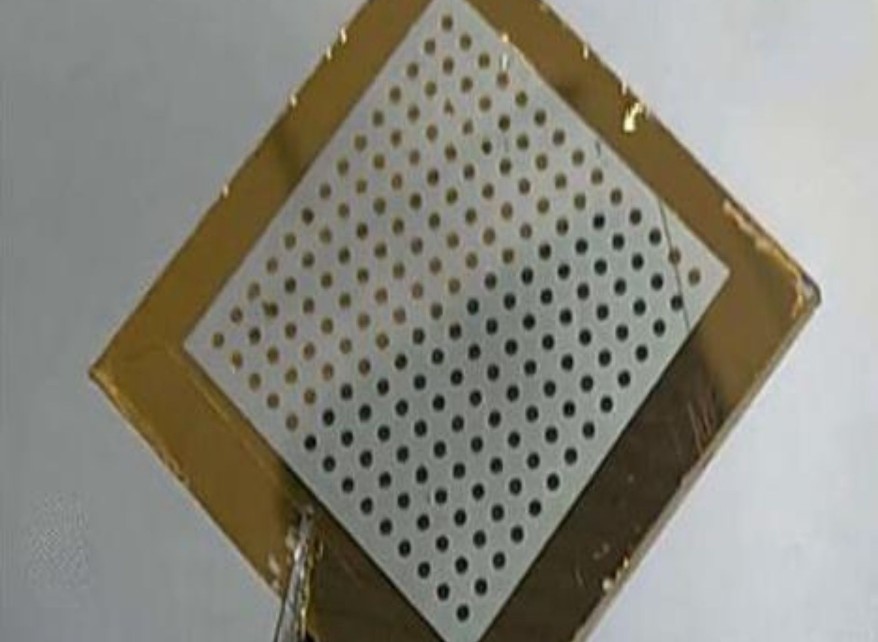
Figure 1. Artificial Eye Sensor.
Although autonomous vehicles are equipped with sophisticated cameras and artificial intelligence, they often struggle in high-contrast environments. Sudden changes in brightness can overwhelm their vision systems, leading to errors that may compromise safety. To address this problem, researchers turned to the human eye for inspiration. Human vision relies on specialized rod and cone cells that automatically adjust to different lighting conditions. Mimicking this mechanism, the team designed a photomemristor using titanium oxide and PEDOT: PSS, a flexible conductive polymer. Figure 1 shows artificial eye sensor.
Titanium oxide captures incoming light and converts it into an electrical signal. This signal triggers physical changes in the polymer layer. In dark conditions, the material absorbs moisture from the air and expands, while in bright conditions it dries and contracts. This self-adjusting behavior effectively acts as an automatic brightness regulator, allowing the device to adapt to varying light levels within seconds.
To evaluate its performance, the researchers built a small 4×4 photomemristor array and connected it to an artificial neural network. The system was challenged to identify a faintly illuminated letter "F" positioned against an extremely bright background—a task designed to simulate difficult real-world lighting conditions [1]. The results were impressive. After only seven training cycles, the system achieved 95% pattern-recognition accuracy, demonstrating its ability to operate effectively in environments that would typically challenge conventional machine-vision systems.
The technology's potential extends well beyond autonomous vehicles. The research team has already filed a provisional patent and envisions applications in industrial robotics, where machines must function reliably under fluctuating lighting conditions. Looking further ahead, Cheng believes the technology could contribute to advanced artificial vision systems designed to assist people with visual impairments.
By combining biological inspiration with innovative materials engineering, this new artificial eye technology represents a significant step toward creating machines that can see and adapt as naturally as humans.
Reference:
- https://interestingengineering.com/science/us-artificial-eyes-robots-and-autonomous-vehicle
Cite this article:
Keerthana S (2026), Artificial Eyes Created by U.S. Researchers Boost Machine Vision, AnaTechMaz, pp.464
Recent Post
-

Ditch the Clutter: This Mini PC Does the Job of Three Devices
The ViewDock Gen2 is pushing the boundaries of what a mini-PC can be—combining solid performance,...
-

“Hydrogen-Retrofit Dash 8 Could Serve 90% of Today’s Flight Routes”
Dutch start-up Conscious Aerospace is ramping up development of a ...
-

Researchers Create Twisting Light Vortex for Advanced Quantum Technologies
A new breakthrough in photonics has enabled scientists to create a ...
-

Revolutionary BNCT Technique Could Transform Cancer Treatment
In the ongoing fight against aggressive brain cancers like glioblastoma, a promising new...
-
Tiny Everyday Carry Tool Packs a 67-Layer Damascus Steel Knife and Bottle Opener into Your Keychain
The Z6 is equipped with a 67-layer Damascus steel blade,...
-
What to Read This Week: Katrina Manson’s Chilling Look Inside Project Maven
Israel’s military is already using artificial intelligence to select ...
-
SNU Engineers Introduce Ultra-Thin, Battery-Free Wearable Device
A research team from Seoul National University (SNU), led by Professor Jerald Yoo, has unveiled....
-

World’s Largest Floating Wind Turbine Goes Online, Set to Power 24,000 Homes
The massive turbine uses a semi-submersible platform with...
-
Advanced Memory Technology Promises Major Battery Life Boost
Researchers at Institute of Science Tokyo have developed an ultra-small memory device that...
-

New Brain-Guided Hearing System Succeeds in First Human Testing
Scientists at Columbia University’s Zuckerman Institute have unveiled a breakthrough...
-
New Laser Acoustic Imaging Technique Aims to Make Surgery Safer
A new imaging technology combining lasers, sound waves,...
-

AI Supercharges Ultrafast Laser Simulations, Boosting Speed by 250x
Scientists have created a powerful deep-learning model...
-
Next-Gen Resin Supports 10 Rounds of Precision 3D Reprinting
Scientists in Japan have developed a recyclable UV-sensitive resin that can be melted down and...
-
Artificial Eyes Created by U.S. Researchers Boost Machine Vision
Engineers at Penn State University have developed a groundbreaking artificial vision device that...
-

MIT Develops Diamond-Based Solution to Enhance Gallium Nitride Chip Efficiency
Researchers at the Massachusetts Institute of Technology (MIT)....