

Advanced Memory Technology Promises Major Battery Life Boost
Researchers at Institute of Science Tokyo have developed an ultra-small memory device that becomes more efficient as it shrinks, overturning a long-standing limitation in electronics. The breakthrough could pave the way for smartphones, wearables, and AI systems that consume far less power and operate much longer on a single charge.
Electronic memory stores information by controlling the flow of electricity to represent binary data—0s and 1s. But conventional memory technologies generate heat and drain battery life because they require continuous energy to operate.
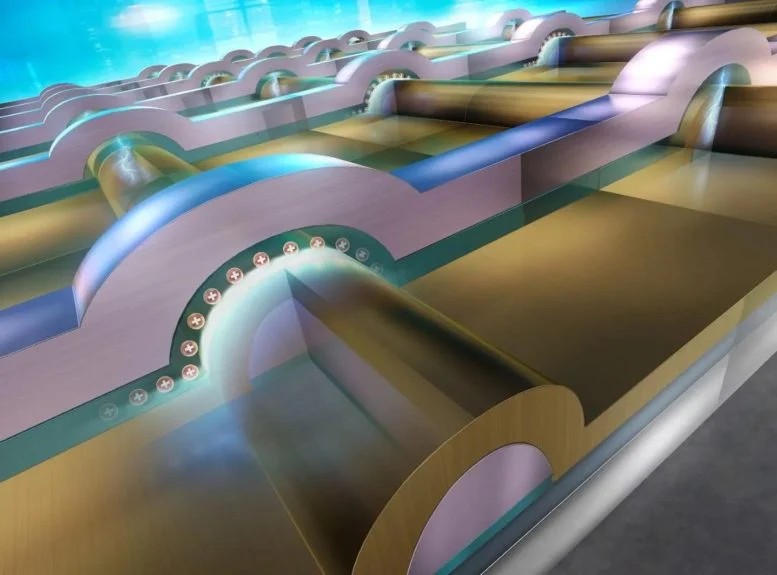
Figure 1. Memory Technology.
A new Approach to Low-Power Memory
The new device is based on a technology called a ferroelectric tunnel junction (FTJ), first proposed in 1971. FTJs use ferroelectric materials, whose internal electric polarization can be reversed. Changing that polarization alters how easily electrical current passes through the material, allowing data to be stored with very low power consumption. Figure 1 shows memory technology.
For decades, however, scientists faced a major challenge: as memory components became smaller, their performance usually deteriorated. That changed after researchers discovered in 2011 that Hafnium Oxide could maintain its electric polarization even at extremely small thicknesses. Building on that discovery, Yutaka Majima and his team created a memory device just 25 nanometers wide—roughly one three-thousandth the thickness of a human hair.
Turning A Major Problem into an Advantage
Miniaturizing memory devices typically causes electrical leakage along boundaries between tiny crystals inside the material. Instead of trying to eliminate the problem entirely, the researchers found a way to reduce its impact by making the device even smaller.
The team also heated the electrodes during fabrication, causing them to naturally form a semicircular structure. This design created a crystal arrangement closer to a single crystal, minimizing the boundaries where leakage usually occurs. The result was unexpected: the device not only maintained performance at smaller sizes, but actually worked better as it shrank.
Longer Battery Life and More Efficient AI
If successfully commercialized, the technology could dramatically improve energy efficiency in consumer electronics. Devices such as smartwatches could potentially run for months without recharging, while connected sensors and Internet of Things systems might operate for long periods with minimal battery replacement.
The memory could also benefit artificial intelligence systems by enabling faster processing with much lower energy demands. Because hafnium oxide is already widely used in semiconductor manufacturing, researchers believe the technology could eventually be integrated into existing electronic devices more easily than entirely new materials.
“Challenging what seem to be the limits of science—such as ‘we cannot make things any smaller’ or ‘they will break if we do’—is like walking in the dark,” said Majima. “By questioning traditional assumptions and exploring new ways to overcome these barriers, we discovered an entirely new perspective.”
Reference:
- https://interestingengineering.com/energy/world-largest-single-unit-floating-wind-turbine
Cite this article:
Keerthana S (2026), Advanced Memory Technology Promises Major Battery Life Boost, AnaTechMaz, pp.459
Recent Post
-

Ditch the Clutter: This Mini PC Does the Job of Three Devices
The ViewDock Gen2 is pushing the boundaries of what a mini-PC can be—combining solid performance,...
-

“Hydrogen-Retrofit Dash 8 Could Serve 90% of Today’s Flight Routes”
Dutch start-up Conscious Aerospace is ramping up development of a ...
-

Researchers Create Twisting Light Vortex for Advanced Quantum Technologies
A new breakthrough in photonics has enabled scientists to create a ...
-

Revolutionary BNCT Technique Could Transform Cancer Treatment
In the ongoing fight against aggressive brain cancers like glioblastoma, a promising new...
-
Tiny Everyday Carry Tool Packs a 67-Layer Damascus Steel Knife and Bottle Opener into Your Keychain
The Z6 is equipped with a 67-layer Damascus steel blade,...
-

What to Read This Week: Katrina Manson’s Chilling Look Inside Project Maven
Israel’s military is already using artificial intelligence to select ...
-

SNU Engineers Introduce Ultra-Thin, Battery-Free Wearable Device
A research team from Seoul National University (SNU), led by Professor Jerald Yoo, has unveiled....
-

World’s Largest Floating Wind Turbine Goes Online, Set to Power 24,000 Homes
The massive turbine uses a semi-submersible platform with...
-
Advanced Memory Technology Promises Major Battery Life Boost
Researchers at Institute of Science Tokyo have developed an ultra-small memory device that...
-

New Brain-Guided Hearing System Succeeds in First Human Testing
Scientists at Columbia University’s Zuckerman Institute have unveiled a breakthrough...
-

New Laser Acoustic Imaging Technique Aims to Make Surgery Safer
A new imaging technology combining lasers, sound waves,...
-

AI Supercharges Ultrafast Laser Simulations, Boosting Speed by 250x
Scientists have created a powerful deep-learning model...
-
Next-Gen Resin Supports 10 Rounds of Precision 3D Reprinting
Scientists in Japan have developed a recyclable UV-sensitive resin that can be melted down and...
-
Artificial Eyes Created by U.S. Researchers Boost Machine Vision
Engineers at Penn State University have developed a groundbreaking artificial vision device that...
-

MIT Develops Diamond-Based Solution to Enhance Gallium Nitride Chip Efficiency
Researchers at the Massachusetts Institute of Technology (MIT)....