

Stitch Is Google's AI-Driven Tool for App Design Assistance
At the 2025 Google I/O developer conference, Google introduced Stitch — an AI-powered tool designed to streamline the creation of web and mobile app front ends by generating UI elements and the corresponding code.
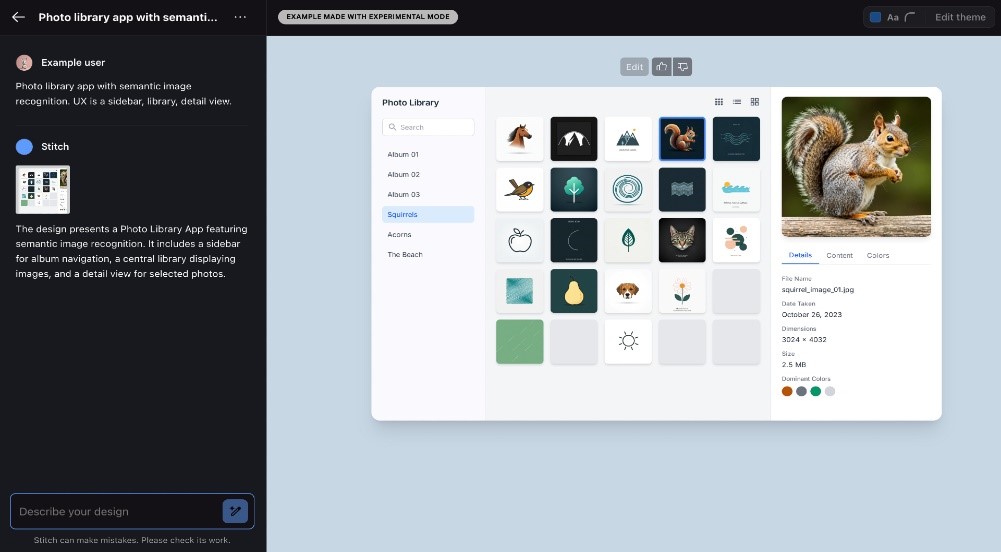
Figure 1. Google’s AI-Powered Tool for Streamlined App Design — Stitch.
With just a few words or even an image as input, Stitch can produce complete app interfaces, providing the necessary HTML and CSS markup. Users can choose between Google's Gemini 2.5 Pro and Gemini 2.5 Flash models to power Stitch’s interface design and code generation capabilities. Figure 1 shows Google’s AI-Powered Tool for Streamlined App Design — Stitch.
Stitch arrives amid the rising trend of “vibe coding” — a style of programming that leverages AI models to generate code. A growing number of tech startups are entering this space, including Anysphere (maker of Cursor), Cognition, and Windsurf. Just last week, OpenAI launched a new assistive coding tool called Codex, and at its Build 2025 kickoff yesterday, Microsoft announced a series of updates to GitHub Copilot.
While Stitch is somewhat more limited compared to other vibe coding tools, it offers a range of customization features. Users can export designs directly to Figma, view and refine code within an IDE, and fine-tune the generated app elements.
In a demo with TechCrunch, Google product manager Kathy Korevec showcased two Stitch-generated projects: a responsive mobile UI for a book-focused app and a web dashboard for beekeeping.
“[Stitch is] where you can come and get your initial iteration done, and then you can keep going from there,” Korevec said. “We want to make it super easy and approachable for people to take that next step in design thinking or software development.”
Following I/O, Google plans to roll out a new feature allowing users to edit UI elements by taking a screenshot and annotating it with desired changes. Korevec emphasized that while Stitch is powerful, it's not intended to replace comprehensive design platforms like Figma or Adobe XD.
Alongside Stitch, Google has broadened access to Jules — its AI agent designed to help developers debug and manage code. Now in public beta, Jules assists with understanding complex codebases, creating pull requests on GitHub, and tackling backlog items and various programming tasks.
In a separate demo, Google product manager Kathy Korevec showcased Jules upgrading a website from the deprecated Node.js version 16 to Node.js 22. Jules cloned the site’s codebase in a clean virtual machine, generated an upgrade plan, and awaited Korevec’s approval before executing the changes. After the upgrade, Jules successfully verified that the website was functioning correctly.
Jules currently runs on Gemini 2.5 Pro, but Korevec noted that users will eventually be able to choose from multiple model options.
Introduction to Stitch
Stitch is a new AI-powered tool from Google designed to help create app front ends quickly and easily. It uses artificial intelligence to generate user interface designs and the corresponding code for web and mobile apps, making the app design process faster and more accessible.
How Stitch Works
Users provide Stitch with simple prompts—these can be text descriptions or even images. Using advanced AI models like Gemini 2.5 Pro and Gemini 2.5 Flash, Stitch interprets these inputs and generates complete UI layouts along with HTML and CSS code that developers can use directly.
Key Features of Stitch
- Generates UI designs from simple prompts or images
- Provides clean, ready-to-use HTML and CSS code
- Allows exporting designs to tools like Figma for further editing
- Let’s users customize and fine-tune generated designs
- Supports workflow integration by exposing code for editing in development environments
Stitch’s Role in the AI Coding Landscape
Stitch is part of the growing trend called “vibe coding,” where AI assists in programming tasks. While some tools focus on writing backend code or debugging, Stitch specializes in front-end UI design, helping developers’ prototype and build interfaces more efficiently.
Future Developments and Use Cases
Google plans to add features like editing UI by annotating screenshots. Currently aimed at initial design iterations rather than full-scale design platforms, Stitch helps users jumpstart app creation and refine their ideas faster. It’s especially useful for designers and developers looking to streamline early-stage app development.
Source:: TC
Cite this article:
Priyadharshini S (2025), Stitch Is Google's AI-Driven Tool for App Design Assistance, AnaTechMaz, pp. 253
Recent Post
-
Research Claims Facebook Is Still Experimenting on Users in Unusual Ways
The process of choosing which ads you see has long passed out of.....
-

Android Phones to Auto-Reboot Every Three Days for Security Purposes
It looks like Google has rolled out a security feature in Android......
-

Chatgpt-4.5 Surpasses the Turing Test Threshold
In 1950, Alan Turing introduced an elegant yet profoundly......
-

Experts Warn: Your DNA May Be Vulnerable to Hacking
The NGS (Next-Generation Sequencing) workflow is a complex series.....
-

Apple Introduces Emergency Satellite Features to iPhone 13 With iOS 18.5
Apple released iOS 18.5 on Monday, bringing emergency satellite......
-
What To Expect at Google I/O 2025: Updates on Gemini and Android 16
Google I/O, the tech giant's most anticipated developer......
-
Google Introduces Its New Android Design Language, Material 3 Expressive
Google revealed its new Android design language, Material 3......
Viral Outrage Over Apple’s EU Payment Alerts Overlooks Crucial Detail
Apple has responded to recent viral claims about new warning labels appearing......
OpenAI Releases AI Software Development Agent Codex in ChatGPT
Artificial intelligence is revolutionizing software development by......

Weeks After Amazon's Alexa+ AI Launch, One Question Remains: Where Are the Users?
The rollout of Amazon's AI-enhanced Alexa+ is progressing slowly......
-
Microsoft's NLWeb Project Aims to Integrate More Chatbots into Websites
As part of its push to streamline the creation of AI-powered......
-
Sonund-Tracking Headphones Enable Eavesdropping in Multiple Languages
As an American living in Portugal and casually studying the......
-
Stitch Is Google's AI-Driven Tool for App Design Assistance
At the 2025 Google I/O developer conference, Google introduced......
-

At the 2025 Google I/O developer conference, Google introduced Stitch
Give your old PC a new lease on life with a fresh OS......
-

A Social Media Disclaimer Won’t Prevent AI From Using Your Data
In an attempt to stop their data from being used to train AI, some......