

Revolutionizing Battery Efficiency: Helical Peptide Polymers Outshine Traditional Electrolytes
For decades, solid-state electrolytes have been a focal point in the quest for advanced energy storage systems and solid-state batteries. These materials offer a safer alternative to conventional liquid electrolytes, which facilitate ion movement within batteries. However, enhancing the performance of solid polymer electrolytes remains a challenge for next-generation materials.
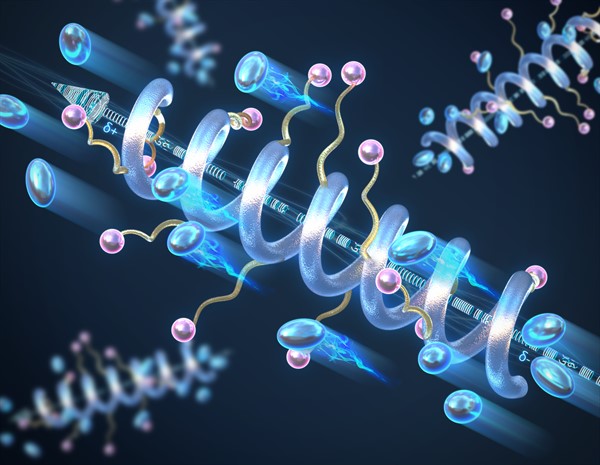
Figure 1. Helical Peptide Polymer Electrolyte. (Credit: University of Illinois)
Researchers in materials science and engineering at the University of Illinois Urbana-Champaign have delved into how the helical secondary structure affects the conductivity of solid-state peptide polymer electrolytes. Their findings reveal that the helical structure significantly boosts conductivity compared to its “random coil” counterparts. They also discovered that longer helices correspond to higher conductivity and that the helical structure enhances the material’s stability against temperature and voltage fluctuations [2]. Figure 1 is an artistic representation of a helical peptide polymer electrolyte with the macrodipole indicated by an arrow with positive and negative charges [1].
“We introduced the concept of using secondary structure—the helix—to design and improve upon the basic material property of ionic conductivity in solid materials,” says Professor Chris Evans, who spearheaded this research. “It’s the same helix that you would find in peptides in biology, we’re just using it for non-biological reasons.”
While polymers typically adopt random configurations, the polymer backbone can be engineered to form a helical structure akin to DNA. This results in a macrodipole moment—a large-scale separation of positive and negative charges. Along the helical length, the dipole moments of individual peptide units aggregate to form this macrodipole, enhancing both the conductivity and dielectric constant, which measures a material’s ability to store electrical energy, and thus improving charge transport. Longer peptides lead to higher conductivity in the helix.
Evans adds, “These polymers are much more stable than typical polymers—the helix is a very robust structure. You can go to high temperatures or voltages compared to random coil polymers, and it doesn’t degrade or lose the helix. We don’t see any evidence that the polymer breaks down before we want it to.”
Additionally, because the material is peptide-based, it can be broken down into individual monomer units using enzymes or acid when the battery fails or reaches the end of its life. This allows for the recovery and reuse of the starting materials after separation, thereby reducing environmental impact.
Source: University of Illinois
References:
- https://www.eurekalert.org/news-releases/1054100
- https://www.nature.com/articles/s41563-024-01966-1
Cite this article:
Hana M (2024), Revolutionizing Battery Efficiency: Helical Peptide Polymers Outshine Traditional Electrolytes, AnaTechMaz, pp. 42
Recent Post
-
Revolutionizing Bacterial Cellulose Production: A Milestone in Sustainable Materials Science
Bacteria produce materials of interest to humans, such as cellulose, silk, and ...
-
Terasaki Institute Develops Egg White-Derived Bioink for Advanced Tissue Engineering
Scientists at the Terasaki Institute have developed an innovative technology...
-

UBC's Accidental Discovery Unveils Nxylon: The Darkest Wood Ever Created
Researchers at the University of British Columbia have stumbled upon ...
-
Scientists Develop Extraordinary Material That Can Transform Sunlight and Water into Clean Energy
Researchers at Oregon State University have developed a groundbreaking...
-

World's Fastest Supercomputer Derives Recipe for Otherworldly Diamond
BC8 super diamonds, which are harder than any known material, are believed...
-

Natural Graphene Has Been Discovered on The Moon
In December 2020, the Chang'e 5 mission landed on the Moon, collected a ...
-
Machine Learning Unveils Next-Gen Membrane Materials
Chemical separation, including gas separation, plays a crucial role in ...
-
University of Virginia Engineers Harness Plant-Based Nanomaterial for Stronger, Greener Buildings
A pioneering research team from the University of Virginia School of Engineering...
-

New Substrate Material for Flexible Electronics Could Aid in Reducing E-Waste
Electronic waste is an increasing issue, but this degradable material could...
-
A Novel Method for Optimizing Quantum Materials
An MIT-led team demonstrates how to precisely control the properties of Weyl ...
-
Graphene, A Wonder Material, Has Been Discovered in Lunar Soil Samples from A Chinese Moon Mission
This graphene, composed of several thin layers, may have formed billions of years ...
-
Revolutionizing Battery Efficiency: Helical Peptide Polymers Outshine Traditional Electrolytes
For decades, solid-state electrolytes have been a focal point in the quest for...
-

UCLA Researchers Develop Scalable Method to Regulate Building Temperatures Year-Round
As global temperatures continue to rise, the demand for sustainable cooling solutions...
-
UCLA Engineers Develop Revolutionary Dynamic Material Inspired by Push Puppet Toys
A team of engineers at UCLA has created an innovative type of tunable dynamic...
-
Unlocking the Future of Lithium-Metal Batteries: A Breakthrough in Predicting Battery Lifespan
In the rapidly advancing world of battery technology, predicting battery life ...