

University of Virginia Engineers Harness Plant-Based Nanomaterial for Stronger, Greener Buildings
A pioneering research team from the University of Virginia School of Engineering and Applied Science is the first to delve into the potential of cellulose nanofibrils, an innovative plant-based material, to boost the advantages of 3D-printed concrete.
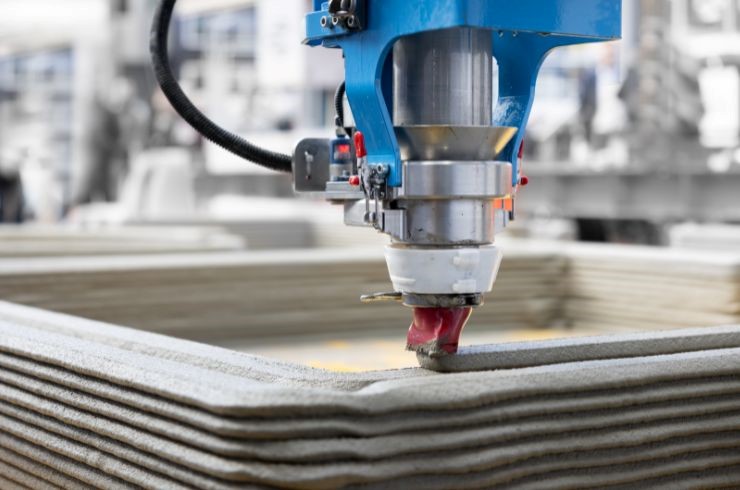
Figure 1. Concrete 3D Printing.
[1] “The improvements we saw on both printability and mechanical measures suggest that incorporating cellulose nanofibrils in commercial printable materials could lead to more resilient and eco-friendly construction practices sooner rather than later,” said Osman E. Ozbulut, a professor in the Department of Civil and Environmental Engineering. Figure 1 shows concrete 3D Printing.
The team’s findings will be featured in the September 2024 issue of Cement and Concrete Composites.
The rise of 3D-printed concrete buildings brings a host of benefits: rapid, accurate construction using potentially recycled materials, lower labor costs, reduced waste, and the ability to create intricate designs that traditional methods struggle to achieve [2]. This technique involves a specialized printer that layers a cement-like mixture to form structures based on computer-aided design software. However, the range of printable materials remains limited, and concerns about sustainability and durability persist.
“We’re dealing with contradictory objectives,” Ozbulut said. “The mixture has to flow well for smooth fabrication, but harden into a stable material with critical properties, such as good mechanical strength, interlayer bonding and low thermal conductivity.”
Derived from wood pulp, cellulose nanofibrils (CNF) present a renewable, low-impact option. Like other plant-fiber derivatives, CNF shows strong potential to enhance the rheology — flow properties — and mechanical strength of these composites.
Before the meticulous study by the UVA-led team in Ozbulut’s Resilient and Advanced Infrastructure Lab, the effect of CNF on conventional 3D-printed composites was not well understood, Ozbulut explained.
“Today, a lot of trial and error goes into designing mixtures,” he said. “We’re addressing the need for more good science to better understand the effects of different additives to improve the performance of 3D-printed structures.”
The team, led by Ozbulut and Ugur Kilic, a Ph.D. alumnus of UVA, experimented with varying amounts of CNF additive and discovered that adding at least 0.3% CNF significantly improved flow performance. Microscopic analysis of the hardened samples revealed better material bonding and structural integrity.
Further testing in Ozbulut’s lab demonstrated that CNF-enhanced 3D-printed components could withstand pulling, bending, and compression.
Source: University of Virginia
References:
- https://www.sciencedaily.com/releases/2024/08/240802170906.htm
- https://techxplore.com/news/2024-08-explore-cellulose-nanofibrils-3d-concrete.html
Cite this article:
Hana M (2024), University of Virginia Engineers Harness Plant-Based Nanomaterial for Stronger, Greener Buildings, AnaTechMaz, pp. 38
Recent Post
-
Revolutionizing Bacterial Cellulose Production: A Milestone in Sustainable Materials Science
Bacteria produce materials of interest to humans, such as cellulose, silk, and ...
-
Terasaki Institute Develops Egg White-Derived Bioink for Advanced Tissue Engineering
Scientists at the Terasaki Institute have developed an innovative technology...
-
UBC's Accidental Discovery Unveils Nxylon: The Darkest Wood Ever Created
Researchers at the University of British Columbia have stumbled upon ...
-

Scientists Develop Extraordinary Material That Can Transform Sunlight and Water into Clean Energy
Researchers at Oregon State University have developed a groundbreaking...
-

World's Fastest Supercomputer Derives Recipe for Otherworldly Diamond
BC8 super diamonds, which are harder than any known material, are believed...
-

Natural Graphene Has Been Discovered on The Moon
In December 2020, the Chang'e 5 mission landed on the Moon, collected a ...
-
Machine Learning Unveils Next-Gen Membrane Materials
Chemical separation, including gas separation, plays a crucial role in ...
-
University of Virginia Engineers Harness Plant-Based Nanomaterial for Stronger, Greener Buildings
A pioneering research team from the University of Virginia School of Engineering...
-

New Substrate Material for Flexible Electronics Could Aid in Reducing E-Waste
Electronic waste is an increasing issue, but this degradable material could...
-

A Novel Method for Optimizing Quantum Materials
An MIT-led team demonstrates how to precisely control the properties of Weyl ...
-
Graphene, A Wonder Material, Has Been Discovered in Lunar Soil Samples from A Chinese Moon Mission
This graphene, composed of several thin layers, may have formed billions of years ...
-
Revolutionizing Battery Efficiency: Helical Peptide Polymers Outshine Traditional Electrolytes
For decades, solid-state electrolytes have been a focal point in the quest for...
-

UCLA Researchers Develop Scalable Method to Regulate Building Temperatures Year-Round
As global temperatures continue to rise, the demand for sustainable cooling solutions...
-
UCLA Engineers Develop Revolutionary Dynamic Material Inspired by Push Puppet Toys
A team of engineers at UCLA has created an innovative type of tunable dynamic...
-
Unlocking the Future of Lithium-Metal Batteries: A Breakthrough in Predicting Battery Lifespan
In the rapidly advancing world of battery technology, predicting battery life ...