

A Major Step Toward Scalable Quantum Photonics
Researchers have developed a new quantum photonic platform that could accelerate the arrival of practical quantum computers and ultra-secure communication networks. The breakthrough combines site-controlled quantum dots with circular Bragg grating resonators, creating a scalable and highly efficient system for generating and controlling quantum light.
Quantum dots, often referred to as artificial atoms, are among the most promising building blocks for quantum technologies because they can emit single photons on demand. However, producing large arrays of quantum dots with consistent performance has long been a challenge. The new approach solves this problem by precisely controlling where each quantum dot is placed on a semiconductor chip, enabling greater uniformity and scalability.

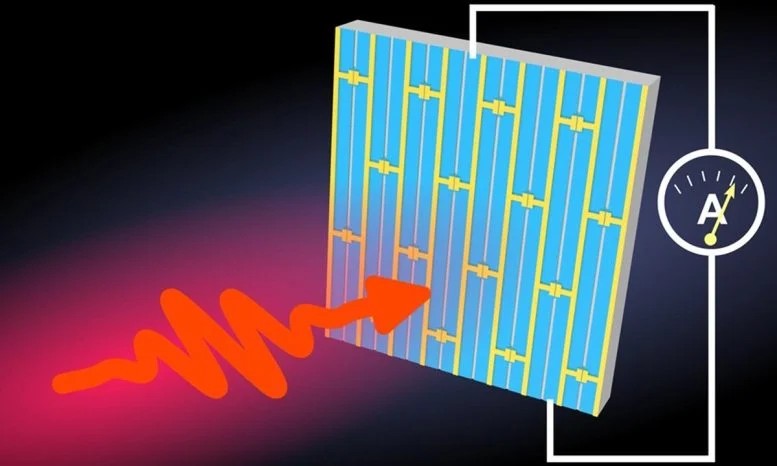
Figure 1. Scalable Quantum Photonics.
A key feature of the platform is the integration of circular Bragg grating resonators, which enhance the interaction between quantum dots and light. These structures improve photon extraction efficiency, increase brightness, and help maintain the delicate quantum properties needed for advanced computing and communication applications. Figure 1 shows scalable quantum photonics.
Using advanced fabrication techniques, the researchers positioned quantum dots with nanometer-scale precision, ensuring optimal alignment with the resonators. This level of accuracy significantly reduces device variability and improves overall performance, making the technology more suitable for large-scale production.
Tests showed that the platform can generate high-quality single photons with strong quantum characteristics and improved coherence. The resonators also enhance the Purcell effect, allowing photons to be emitted more rapidly while preserving quantum information. Faster emission rates could help future quantum processors perform calculations more quickly and efficiently.
Because the technology is built using semiconductor-compatible materials and manufacturing methods, it can be integrated with existing photonic components such as waveguides, detectors, and optical circuits [1]. This compatibility opens the door to mass-produced quantum photonic chips for applications ranging from quantum computing and secure communications to advanced sensing systems.
The modular design also allows multiple quantum dot-resonator units to be combined on a single chip, creating scalable architectures capable of supporting complex quantum operations. Researchers believe this approach could form the foundation of future quantum networks, photonic quantum simulators, and large-scale quantum computers.
By overcoming longstanding challenges in quantum dot placement, photon extraction, and device scalability, this breakthrough brings the vision of practical quantum photonics significantly closer to reality. As the field continues to advance, technologies like this may play a central role in shaping the next generation of quantum information systems.
References:
- https://bioengineer.org/scalable-quantum-photonics-with-site-controlled-quantum-dots/
Cite this article:
Keerthana S (2026), A Major Step Toward Scalable Quantum Photonics, AnaTechMaz, pp.519
Recent Post
-
Neutral Atoms Offer Scalable and Connected Quantum Computing
A new white paper from the EuRyQa consortium argues that neutral-atom quantum computing has moved...

Quantum Algorithms Solve Industrial Problems Using Fewer Qubits
Researchers from West Virginia University and Cornell University....

Physicists Measure “Negative Time” in Unusual Quantum Experiment
Quantum physicists have reported a strange effect in which photons...

Scientists Develop Tiny Chip That Processes Information Using Light Instead of Electricity
Researchers have developed a tiny chip capable of manipulating....

New Magnon Breakthrough May Drastically Reduce Quantum Computer Size
Physicists at the University of Vienna have identified magnons with....
-
Beyond Atoms: How Quantum Physics Explains Bonding
In a remarkable breakthrough that is redefining the foundations of chemical science, researchers at...
-

Breakthrough May Enable Coin-Sized Quantum Computers
For years, scientists have viewed magnons as one of the most promising building blocks for...
-
Quantum Computing Breakthrough: Majorana 2 Keeps Qubits Stable for 20 Seconds
Microsoft has unveiled Majorana 2, its latest quantum computing chip,....
-
A Major Step Toward Scalable Quantum Photonics
Researchers have developed a new quantum photonic platform that could accelerate the arrival of....
-

The Future of Networking is Quantum, Says Cisco
At Cisco Live 2026, Cisco Research head and Cisco Fellow Ramana Kompella outlined the company's....
-
China Unveils Record-Breaking Quantum Memory to Bridge Traditional Data and Quantum Computing
Researchers at Zhejiang....
-
Quantum Technology Pushes Terahertz Sensing to New Heights
Researchers have developed a novel quantum detector that dramatically improves the detection....