

Quantum Computing Breakthrough: Majorana 2 Keeps Qubits Stable for 20 Seconds
Microsoft has unveiled Majorana 2, its latest quantum computing chip, marking a major milestone in the company’s quest to build a commercially viable quantum computer. The new chip reportedly delivers a 1,000-fold improvement in qubit stability, significantly extending the lifespan of quantum states and accelerating the path toward scalable quantum computing.
The breakthrough was achieved with assistance from Microsoft Discovery, the company’s AI-powered scientific research platform. Leveraging autonomous AI agents, Microsoft now believes it can achieve a scalable quantum computer by 2029, cutting its previous development timeline in half.
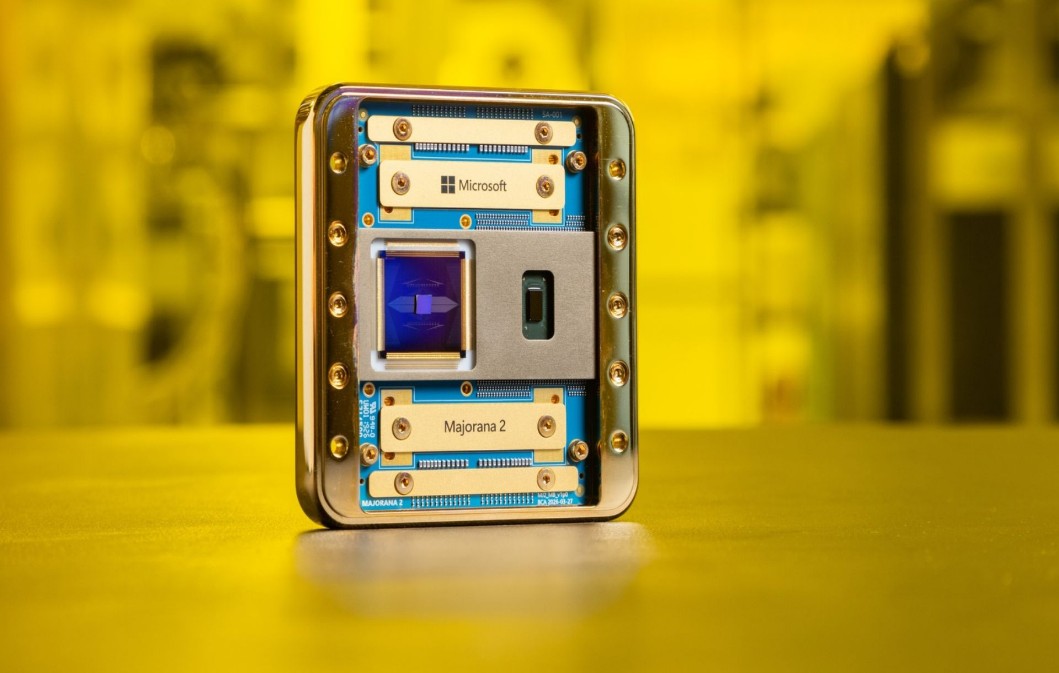
Figure 1. Majorana 2.
Building upon the topological quantum computing architecture introduced with Majorana 1 in 2025, Majorana 2 incorporates an advanced materials design and more resilient qubits—the fundamental units of quantum information. According to Microsoft, the chip’s average qubit lifetime has increased to 20 seconds, with some qubits remaining stable for up to one minute. Figure 1 shows majorana 2.
This achievement addresses one of the greatest challenges in quantum computing: preserving fragile quantum states long enough to perform meaningful calculations. Longer-lasting qubits reduce errors and improve the reliability of quantum systems, bringing real-world quantum applications closer to reality.
A key factor behind the improvement is a shift in materials. While Majorana 1 relied on aluminum-based superconductors, Majorana 2 utilizes lead-based superconducting materials, which provide stronger protection against environmental disturbances that can disrupt quantum operations.
“We need to make improvements each year that move us closer to delivering a quantum computer with significant commercial and societal impact,” said Chetan Nayak, Microsoft Technical Fellow. He noted that the latest chip represents a dramatic leap forward, describing its performance as “1,000 times better” than the previous generation.
Beyond hardware advancements, Microsoft credits artificial intelligence as a critical accelerator of discovery [1]. Through Microsoft Discovery, AI agents helped automate complex measurements, optimize manufacturing processes, analyze vast amounts of research data, and identify hidden performance bottlenecks.
According to Nayak, agentic AI has become deeply integrated into the company’s research workflow, helping scientists process information across disciplines, generate new hypotheses, and uncover patterns that might otherwise go unnoticed. Microsoft has also announced the general availability of Microsoft Discovery for organizations, enabling research teams to deploy AI agents for scientific and engineering projects. Additionally, a preview version of the platform is now available for individual users through GitHub Copilot.
As competition intensifies in the global race to make quantum computing practical, advances such as Majorana 2 could have far-reaching implications for fields including drug discovery, materials science, energy optimization, cryptography, and logistics planning. With dramatically improved qubit stability and AI-assisted innovation driving progress, Microsoft’s latest breakthrough suggests that the era of practical quantum computing may be arriving sooner than many expected.
References:
- https://interestingengineering.com/innovation/microsoft-majorana-2-quantum-chip-agentic-ai
Cite this article:
Keerthana S (2026), Quantum Computing Breakthrough: Majorana 2 Keeps Qubits Stable for 20 Seconds, AnaTechMaz, pp.518
Recent Post
-
Neutral Atoms Offer Scalable and Connected Quantum Computing
A new white paper from the EuRyQa consortium argues that neutral-atom quantum computing has moved...

Quantum Algorithms Solve Industrial Problems Using Fewer Qubits
Researchers from West Virginia University and Cornell University....

Physicists Measure “Negative Time” in Unusual Quantum Experiment
Quantum physicists have reported a strange effect in which photons...
Scientists Develop Tiny Chip That Processes Information Using Light Instead of Electricity
Researchers have developed a tiny chip capable of manipulating....

New Magnon Breakthrough May Drastically Reduce Quantum Computer Size
Physicists at the University of Vienna have identified magnons with....
-
Beyond Atoms: How Quantum Physics Explains Bonding
In a remarkable breakthrough that is redefining the foundations of chemical science, researchers at...
-
Breakthrough May Enable Coin-Sized Quantum Computers
For years, scientists have viewed magnons as one of the most promising building blocks for...
-
Quantum Computing Breakthrough: Majorana 2 Keeps Qubits Stable for 20 Seconds
Microsoft has unveiled Majorana 2, its latest quantum computing chip,....
-

A Major Step Toward Scalable Quantum Photonics
Researchers have developed a new quantum photonic platform that could accelerate the arrival of....
-
The Future of Networking is Quantum, Says Cisco
At Cisco Live 2026, Cisco Research head and Cisco Fellow Ramana Kompella outlined the company's....
-
China Unveils Record-Breaking Quantum Memory to Bridge Traditional Data and Quantum Computing
Researchers at Zhejiang....
-
Quantum Technology Pushes Terahertz Sensing to New Heights
Researchers have developed a novel quantum detector that dramatically improves the detection....