

New Quantum Technology May Finally Prove the Existence of the Multiverse
Imagine a gamma ray laser so precise that it can destroy cancer cells without harming the surrounding healthy tissue. Or a device compacts enough to fit on a chip, yet powerful enough to explore the fundamental nature of the universe—including theories like Stephen Hawking’s concept of the multiverse.
Thanks to a breakthrough by Dr. Aakash Sahai, Assistant Professor of Electrical Engineering at the University of Colorado Denver, such science-fiction ideas may soon edge closer to scientific reality. Sahai has made a major quantum-level advancement in material science that could reshape the future of physics, medicine, and cosmology.
“This technology opens up entirely new areas of study and could have a direct impact on our world,” said Sahai. “Just as our understanding of subatomic structures led to lasers, microchips, and LEDs, this innovation follows a similar trajectory—only now we’re working at the quantum scale.”

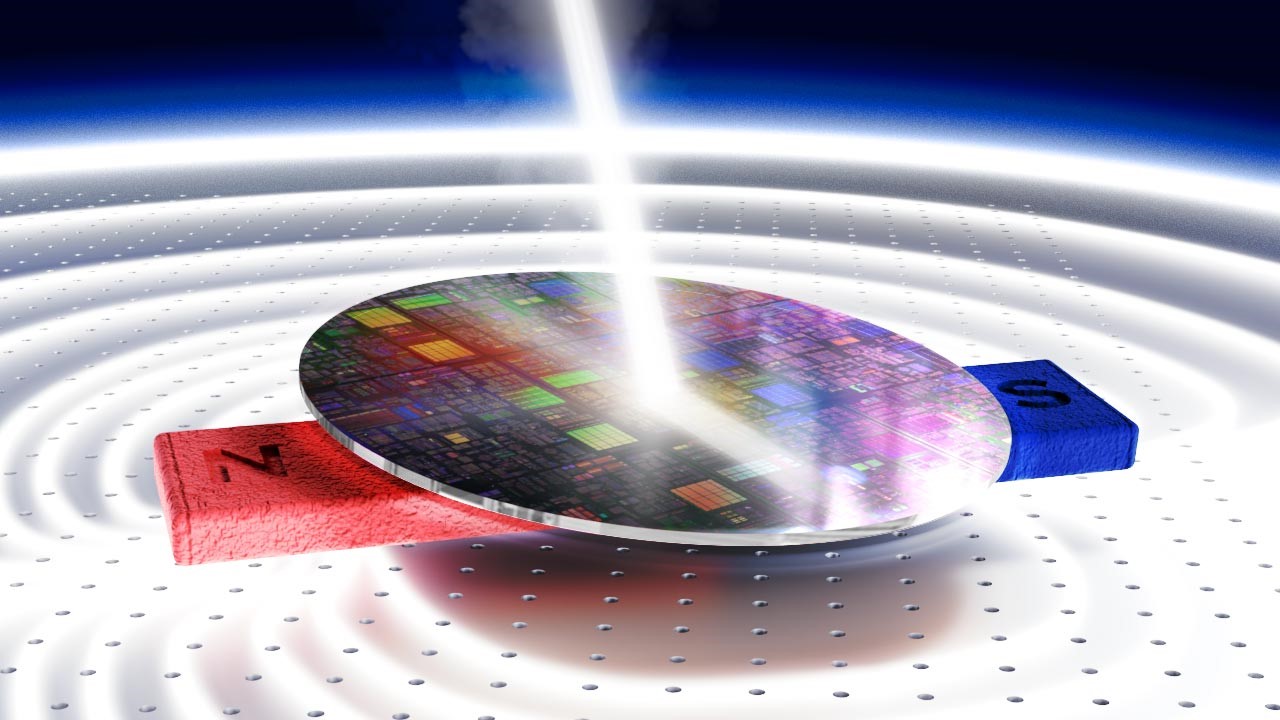
Figure 1. Existence of the Multiverse.
His discovery, recently featured on the cover of Advanced Quantum Technologies, involves creating ultra-intense electromagnetic fields previously achievable only in large-scale particle accelerators [1]. By engineering a silicon-based, chip-scale material capable of withstanding high-energy particle beams, Sahai has found a way to generate and control these fields in a lab setting—using a device no larger than a human thumb.
At the heart of this innovation is a new material that channels the energy produced by rapidly oscillating electrons—known as quantum electron gas—while maintaining structural stability through effective thermal control. These rapid electron movements generate intense electromagnetic fields, a process once limited to massive infrastructure like CERN’s 16.7-mile Large Hadron Collider. Figure 1 shows existence of the multiverse.
“Managing this level of energy flow while preserving the integrity of the material—that’s the breakthrough,” explained Kalyan Tirumalasetty, a graduate student working in Sahai’s lab. “It’s a tool that can transform how we explore nature, and ultimately how we improve the world.”
The implications are wide-ranging. In medicine, gamma ray lasers based on this technology could allow for cellular and even atomic-level imaging, potentially enabling doctors to see and treat disease at its most fundamental level—down to the atomic nucleus. In physics, the extreme plasmon technique could help researchers test some of the most profound theories in modern science, including the existence of parallel universes.
“It’s very possible that gamma ray lasers could soon be real,” Sahai said. “We’re talking about the ability to modify atomic nuclei and precisely remove cancer cells at the nanoscale. At the same time, this could help us explore the forces and particles that define the universe itself.”
The technology was developed at CU Denver and tested at the SLAC National Accelerator Laboratory, operated by Stanford University and funded by the U.S. Department of Energy. CU Denver has already secured provisional patents both domestically and internationally, underscoring the invention’s global significance.
The journey, however, is far from over. This summer, Sahai and Tirumalasetty will return to SLAC to refine the silicon-chip material and laser technique. While developing such groundbreaking tools can take years—or decades—Sahai remains optimistic.
“Some of the foundational ideas behind this go back to 2018, when I first started publishing research on antimatter accelerators,” he noted. “It might take time, but within my lifetime, I believe this could become a reality.”
For Tirumalasetty, who once aspired to be a physicist, the work represents the perfect blend of curiosity and purpose. “Understanding how nature works at the most fundamental level—that’s powerful,” he said. “But what excites me even more is building the tools that allow us to act on that knowledge. That’s what engineering makes possible—and that’s exhilarating.”
Reference:
- https://advanced.onlinelibrary.wiley.com/doi/10.1002/qute.202500037
Cite this article:
Keerthana S (2025), New Quantum Technology May Finally Prove the Existence of the Multiverse, AnaTechMaz, pp.335
Recent Post
-
Blue Laser Cracks a 150-Year-Old Physics Puzzle
For more than 100 years, physicists suspected that a strange magnetic signal was present in...
-

Physicists Set New Record for Qubit Coherence, Pushing Quantum Limits
On July 8, 2025, researchers at Aalto University in Finland announced...
-

fortios: Ensuring Quantum-Safe Security in the Era of Advanced Computing
Traditional encryption has safeguarded data for years, but the emergence of...
-
Breakthrough in Measurement Tech: New System Approaches Physics' Theoretical Boundaries
Fast, precise, and field-ready—a quantum-level optical frequency...
-
New Quantum Technology May Finally Prove the Existence of the Multiverse
Imagine a gamma ray laser so precise that it can destroy cancer cells...
-

Harvard Engineers Pack a Quantum Computer into a Tiny Chip
In a breakthrough that could reshape the future of quantum technology, engineers at Harvard have developed...
-
Quantum Leap: Scientists Uncover Hidden Clue to Solving a 60-Year-Old Superconducting Puzzle
A team in Copenhagen has discovered an ingenious “backdoor” method...
-

U.S. Mathematicians Transform ‘Pure’ Math Once Deemed Impractical into a Quantum Computing Breakthrough
Researchers at the University...
-
Physicists Astonished by Groundbreaking Room-Temperature Quantum Discovery
In a groundbreaking leap for quantum science, researchers have shown ...
-

Physicists Develop a “Quantum Lie Detector” to Expose Fake Quantum Computers
Is it possible to verify whether a large quantum system genuinely follows...
-

Chinese Scientists Reveal Atom Array 10 Times Larger, Paving Way for Next-Generation Quantum Processors
Chinese scientists have made a...
-

Harnessing Sound Waves: A Breakthrough Route to Practical Quantum Computing
Caltech researchers have designed a new kind of hybrid quantum...
-

Quantum Guitar: Scientists Resolve 90-Year-Old Puzzle of the Damped Harmonic Oscillator
Imagine plucking a guitar string. It vibrates, the sound lingers, and ...
-

Scientists Create ‘World’s Smallest Cat Video’ to Push Quantum Computing Forward
A team of physicists in Shanghai has made what they call the...

Sandia Harnesses Chiplet Technology to Advance AI and Quantum Computing
Sandia has a long-standing track record in semiconductor research, driven by...